Why can’t my portfolio exactly match the full market? — June 25, 2014

Why can’t my portfolio exactly match the full market?

So far as I understand the conceptual basis for a lot of theorems in finance, one of the ideas seems to be reasonably straightforward: if some type of investment — domestic equities, foreign equities, bonds, housing, whatever — were systematically higher-yielding than some other type of investment, then everyone would just invest in the higher-yielding category and wipe out the difference in yield. So in the long run, you’d expect yields across asset classes to equilibrate.

Yes, this is based on assumptions, which might well be false. But let’s assume that it’s roughly true. Then the usual argument says that you can’t beat the market, and you’ll never do better than to diversify your portfolio. But note carefully what “diversify” means here. It *doesn’t* just mean “invest in all 500 stocks in the S&P 500”. There’s a whole lot more market out there! That is, there are a lot more asset classes than just large industrial stocks of the sort that the S&P traffics in. Even within the class of U.S. stocks, there are larger indexes like the Wilshire 5000. Or there’s the set of stocks tracked by the Vanguard Total Stock Market Index Fund. And then there are foreign stocks. And then government bonds. And municipal bonds. And corporate bonds.

But there’s *still* a lot more market out there. Some asset classes are harder to invest in than others, like houses. Wouldn’t it be cool if you could buy housing across many worldwide markets? It’s a little weird to imagine exactly how that would work, though large property owners do own a shocking amount of property across many cities. So in our imagined perfectly diversified portfolio, we’d have a bunch of housing. And we’d also have a lot of unlisted stocks. And we’d have some private equity. And we’d own some mines. Because again, the principle behind the diversification is that if everyone already knew that some asset class yielded outsized returns, they’d already be investing in it. The only way to beat the market in such a case is to know something that others don’t — to avoid some asset class that you know yields lower returns than the rest of the world thinks it does, or to invest in an asset class that others are systematically avoiding. In principle, I can’t see any reason why your buddy Doug’s new venture doesn’t count as an asset class for the purposes of this argument.

So here’s my question: how do I, J. Random Small Investor, get my portfolio fully diversified across all possible asset classes? One of Piketty’s observations in his masterwork is that the wealthy are able to obtain systematically above-market returns, in no small part because they can invest in asset classes that you and I don’t have access to. And in one example he gives — the Harvard endowment — it helps that the Harvard Corporation spends $100 million every year to manage $30 billion in assets. You and I could probably also do very well as investors if we spent all day every day managing our investments, and if we had a staff to do it, and if we had enough money to play with that we could offset some losing bets with more winning bets.

But that argument isn’t convincing to me, because we *do* have that ability; this is why we hire mutual funds. Apparently the Vanguard Total Stock Market Index Fund has $190 billion in assets. Granted, that particular fund won’t be investing in obscure corners of the asset universe, but why doesn’t Vanguard set up a fund that’s truly diverse across all asset classes, draw many billions of dollars from investors like me, and earn the same returns as the Harvard endowment or Bill Gates?

One possible answer is that regulation forbids them from investing in risky asset classes (like hedge funds or complicated swaps) if non-rich guys like me are on the other end of the trade. Is there some other reason I’m missing why wealthy people *must* earn higher returns than mutual funds do?

Is everyone here already reading “Pedestrian Observations”? —
Cambridge is trying to kill Uber again — June 17, 2014
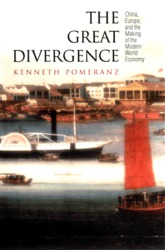
Shorter Great Divergence — June 13, 2014

Shorter Great Divergence

Detail of _Guangzhou Factories, 1855-1856_, Sunqua, oil on canvas.
Once in a very great while, I find something that I swear is an extended academic joke. I don’t mean “joke” in the sense that it’s unserious; I mean that the delivery of the whole thing is conducted with a tongue very forcefully rammed into a cheek. Maybe the best example of such a thing is Leo Harrington’s talk proposing an analogy between Hegelian logic and some topics in group theory. There’s just no way he’s serious there, but I’ll be damned if the man ever cracks a smile.

Pomeranz’s The Great Divergence is deadly serious. What could be more serious than a discussion of why the West won? The whole discussion is so often laden with moralistic Gregory Clark-style musings, and very often the whole exercise seems like an excuse to praise white people.

Which is why Pomeranz is so funny, to me at least. Throughout the book (I’m about halfway done) I hear him humming gently in the background, “It’s the slavery, stupid”. The rest of the book is very rigorous academic garb for that very simple idea.

I’m absolutely certain that I undervalue the importance of slavery to literally every bit of American history. That’s why constantly reminding myself, via something like Ta-Nehisi Coates’s reparations piece, is so vital.

The somewhat longer story, from Pomeranz, is that many nations were running up against fundamental labor and land constraints in the 1700s, and that Western Europe eliminated those constraints, respectively, by a) enslaving Africans and bringing them to the Americas, and b) taking over North America and killing all the native people there.

I really do hear Pomeranz saying throughout, in as measured a way as possible, “You are ignoring the biggest story of at least the last half-millennium if you ignore these.” That’s what I hear when he politely swats down one story, namely that white people had developed a habit of consumer acquisitiveness which started with increased consumption of sugar and tea. I hear Pomeranz quietly saying, “Interesting that you focus on the consumers of the sugar. Where do you think Western Europe got all that sugar?

Thus far the bulk of the argument has been to show that the data don’t show any significant differences between Chinese culture and the Western European one; and to the extent that there are any such differences, they tend to tilt in China’s favor. Pomeranz shows that the Chinese government was no more resistant to urbanization than the British one; that it wasn’t any more insistent that women stay out of the workforce; and so forth.

That’s all by way of ideological thicket-clearing. Presumably the next steps in the argument from here cut to the heart of the matter and show that only slavery and extermination of the indigenous population are of the right magnitude to explain why the West rose when it did. Pomeranz has also hinted that the Chinese government’s remonetizing silver when it did was well-timed with the Spanish government’s mining of silver in the New World; it prolonged foreign investment when that infrastructure was needed. And part of that story is an interesting one about how long-distance trade requires sophisticated banking: if your goods disappear long before you receive payment for them, and if that payment ultimately comes from someone thousands of miles away, you need some strong guarantees that you’ll get your money; these guarantees, in turn, probably require strong institutions that allow people to trust each other; and so on down the line. Presumably Pomeranz will show at some point that these institutions were just as strong in China (which has famously had a strong central government since well before the time of Christ) as they were in the West.

This scope of argument can often make me experience vertigo. You’re explaining the growth of an entire civilization, after all, even while you’re pulling in the very worst acts that we’ve ever perpetrated against other humans. Pomeranz doesn’t often let us get lost staring at the stars, because — bless him — he is off in the weeds. He has to be: if people are going to argue that there’s something vital in the bourgeois souls of white folk — something which allowed white people to rise to take the mantle of leadership over the benighted races — then there are probably just about two options:

  1. Engage with this on its own vague level, pointing out that the Chinese are so good people; or
  2. Try to find data that can concretely address these sorts of claims.

You probably can guess that I prefer 2. to 1., despite the paucity of the data. I’d rather believe a small number of things based on the little bits of truth that we can polish here and there, than believe a lot of transparently self-serving metaphysical bollocks about the superiority of white people. So when Pomeranz goes off in the weeds on these sorts of things, I think we’re obliged to follow him.

This is probably the third time I’ve tried to make my way through The Great Divergence, though, because the weeds have — I admit — thrown me off in the past. I’m over that now; I find the book fascinating, because its eyes really are focused on the stars even while it’s digging in the dirt. If you bear that in mind while you’re reading Pomeranz, I think you’ll appreciate it as much as I now do.

My paranoid backup scheme — June 11, 2014

My paranoid backup scheme

Inspired, I think, by Marco Arment, I trebly back up my computers:

1. To a Time Capsule at home.
2. Via SuperDuper to an external hard drive that sits at work. (I couldn’t really tell you how this differs from just using dd(1), other than that it has a nice UI, only copies the diffs, and seemingly makes the external disk bootable. In any case, it’s great.)
3. In the cloud to Backblaze.

I have my laptop set to automatically back up to the cloud at all times, and my girlfriend’s laptop set to do the same. Then I use the Backblaze iPhone app to periodically ensure that all my backups are up to date. It’s awesome. The best backup is the one you never have to think about, and I definitely don’t have to think about this one.

…and if you decide to use Backblaze, too, I can get a cut. It’s great. I would never recommend a product I didn’t use enthusiastically, and I wholeheartedly recommend Backblaze.

(As it happens, I also wholeheartedly recommend my Time Capsule and SuperDuper, but they offer me no way to get filthy rich, like Backblaze does.)

Ten-cent economic hypothesis of the day, keeping-up-with-the-Joneses edition — June 4, 2014

Ten-cent economic hypothesis of the day, keeping-up-with-the-Joneses edition

This Matt Yglesias post (about a Houston-area day spa for babies [sic]) makes me wonder if the following has been formalized appropriately. Imagine some microeconomic decision like how large a house to buy. Some part of that decision will come from your actual desire to own a larger or smaller home. Some part will come from zoning (maybe you *can’t* buy a 1000-square-foot ranch-style home in the gated community). And some part will come from a pointless arms race between neighbors: I need to have a larger house than you, and you need to have a larger one than me, and so we proceed, more and more garishly.

That last motive is a collective-action problem: I don’t actually care *where* I end up, so long as I end up ahead of you; you, of course, think the same way. This is an arms race, in other words. During the Cold War, neither the Soviet Union nor the U.S. *wanted* to build up a nuclear arsenal; they were both forced to, because neither side could credibly commit to the other that it would disarm. So it is, I think, with housing. If there were some way to forcibly disarm both of us — if there were a single superpower, to continue the analogy, with a monopoly on violence that could bring both the Soviet Union *and* the United States to heel, well then the problem would be solved.

As it happens, we have such a superpower in the United States. It’s called the U.S. government, and it has a magical power called “taxation”. Imagine if we taxed the wealthy to such an extent that they no longer had the choice to participate in housing arms races and could only buy ordinary-sized homes. In some sense they might not mind this: if the point is to get ahead of your neighbor, and your neighbor is getting taxed at the same high level as you are, you’re both reasonably happy with the situation. Of course, you’d be happier if you both had more money, but by stipulation you were already forced to throw money into a zero-sum pursuit of larger homes; now you’re just forced to throw money to the federal government.

I don’t claim that wealthy people would raise no tantrums at all if they were forced to pay higher taxes, but I *do* wonder whether much consumption among the wealthy is fundamentally about this sort of wasteful arms race.

There’s probability ε, for some very small ε, that economists haven’t already run through this idea. … Indeed, a moment’s Googling suggests that I’m talking about a positional good; Veblen’s (“conspicuous consumption”) name comes up, as I should have expected. Time to read some Veblen.

What I’m looking for, though, is a formal estimate of how much economic waste goes into the pursuit of positional goods, and maybe a theory of optimal taxation based around it. I wonder if any of you lovely people have seen such a thing.

Four trivial financial notes — June 3, 2014

Four trivial financial notes

1. Savings accounts suck. I have an account with Capital One 360 (ne ING Direct), where the interest rate is uncommonly high at 0.75%. The inflation rate, for comparison’s sake, was 1.2% last year. So the *real* interest rate on that savings account is -0.45% per year. I.e., you’re losing money every month.
I realized the other day that it’s actually even worse: your interest is taxable. Suppose your marginal rate is 28%; that means your interest rate drops to (1-.28)*0.75% = 0.54% in nominal terms, or -0.66% in real terms.
2. Somehow the world allowed me to become an adult at some point, which is weird to me. In part because of the realization in 1., I looked around the other day for some basic index funds to put some savings in, while leaving enough in my savings account to cover about six months of expenses. [1] So I just opened up an account on Vanguard and transferred a significant sum of money into it … like I’m some kind of adult who’s capable of handling his own money. Frankly, I think the world got something horribly wrong here, but I won’t tell them.
3. When I created the Vanguard account, I told it to seed the account with money from my bank account. The withdrawal happened with no roadblocks at all. But in order for me to *withdraw* money from Vanguard into the bank account, I need to go through a verification step that involves the standard “deposit two small sums of money into your bank and confirm that you know what the amounts were” trick. Q: does this make any sense at all?
4. I’ve decided for now not to buy a single-family home. a) The housing market here is just insane, b) any number of calculators tell me I shouldn’t buy unless my rent is insane (which it’s not), and c) my partner’s and my geographic location in this world isn’t entirely static for the next few years. I still think the economics of a multi-family home are different, but I need to save up the downpayment on that for a while longer.

Not that anyone asked about my finances. But since I’m off Facebook and Twitter, this is what I’ve got.

[1] – Why an index fund? Because I’m not smart enough to do better than the market. Or if I’m smart enough, I’m too lazy. There are people who get paid many millions of dollars a year to pick stocks as their full-time jobs. It’s hard to believe that I am going to win against them. Granted, there are well-known anomalies. Last I knew, there were even some persistent patterns, owing to people’s reluctance to end a quarter with a loss and so forth, such that there’s predictable non-randomness all over the place. And maybe in time I will get un-lazy enough that I will build a portfolio for myself based around these anomalies. It’s still hard for me to believe that hedge funds and so forth wouldn’t have already exploited these, but you never know.

In the meantime, I follow Daniel Davies’ advice:

> As far as active investment goes, I always put it this way are you prepared to put as much time and effort into managing your investments as you would into running a small business? If you are then go for it playing the market is not a bad hobby, about as interesting as birdwatching or something. And most people on this list actually do have enough intelligence to beat the market and therefore to beat most active-managed funds, in my opinion. The trouble is of course that beating the market doesnt just require intelligence, it requires self-discipline, hard work and the ability to control your emotions. But in many ways so does success in bird-watching.

Susan E. Eaton, The Other Boston Busing Story: What’s Won and Lost Across The Boundary Line — June 1, 2014

Susan E. Eaton, The Other Boston Busing Story: What’s Won and Lost Across The Boundary Line

A toy school bus on top of a map of metro Boston

This book is a couple-thousand-word-long blog post that has, through laborious and painful editing, been stuffed into a couple-hundred-page-long book.

Boston has two busing stories, one famously terrible, the other successful and not famous. The first busing story is the one covered epochally well in Lukas’s Common Ground, which is one of the few books that I think every American ought to read (the others are The Making of the Atomic Bomb, Caro’s The Power Broker, and Cronon’s Nature’s Metropolis). It is the “forced busing” story that everyone’s heard of, which tore apart Boston in the Seventies.

The other story is METCO, a voluntary program by which the parents of poor black students from inner-city Boston can choose to send their kids to white suburban schools. By all accounts that I’ve seen, it’s been a quiet success. There are many questions you could ask about it:

  • How are the outcomes? Compared to their peers, how well do METCO students do later in life? How well do white people relate to black people after they’ve shared a class with them?
  • Are the parents who send their kids to METCO systematically more involved in their kids’ education than the parents who don’t, so that the kids would be more likely to succeed than their peers even if they attended inner-city schools?
  • Why has the program not expanded, if it’s been so successful?
  • Has METCO helped or hindered the goal of merging urban and suburban school districts? Was that ever an option?

Eaton’s focus is not on any of these. Instead she repeats the same few points over and over:

  • Black students often felt like they had lost their identities to METCO, with their friends back home thinking them too white for the neighborhood and their white schoolmates treating them as gangland curiosities (“Do you own a gun? How often do you see people being shot?”)
  • Later in life, METCO students often found themselves able to walk the line between black and white people in the workplace; they were ambassadors, in a way that their colleagues who’d grown up with a segregated education were not.
  • For all its difficulties, most METCO adults would go through the experience again, and most would put their kids through METCO. The few who really hated METCO did so because they felt it had destroyed their identity and left them rootless, or because white people just couldn’t get over their classmates’ blackness.

These are fine, interesting points. I would have liked them much more had they been in the hands of a different author. Or indeed, I would have liked them more had the author just stepped out of the way and added no narration to the lengthy interviews she’d conducted with 65 METCO adults. The interviewees were interesting enough on their own. Also, this just didn’t need to be a book; an academic paper would have been plenty.

Most of us, though, are primarily going to want to know other things about METCO, like how it functions as a program as well as how it changes the racial identities of its participants. That is indeed why I found this book to begin with: it was cited in Gerald Grant’s book, as though Eaton’s book had something to say about METCO as a whole. Sadly for me, it doesn’t. Perhaps your interest is much more about racial identity than mine was; if so, Eaton’s book may be for you.

I just saw amazing theater — May 28, 2014

I just saw amazing theater

The Tempest at the American Repertory Theater. Music by Tom Waits. Dance by Pilobolus. Magic by Teller of Penn and Teller. It’s all so elegantly and fluidly combined that it seems perfectly natural for all of these things to exist cheek by jowl. Ariel lazily makes card decks disappear. A Greek chorus performing Waits’s “Dirt in the Ground” couldn’t be more natural. Caliban is performed here by two dancers practically lashed to one another, twirling across the stage and always just a few degrees from the vertical; indeed, they’re always unstably in motion. Prospero, by contrast, is all economy of motion, upright and stern throughout. I couldn’t breathe whenever he uttered a word.

The play was by turns funny and unspeakably moving, jaw-dropping and toe-tapping. Waits’s music and Teller’s magic couldn’t be a better fit for The Tempest‘s playful, mythological island fantasy.

If you’re in the Boston area, you need to find some way to get into The Tempest during its run. If there’s any justice in the world, it’ll soon move to Broadway, and you’ll be able to catch it there.

Boston taxis: an industry worth destroying and rebuilding — May 26, 2014

Boston taxis: an industry worth destroying and rebuilding

Boston cab drivers spent May 22nd protesting, rather than making their service better. I’ve taken a lot of cabs here in my time, and the story is the same every time: Rude drivers. Crazy drivers. Unsafe drivers. Drivers with gross, unclean cars. Drivers whose credit-card machines mysteriously stop working right when you need them to work. Drivers who won’t take you from Boston to Cambridge, or vice versa, out of the legitimate fear that they’ll have to deadhead (i.e., that when they take someone from Boston to Cambridge, they can’t then pick someone up in Cambridge and return them to Boston, because Boston cab laws are stupid).

I’m no expert, but this system doesn’t seem to benefit the cabbies. Medallions, 20% of which are in the hands of a single company (Boston Cab) cost $625,000. It’s a giant scam benefiting only a few people.

Uber, on the other hand, has been almost unfailingly great. I’ve taken both the black cars and the cheaper UberX; under the latter scheme, Joe Schmoe can pick you up in his ordinary car, provided it passes certain tests: it has to be reasonably new, and apparently Uber gets on the drivers about keeping their cars in shape or getting new ones. And apparently the company has very low tolerance for poor drivers. Tonight I had my first unsatisfactory experience with an UberX or black-car driver; within a few minutes of submitting the review, I’d received a personal, apologetic email from Uber, assuring me that they’d contact the driver and tell him to clean up his act. Otherwise the batting average has been 1.000.

Markets don’t always work. But in this case we have every reason to believe that they will: there’s a nimble entrant up against an underperforming monopolist. Let Uber continue to be Uber, and maybe cab companies will get it together. Or maybe they won’t, in which case the Boston cab industry should go away.