Russell Banks, Lost Memory of Skin — December 7, 2013

Russell Banks, Lost Memory of Skin

The only real thing to call out about this cover is that there's an iguana on it. He is important, that iguana.

If I tell you that this book is, in large part, about sex offenders living under an overpass in a notional Florida town that you should basically envision as Miami, I have explained the substructure for the plot but told you very little about what makes this book so haunting. If I then explain to you that what makes it haunting is what it says about living in America today — the gaudy high rises on the Florida coast; addiction to pornography; dysfunctional single-parent families; children with no friends other than those they meet online — I’m not really going to woo you into reading this novel.

So suffice to say that [book: Lost Memory of Skin] is a little gut-churning masterpiece that I was obsessively reading every chance I got over Thanksgiving. You should read it, too. It’s an exceptionally well-told story that somehow also manages to say a lot of really important and depressing things about American life in the early 21st century.

Peter A. Diamond and Peter R. Orszag, Saving Social Security: A Balanced Approach —

Peter A. Diamond and Peter R. Orszag, Saving Social Security: A Balanced Approach

The title with 'Saving' in black, 'Social Security' in white, and a jigsaw-puzzle background. 'A balanced approach' is the missing piece to the jigsaw puzzle. DO YOU GET IT.

In this country, we seem to revisit the same topics over and over again; it’s the price of living in a democracy, I suppose. The charlatans want you to forget that we’ve been over the same terrain many times; they hope that your attention span is short. If they pound the same terrifying sound bites into your head over and over, they hope that you’ll eventually fear what they want you to fear. [1]

So it is with Social Security. It doesn’t matter how many times people explain that there is no Social Security crisis. There’s always going to be someone who hates it, so there will always be a market for mendacious arguments against it.

That’s where Diamond and Orszag come in, reminding us of exactly why Social Security is the way it is. It’s an annuity, which is to say that is pays you a fixed amount for the rest of your life, no matter how long your life lasts; that way you can’t outlast your savings. Better than that, it’s an inflation-protected annuity, meaning that your Social Security savings won’t be decimated as the years pass. And it provides benefits if you become disabled. And it’s a joint-and-survivor annuity, meaning that your spouse will get a fraction of your Social Security benefit after you die. Maybe better still, if you’re of a liberal cast of mind: it’s progressive, in that people who’ve earned little throughout their lives get a larger percentage of it back when they retire than do wealthy people.

So if you know nothing else about Social Security, keep that one-sentence rough definition in mind: Social Security is a progressive, inflation-protected, joint-and-survivor annuity. Anyone with a plan for “saving” Social Security had better explain either a) how they’re going to keep those attributes, or b) why a system lacking those attributes still deserves to be called “Social Security”.

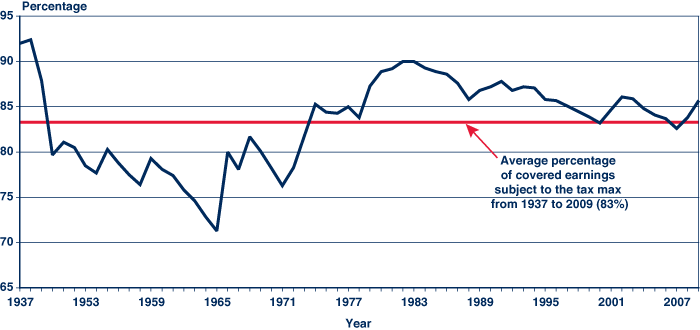
A spiky line: at its highest, right around 92% in 1937; falls as low as 70% in 1965; rises back to 90% or so in 1980; has fallen gradually back to 85% or so by 2007 Social Security has some problems, of course. The biggest is that the ratio of current workers to current retirees is falling. There are a few obvious responses to this. One is to cut benefits. Another is to increase the retirement age (which is, in fact, synonymous with cutting benefits). A third is to raise taxes. Diamond and Orszag, being affiliated with the Brookings Institution, pick the middle way: some taxes, some benefit cuts. Along the way, they lay out, in sober, quantitative detail, some other financing problems. One is that Social Security only taxes income up to a certain limit; because we live in a society suffering from rising inequality, the fraction of income subject to Social Security taxation has been falling (see chart at right).

There seem to be some obvious solutions here. One is to do whatever we can to raise the ratio of current workers to current retirees. How about allowing more people into the country, for instance, by liberalizing immigration laws? That’s entirely off the table in Diamond/Orszag. Next up: how about adjusting the taxable maximum (the “tax max”, as the SSA apparently calls it) so that the same fraction of U.S. payroll is always below it? Or how about removing the tax max altogether? That’s what we did to the Medicare tax starting in 1994.

Diamond and Orszag consider some variant of the former (increasing the tax max). Removing it altogether is just not centrist enough for them. It’s not at all clear why. I have to imagine that it’s because they wanted to put together a proposal that would appeal to some Republicans and some Democrats, and for that I have to salute them. I also, though, have to wonder if it’s a fool’s errand to try to woo a party that has been trying to sell us on Social Security privatization.

Diamond and Orszag devote one of the best chapters of [book: Saving Social Security] to these private accounts (the book dates from 2004, right in the thick of the Bush Administration’s push to privatize). With as much force as responsible scholarship will allow, they tear the idea of privatization to shreds. First, privatization would subject retirement savings to the ups and downs of the market. Riding the market may, as a general matter, be a fine idea, but that’s not the purpose that Social Security is supposed to serve. Social Security is supposed to provide a base level of savings that keeps the elderly out of poverty. Social Security is supposed to — and does — avoid financial mistakes that many of us make. For instance, when we cash out our 401(k)s upon retirement, we should convert them immediately into annuities so that our savings don’t end before we do; Social Security does this for us. If you claim that you want to replace Social Security with a system of private accounts to “strengthen” Social Security, but you don’t impose some sort of requirement on people’s private retirement savings — e.g., you don’t require that they buy an annuity, and you don’t require their savings to shift from equities to bonds as they age — then you’re not actually strengthening it; you’re replacing it with something else. If, on the other hand, you impose a number of restrictions on people’s private accounts, such that those accounts are just as constrained as the existing Social Security system is, then what problem are you solving? The cynical answer is that you’re solving the problem of insufficient fees going into mutual-fund companies’ pockets. Diamond and Orszag are not nearly so cynical. Or maybe they’re just very polite.

I’d be curious what Diamond and Orszag would write today, now that the White House and Senate are under the control of the Democratic Party. (Diamond was President Obama’s nominee to serve on the Federal Reserve Board. Orszag was Obama’s Director of the Office of Management and Budget.) More to the point, we’ve just gone through a financial implosion that decimated many people’s retirement savings. Now would seem to be the right time to push to strengthen — truly strengthen — Social Security in automatic ways that would be hard to roll back. For instance, how about mandating automatic adjustments to the retirement age that factor in the poverty and race of the recipient? The poor don’t live as long as the wealthy, and black people don’t live as long as white people; why not allow everyone to have an approximately equal-length retirement by setting the retirement age to life expectancy minus a fixed amount? And why not eliminate the tax max? Diamond and Orszag don’t really argue the merits of an all-liberal (e.g., only increase taxes on the wealthy and don’t cut benefits) or all-conservative (the reverse) policy; they merely nod in the direction of both and then say that they’re aiming for something in the middle. Nowadays it’s not clear that they would claim many admirers on either side from this approach. (One of the book’s first footnotes cites Dean Baker’s book [book: Social Security: The Phony Crisis], which apparently argues that there’s no problem to solve. It goes on the wish list.)

The following will probably sound snarky, when I don’t mean it to at all: [book: Saving Social Security] would be the Bible in a technocratic world. To quote Cosma Shalizi (who was writing on a different topic): Diamond and Orszag would love to be arguing from “just a little bit to the left of a technocratic center, and to debate those just a little bit to [the] right about optimal policies within a shared objective function, and pretend[] that it is a technical and not a political discussion. But … shit is fucked up and bullshit”. Such is the fallen world we’re in.

Generally speaking, I don’t know how to deal with Brookings these days. They seem like technocratic centrists in a world that uses technocratic centrists as its tools, if it uses them at all. With any luck, the world will shift back to a place where Brookings and friends can go back to being a central part of the discussion.

[1] – This just came up today, when Rick Santorum explained his opposition to ObamaCare in the same breath that he lauded Nelson Mandela, along the way telling us that the size of government keeps increasing. Never mind that the government is only large because we’re in a recession, and that if you instead look at government expenditures as a percentage of potential GDP, we’re right where we were in the era of the sainted Reagan.

I’ve had this running through my head for the past day, so the only thing to do is stick the rest of y’all with this beautiful earworm — December 6, 2013
“How Academia Resembles a Drug Gang” — December 4, 2013

“How Academia Resembles a Drug Gang”

Fascinating read, via the estimable Rick Perlstein (whose [book: Nixonland] you really want to read, and which I’ll one day get around to properly reviewing), via Corey Robin at Crooked Timber. [1]

I think of my friends in desperate pursuit of tenure — or even a job that promises tenure in a mirage-like way — and I wish them luck. I used to dream that academia would be free of all the bullshit that I expected the corporate world to be filled with, and that academics had endless freedom to research whatever they chose. My sense is that the latter just isn’t true. As for the bullshit piece: I’m sure academia has its own bullshit; it’s just different bullshit than the bullshit I deal with.

We’re all part of the capitalist machine, whether we like it or not. Fortunately, that means the solution to your problems is likely the same as the solution to mine: organize.

[1] – Robin one day leapt onto my radar, and has been writing astonishing essays ever since. His [book: Reactionary Mind] is on my list, though I think I need to read [book: The Rhetoric of Reaction: Perversity, Futility, Jeopardy], by the great A.O. Hirschman, first. I also owe you guys a review of a Hirschman biography that I recently read, not to mention Hirschman’s own [book: The Passions and the Interests: Political Arguments for Capitalism Before Its Triumph]. What can I say; I’m behind.

The 1940 census is awesome — December 3, 2013

The 1940 census is awesome

The Census Bureau, 72 years after the 1940 census, put the raw data from the 1940 census up on the web last year. It is completely fascinating.

It’s also tricky, for me anyway, to find my ancestors’ information. My partner has an easier task for her grandparents: they lived in New York City, and the New York Public Library helpfully posted 1940 phone books expressly to help people navigate the 1940 census (thanks, New York Public Library!). No such luck for Burlington, Vermont. But by asking my parents, I was able to find my dad’s parents, 7 years before my dad was born, when it was just my grandparents and my aunt. Among the interesting tidbits:

* My grandfather was listed as unemployed (and seeking work) at the time of the census; in 1939 he had only been employed 30 weeks. He had been unemployed for the four weeks preceding March 30.
* In 1935 they had lived in Alburg, Vermont on a farm.
* My grandfather’s profession was listed as ‘weaver’ at ‘woolen mill’. I knew him as a watchmaker, though I imagine he was just an all-around handyman.
* As of 1939, his salary was $630. Looking around a bit, I found a Social Security Administration document from 1947, which says that the median family income in 1939 for a family with 3 people, with a male head of household under age 35 (my grandfather was 30) was $1,373. So as of 1940, it looks like my grandparents weren’t doing so well. I’ll be curious how that changes when the 1950 census data become available in 2022.
* Both my grandmother and grandfather had fourth-grade educations.

There are a couple things to note about this. First, my method for chasing down the census records was basically ad-hoc; I asked my parents, who asked my aunt, who guessed what their street address had been when she was seven years old and was basically right on the money. Even with that information, the census data aren’t terribly easy to navigate. With luck, you can use an address to get an Enumeration District, which is basically the terrain that a single census-taker covers. But even within an ED, there are a lot of scanned census forms to peruse. This seems like a case that would derive a lot of value from some crowdsourcing: people using the 1940-census site would be able to tag individual records or pages with whatever information they want to contribute: street addresses, names, etc. Over time, it ought to be possible to write SQL queries against raw census data (“SELECT * FROM 1940_data WHERE state = ‘Vermont’ and LastName = ‘Laniel'”).

Even in my partner’s case, which is less ad-hoc, not everyone had a phone in 1940. What would we do if we wanted to look up the census information of someone alive in 1940? I’m sure there’s a well-known way to bootstrap oneself to a family tree, but I’m not familiar with it. And I’d vastly prefer a SQL query to a complicated bootstrapping process.

Matt Yglesias has discovered the concept of the “library” — December 2, 2013

Matt Yglesias has discovered the concept of the “library”

I dunno. Tell me if you disagree on this one. He’s talking about a public library for cast-iron stoves, a public library for DVDs, etc. “Deliver the thing in an electronic form” is just an implementation detail; the overall architecture is just “people shouldn’t own things; they should rent them or borrow them or use them in non-tangible form.”

This reminds me that I really should use the public library for books more. I own too many books. The thing is, though, that I love beating the crap out of them, breaking their spines, taking notes in them, spilling coffee on them, etc. I’m something of a book sadist.

(I finished [book: The Sleepwalkers] and [book: Lost Memory of Skin] this weekend, by the way. Reviews forthcoming, for some definition of ‘forth’.)

Shared without comment — November 23, 2013
“Why I Wont Do the Food Stamp Challenge” —

“Why I Wont Do the Food Stamp Challenge”

> Or perhaps like with two of my children, a 6 year old cares for her 18 month old brother after school alone every day and all day on weekends while her mother works her food options are limited to what her mother feels she can safely prepare microwave popcorn, microwave hot dogs, cereal, canned soup.

> I can buy enough brown rice, cabbage and dried beans to live cheaply and on food stamps but what I cant do is mimic the circumstances and realities that accompany life on food stamps.

Why I Wont Do the Food Stamp Challenge (via Cosma Shalizi‘s Pinboard)

“Conservative” health reform —

“Conservative” health reform

You should go read Uwe Reinhardt. That’s true 100% of the time, but it’s especially true here. Reinhardt writes about “conservative” health reform, where “conservative” somehow means “involving a great deal of intrusion into everyone’s life.” Remember how one of the big problems with HealthCare.gov is that it’s required to connect to so many other systems to confirm details of the beneficiary’s life? It needs to confirm that you’re not in the U.S. illegally; needs to confirm that your income is low enough to qualify for subsidies; needs to connect to private insurers’ websites; etc. How is that conservative? It’s likely to make an already inefficient system even less efficient.

Why is this so hard? I don’t need to sign up for bronze, silver, and gold national defense. I pay my taxes, and I get a service in response. Let’s just expand Medicare to everyone and call it a day. Or extend the VA hospital system to everyone and call it a day. Inasmuch as ‘conservative’ should mean ‘delivering a given level of service as cheaply efficiently as possible’, those approaches would be highly conservative. Instead we get systems that are more and more jerry-rigged over time, with more and more obvious flaws. Enough already.

How low an unemployment rate can we tolerate? — November 20, 2013

How low an unemployment rate can we tolerate?

On the occasion of Jared Bernstein’s and Dean Baker’s publishing an essay on how low an unemployment rate we can tolerate before inflation spirals out of control, it’s worth linking back to a something I wrote in 2010 about James Galbraith’s views on the matter.

Even supposing that there actually is a NAIRU (i.e., a level of unemployment below which inflation will start accelerating), and even supposing that something bad will happen if we cross below that line, it’s not as though we lose control of the ship right then. At that point we know what happens: the Federal Reserve jacks up interest rates, unemployment skyrockets (particularly as mortgage rates rise and employment in the housing sector collapses), and inflation drops back down. It’s happened before. We have control over this. Doesn’t the Federal Reserve just need to signal that it takes its dual mandate seriously? If everyone believes that the Federal Reserve will bring the hammer down if inflation rises too high, what’s the big deal? Better to let inflation rise too high because unemployment was allowed to drop too low, and correct the problem later, than allow millions of people to remain involuntarily idle.