This is really just my way of endorsing, from whichever mountaintop I’m able to yell it from, the book A Mathematician’s Lament. It sings to my soul, and it informs a lot of how I think about both education and math. If you’ve ever felt like the mathematics education you got was boring, and focused on fiddly little details that bled the topic of any beauty at all, Paul Lockhart agrees with you, and his book will expand on this belief of yours until you, hopefully, also feel him singing directly to you.
Today I want to focus just on one small portion of the argument–which maybe Lockhart doesn’t even make; I’m relying on the version of his book that resides in my soul, and I’m not going to go look at the text to find out if it’s there (though a quick Cmd+F says that the phrase “right answer” doesn’t apppear in it). The thing to say is that mathematics isn’t about getting the right answer. Or, more carefully: yes, given a set of premises, and given the laws of logic, the premises will either lead to a specified conclusion or they won’t. But:
- The premises matter. That’s the point–or what should be the point–of “word problems,” which everyone seems to hate, even though they’re the whole mathematical ball game. It matters which assumptions we make. Some assumptions don’t line up with the thing you’re trying to model.
- There’s loads of very abstruse mathematical formalism, all the way down to set theory and probably even further down into levels that I don’t know. Mathematical novices presumably look at these levels and say, “Well, surely that level is locked in. Surely we don’t have any choice how we define numbers or circles or whatever, right?”
This is how my daughter came home from school one day and told me that circles have zero sides.
Now, I’m not going to tell you that it’s wrong that circles have zero sides. What I am going to tell you is that you should be having a discussion about how many sides a circle has. Yes, of course I understand what people mean when they say that a circle has zero sides: basically, I think (challenge me on this!), a side is a thing where, if you move your finger along the perimeter of the shape, you’re changing the angle of your finger a bit. A square has four sides because you move your finger along, make a 90-degree turn, and repeat that same two-step 3 more times. The turning of the finger is what makes it a side, right? So a circle, which you move along continuously without ever really turning your finger–or turning it so imperceptibly that you may as well not be turning at all–has zero sides, right?
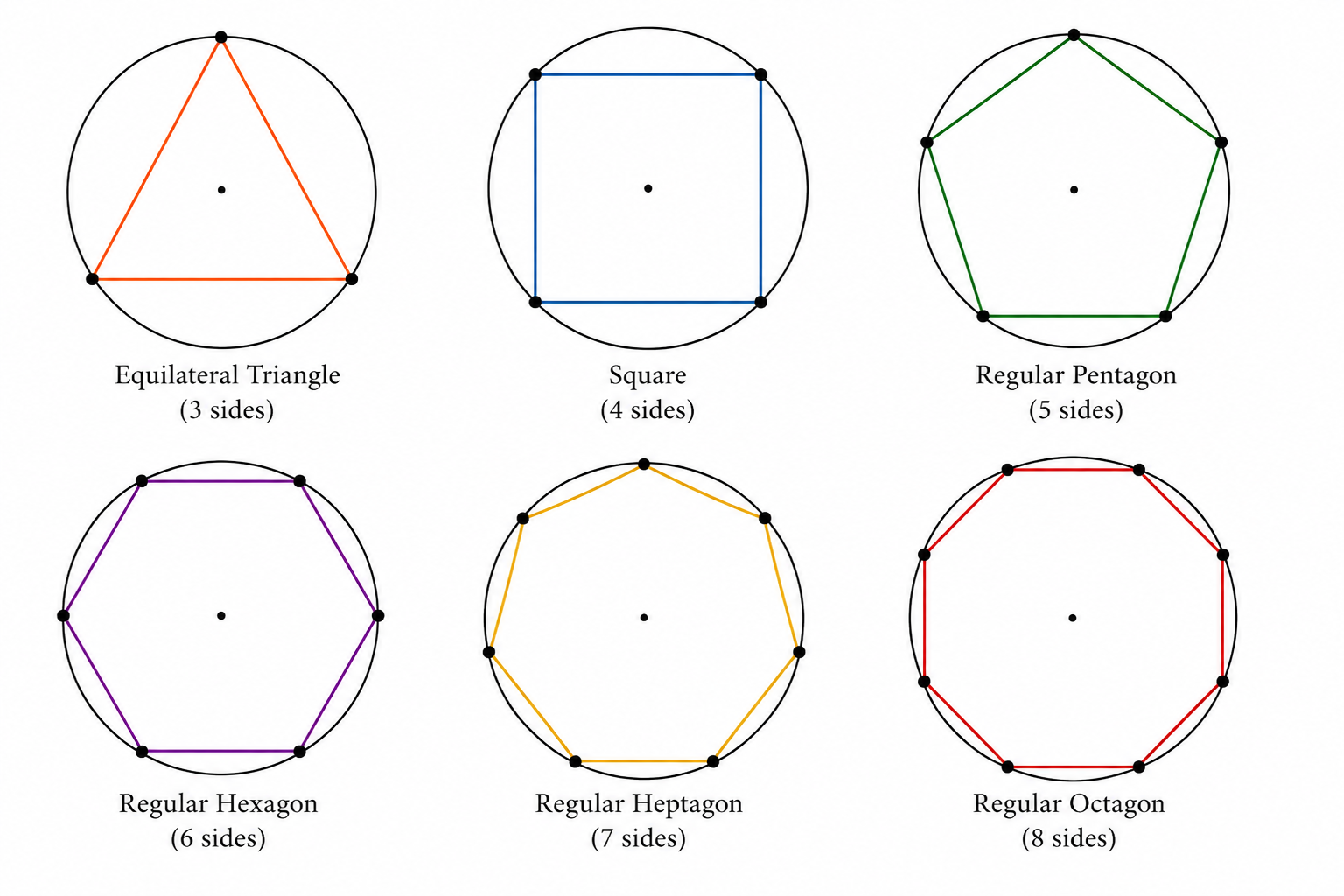
Sure, that’s one possibility. Another possibility is that a circle has infinitely many sides. The way to look at this is to inscribe a triangle inside a circle, then a square, then a regular pentagon, regular hexagon, regular heptagon, and regular octagon. You can see that as the number of sides increases, the inscribed shape gets closer and closer to the circle. If you inscribed a 20-sided shape, it would look very close to a circle. If you let the number of sides increase without bound, it would look exactly like a circle. This is known as the “method of exhaustion”.
My point here isn’t that the method of exhaustion is the right way to think about this. I can see why people would think that a circle has zero sides. The point is the argument. The point is that mathematics is a way of thinking, and it’s a creative endeavor, and it is not a set of perfect little truths handed down from on high. If you can argue convincingly that, for your particular use case, a circle should have zero sides, have at it. As Lockhart says somewhere in his books (Measurement is also very good), mathematics is a creative endeavor, like storytelling, and the stories you’re constructing don’t need to have anything to do with anything in the real world. But one of the fun things about math is that, once you’ve chosen a place where your stories start, you’ve somewhat tied your own hands: what your characters do early in the story constrains what they do later. If you tell me that a circle has zero sides, that’s your right, but then you’ve locked yourself in later.
My wife made the very reasonable point that you can’t expect children to understand this. And you can’t leave the mathematical sky wide open for them; they need to have some answers to build from. The blunter way she’s put this at other times is that “This is why our kids are going to hate you when it comes time for them to take math tests.”
I worry that that’s the crux of the matter, and that that’s how people come to hate math: this generation says “Well, the story may be more complicated and beautiful than the teachers let on, but you’ve got to pass the test.” Mathematics, for most people, is the thing that they learn so that they can pass the test, nothing more. And that’s how people end up finding it dull, dry, and lifeless. (Something similar, incidentally, probably explains why a lot of people don’t read any books at all after books stop being assigned in school. Why read a book if all the life will be drained out of it?)
Maybe it’s too much to hope that your and my kids will get in arguments with their teachers, trying to defend the idea that a circle has infinitely many sides and that something like this is at the heart of calculus. If nothing else, your kids should go let Lockhart stiffen their spines.

