Medicare releasing data — January 23, 2014

Medicare releasing data

So this is really interesting: the more data Medicare releases on provider payments, the better. But there are real concerns about patient privacy here. I remember when I was a wee undergraduate at CMU, Professor Fienberg was working on how to release raw data from the Census Bureau without revealing personally identifiable information. You can imagine the problem like this: in towns like the one I grew up in in Vermont, revealing that “the average black person” earns a certain sum of money could well mean that you’ve just revealed John Smith’s income; there just aren’t that many black people in Vermont.

As I understood it at the time — note here that my understanding is many years out of date — the Census Bureau had a couple ways of releasing its multidimensional contingency tables. First, it would only publish data in a given cell if the number of observations in that cell was above some threshold (that is, if the cell didn’t uniquely identify John Smith). I believe they also applied some scaling factor to every cell, deliberately obfuscating it so that any summary statistics from the table would come out right, but raw data were all incorrect.

These problems get harder if you’re able to combine, say, Census Data with data that you get from credit-card companies or data from (as above) hospitals. The more data you can agglomerate, the less anonymous any one source is, no matter how hard you try. I’m sure there are lots of people, all around the country, working very hard to de-anonymize various databases for marketing and law-enforcement purposes.

Point being just that, while releasing raw Medicare data would be terrific (the AMA’s comment in that link that people wouldn’t know what to do with all that raw data, and would take it out of context, is thoroughly disingenuous), there are difficult problems to surmount first. I wish them luck. I should check to see where Professor Fienberg’s work has taken him; the last update I got was more than a decade ago.

Max Weber, The Protestant Ethic and the Spirit of Capitalism — January 18, 2014

Max Weber, The Protestant Ethic and the Spirit of Capitalism

Having now finished this book, I don’t entirely get what the big deal is. The argument runs as follows:

  1. There is a certain spirit that is vital to the life of capitalist societies. It is, roughly speaking, the spirit of the (idealized) Ben Franklin: work for its own sake, working for a calling, diligently saving, etc. It’s this spirit that Weber proposes to trace to its roots. He is explicitly not trying to chase down the origins of business, of industrial production, etc; as he notes, these have all existed in other times and places.
  2. This spirit comes from Calvinism specifically, less so from Lutheranism, and still less from Catholicism. Specifically, Calvin and his heirs transmuted Catholic monastic asceticism into a “worldly asceticism”. That is, rather than prove your devotion to God through quiet scholarly contemplation while holed up in a monastery, you proved that devotion by steady work toward a calling.
  3. Whereas Catholicism enables you to sin on Monday and be forgiven for it on Sunday, thereby leaving you free to sin again the next day, Calvinism requires a life that consistently and strategically aims at the greater glory of God. A Calvinist life is more totalizing, one might say, that Catholicism. It is thereby more in line with the requirements of capitalist life, where businessmen make plans that aim at the rational maximization of profit.

I think there’s an “only if” hidden in here that Weber doesn’t argue, but which would seem vital to the whole project. If the story is simply that “Protestantism carries with it a certain rationalizing spirit, and it also happens that capitalism requires this spirit,” then that would seem to be either a) confusing correlation with causation, or b) a nice coincidence that makes a fun story, nothing more. If there’s no “only if” here — if Weber isn’t telling us that capitalism requires Protestantism of a certain sort — then the story isn’t so interesting. Yes, these two strands of Western civilization sat comfortably alongside one another, but what of it?

To argue the only-if, Weber would have to show that non-Protestant societies simply lacked a fundamental piece, and that they would always be lacking an important piece of the capitalist spirit. Because again: suppose it happens that Confucian societies either a) develop the spirit that Weber calls classically Protestant, or b) don’t develop the Protestant spirit, but go on to successfully build capitalist societies. Then what happens to Weber’s story? I submit that it becomes much less interesting; it becomes a story of two developments — Calvinism and capitalism — that happened at the same time. Which is just not all that world-historically interesting a coincidence.

I could be missing something important here, but I don’t think I am. Much of The Protestant Ethic is devoted to spinning out this historical tale, so that the story from about Luther’s time to that of Franklin comes through with no gaps. But that just doesn’t seem so interesting to me. Its lack of interest reminds me a lot of Clark’s A Farewell to Alms, which tries to argue that the Industrial Revolution began in England when it did because the English had genetically (sic) developed the bourgeois virtues (saving, breeding less) under ruthless selection pressure. Even granting this facially absurd premise, what of it? Does it mean that when Korea industrialized in the 1970s, it had also attained genetic superiority? If not, then, again, Clark is just telling us a nice story with no relevance beyond its time. That seems to be where Weber has left us.

The war on the bros —

The war on the bros

What Uwe Reinhardt said. In short: if you think that it’s an outrage that you have to pay more for your health insurance so that everyone can pay the same premium, including women and the elderly and the sick, then you should have been upset at the existing system of employer-based health insurance. Women and the old and the sick *at your company* are also paying the same premium as you, even though they likely go to the doctor more.

Reinhardt doesn’t even touch on the other obvious fact: one of these days you will be sick. One of these days you and your spouse may want to have a child. One of these days you will be old. When that happens, you’ll benefit from the same community rating that supposedly harms the “bros” today.

Did this country at some point lose the notions that we’re all in this together, that we’re sharing burdens, and that we’re all only one accident away from catastrophe? The phrase is “there but for the grace of god go I”; a just society protects everyone from unexpected, uncontrollable disaster. I hope we can relearn this.

1+2+3+4+5+… does not equal a negative number —

1+2+3+4+5+… does not equal a negative number

Someone is wrong on the Internet. In particular, today my friend Paul sent me a link to this guy, who credulously buys someone’s argument that 1 + 2 + 3 + 4 + 5 + 6 + … equals a small negative number. This is completely false, but it’s false for reasons that trip up a lot of people, so I think it’s worth spending some time on.

This is the same genre of argument by which you can “prove” that 1 = 2. So here’s the first step in arguing against it: think to yourself, “If I find this nonsensical, then it’s probably nonsense.” That’s really an okay way to feel. But people are scared of math, so they often think, “Well, mathematics says a lot of crazy things, so what do I know?” They’re likely to blame mathematicians for being unrealistic and for endorsing absurd conclusions just because their axioms made them say so.

The next step is to ask why mathematicians *don’t* just follow their axioms off a cliff. 1 is not equal to 2, and mathematicians know it. But who knows, maybe some abstruse chain of reasoning would lead a mathematician somewhere absurd. The reason that doesn’t happen is that *mathematics eventually has to collide with the real world*. Eventually physicists are going to use mathematics. Eventually engineers are going to build buildings; if they prove that a steel beam can handle 2 tons of weight, it damn well better not actually be 1 ton of weight. Mathematics is used in all sorts of real contexts. Logic cannot be used to lead us to unreasonable conclusions.

Now, mathematics is nice, because it consists of axioms and logic. You start with some axioms, and you follow some logic, and you get a conclusion. If the conclusion is absurd, then it must be because either the axioms were wrong or the logic was wrong. So you only have a small number of places to check for mistakes. (As opposed to your gut, which is less subject to verification.)

But infinity is weird, right? Surely infinities can do weird things. That’s absolutely true, which is why a couple hundred years of mathematicians and philosophers, starting with Isaac Newton and Bishop Berkeley, worked very hard to create a set of tools that allow us to talk about infinity in a sensible way that makes it hard for us to trip ourselves up. This is what calculus is, and why calculus is one of the monuments of Western civilization. It’s not just a very useful collection of tools used in everything from humdrum contexts like building buildings to literally heavenly pursuits like astronomy, though it is that. It’s also a philosophical marvel that makes the infinite comprehensible to mere finite humans. It is a way of keeping our language precise and avoid getting in hopeless muddles, even when we’re talking about incomprehensible vastness.

The basic trick that the essayist and the video creator are (mis)using, and the trick that lands them in such a muddle, is the following. We start with this:

x = 1 – 1 + 1 – 1 + …

and we add another copy like so:

2x = (1 – 1 + 1 – 1 + …) + (1 – 1 + 1 – 1 + …)

Then we write them on separate lines and shift things, like so:

2x = (1 - 1 + 1 - 1 + …)
   + (1 - 1 + 1 - 1 + …)
   = (1 - 1 + 1 - 1 + …)
       + (1 - 1 + 1 - 1 + …)

Nothing too complicated, right? We just shifted everything down a line and over by a couple of spaces. Great. Now, goes the argument, we see that every +1 on one line is paired with a -1 on the next line, or vice versa. From this they conclude that

2x = 1 + (-1 + 1) + (-1 + 1) + …
   = 1 + 0 + 0 + …

And that equals 1. So then 2x = 1, which means x = 1/2.

Your intuition should tell you that this is absurd. The sum up to the first term is 1. The sum up to the second term is 0. The sum up to the third term is 1. And on we go, back and forth, forever. The sum never settles down at a single value. Your intuition should tell you this, and your intuition is correct.

Another way to respond to this essayist’s nonsense is to use his argument against him. Take the same chain of reasoning as before: we put the definitions of x and 2x on separate lines, except this time we shift everything ahead *two* positions rather than just one. Like so:

2x = (1 - 1 + 1 - 1 + …)
   + (1 - 1 + 1 - 1 + …)
   = (1 - 1 + 1 - 1 + …)
           + (1 - 1 + 1 - 1 + …)

Again, nothing suspicious about this, right? Only this time, the same chain of reasoning — that we pair the row above with the row below — leads us to conclude that

2x = 1 - 1 + (1 + 1) + (-1 + -1) + (1 + 1) + (-1 + -1) + …
   = 0 + 2 + -2 + 2 + -2 + …

which lands us back where we started. If just shifting things around by an arbitrary amount leads to wildly varying results, then your intuition should tell you that something is probably wrong with the “shifting” method.

Basically everything in that essay and that video reduces to this “shifting” trick. By repeated application of the method they end up concluding that 1+2+3+4+5+… equals a negative number. It doesn’t, which is obvious. Your intuition doesn’t fail you here.

The actual answer is that talking about the sum of this series makes no sense, because it has no sum. If a sum is going to eventually settle down to something nice and finite, the terms have to get smaller. Here the terms aren’t getting smaller; they’re just oscillating. Likewise, the terms in 1+2+3+4+5+… aren’t getting smaller; they’re increasing. So that sum doesn’t converge either, and for a different reason: it’s blowing up, and will grow without bound.

The mathematical answer is that if a sum “diverges” like this one does, then you can’t arbitrarily rearrange terms in it and expect the sum to keep working out. Your intuition should tell you that the problem with 1+2+3+4+5+… isn’t the sort of problem that can be solved by just shifting things around; the problem with that sum is that *you’re adding things that keep getting larger*. No amount of shifting things is going to make that sum up to something nice.

Indeed, the 1-1+1-1+… example is one that they give you in calculus textbooks to show you that we can’t treat infinite sums the way we treat finite ones. The example shows that you need to be much more careful with infinities. It shows you that the logic and axioms you thought were sensible for finite quantities don’t quite work out for infinite ones.

Your intuition does, then, need help sometimes. In particular, it regularly fails when it’s faced with infinities. But there are times when your intuition leads you the right way, and mathematics can help you confirm it.

There are other examples that are facially similar but differ in crucial ways from this 1-1+1-1+… nonsense. There’s a mathematical proof, for instance, that .99999…=1. That happens to be true. The basic intuition there is that if I can bring two numbers as close together as I want, then those two numbers are indeed equal. If I am standing a foot away from you, and tell you that I’m going to halve the distance between us, then halve it again, then continue halving it forever, then — assuming we both live forever — I will eventually be standing 0.00000… inches away from you.

This can be proven rigorously. It’s important to note, though, that it can be proved entirely with finite numbers. I never need to use an “actual infinity” to prove to you that this works. All I need to say is that, essentially, I have a recipe for coming close to you. The recipe is “at every step, close half the distance between me and you.” Then you challenge me: “I bet you can’t get within 1/4 of a foot of me.” I reply, “My recipe will get me there in two steps: after one step I’m 6 inches away, and after two steps I’m 3 inches away.” So you say, “Fine, but I bet you can’t within an inch of me,” to which I reply, “My recipe will get me there in four steps: after 1 step I’m 6 inches away, after 2 steps I’m 3 inches away, after 3 steps I’m 1.5 inches away, and after 4 steps I’m 3/4 of an inch away. At that point I’m within an inch of you.”

You see what’s happening. I never actually say anything about how “after an infinite number of steps, I’m 0.000… inches away from you.” Instead I just show that I have a recipe that will get me as close as you could wish, in a finite number of steps. That is what we call a “limit” in calculus. The labor that went into making that word intellectually coherent is one of our species’s greatest accomplishments.

So please: use your intuition here. And if you question whether your intuition is the proper guide, learn a little bit of math. The mathematics of infinities is both spectacularly beautiful and really fun. Maybe in subsequent posts I’ll give some examples of how fun it is.

__P.S.__ (same day): This is an excellent response to the #slatepitch quackery, also via my friend Paul.
Scholarly research semiotics-or-something bleg — January 14, 2014

Scholarly research semiotics-or-something bleg

Synopsis: I had a thought this morning, and pretty quickly realized that someone has likely written on just this idea. So in keeping with my axiom that I want to behave such that people who know more about things than I do don’t think I’m a jackass, I’m looking here for pointers to people who’ve written about this.

So the idea was that, when you’re looking at something like the Bible or the U.S. Constitution, the literal meaning of the text is basically entirely beside the point (assuming we know what “literal meaning” means blah blah blah). The meaning of the Constitution is the meaning that people have ascribed to it over the years. If people behave as though the equal-protection clause applies to gay people, then that’s the meaning of the text for those people. If people behave as though the Bible says that gays have committed an offense against god, then that’s the meaning of the text for those people.

Different communities might then have different meanings for the same text. Some meanings might be enforced at gunpoint (e.g., Court decisions affirming the right of gay people to marry). Others might be dominant through historical accident. But the point is that you can’t escape power relations: the meaning of a text is a sociological/political fact, not a syntactic one.

I could probably argue the other side if you asked me to. I could, for instance, argue that all of the above does violence to what ordinary people mean by the word “meaning”. But then this “ordinary meaning of the word ‘meaning'” is, itself, a sociological fact blah blah blah. You see how this could very quickly start to involve crawling up your own butt. But anyway, this is just what came to mind, and I’m sure that a bazillion people have written on it. Can anyone recommend any good reading on the subject?

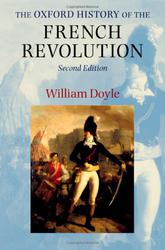
William Doyle, The Oxford History of the French Revolution —

William Doyle, The Oxford History of the French Revolution

An oil painting, presumably by someone like David, of someone holding a bow and arrow.I was looking for a book about all the things that everyone is supposed to already know about the French Revolution. What, exactly, is a Jacobin, for instance? How about a sans-culotte? Well, now I know. (Those are essentially the Jesuits of the French Revolution, and the Tea Party, respectively.)

Given that the middle 80% of the book — and hence the middle 80% of the French Revolution — was essentially one group massacring another group until the tables turned and the first group was massacred, I can’t say that I entirely understand what happened. That’s not Doyle’s fault, and I’m not entirely sure it’s mine, either; I think it may be the Revolution’s fault. The fact that no one could keep track of who was in power, and that a lot of people’s heads literally rolled between 1789 and 1802, likely explains a lot of why Burke and friends were so vehemently anti-French, and why those who disliked Jefferson really disliked Jefferson. (They thought Jefferson a Godless Communist before that term had crystallized.) The French Revolution was a devastating, paralyzing, anarchic, at times hopeful, often disappointing, polarizing, world-historical unleashing of forces, and it drew violent support and violent derision.

Doyle is very focused on serving the needs of people like me, who need to know the basic timeline and the most important actors, which doesn’t really allow him to linger on any one topic very long. I wanted to know much more about Robespierre, for instance. He may well be a tragic figure in all of this — Doyle pretty clearly thinks so — though I think the Brits normally look upon him quite differently. In brief, Robespierre was the proto-Jacobin — an idealist of the Revolution, perhaps its main ideologue, and apparently a splendid orator. He was also, seemingly, one of the main architects of the Terror.

To be honest, it’s hard for me to distinguish between one endless episode of bloodletting (90% of the Revolution, seemingly) and an even more orgiastic one (the Terror). Much of the bloodletting during the Revolution was seemingly just a concerted attempt to end the anarchy by trying to establish a monopoly on violence. Then there were what we’d call “purges” if we were describing the Stalinist era: people killing off the “counterrevolutionaries”, where by “counterrevolutionary” we mean “the other guy.”

From the modern perspective I think it’s one of the main questions we’re going to run up against: how earnest were the revolutionaries and the various bands of counterrevolutionaries? That is, when they were slaughtering the others in droves, did they really believe they were the true bodyguards of the Revolution and that the other side wanted to bring about a return of the Bourbon monarchy? Did the later terrorists really believe, for instance, that Robespierre was going to destroy the Revolution? Or was it all just a convenient way to kill someone while seeming noble?

Some British reactionaries (a term, like “terrorist”, that the French Revolution created — there was nothing to react against before there was a revolution) foresaw from the beginning that all this democracy would become anarchy, which would be swept aside by a charismatic general who would establish a monopoly on violence. That did, indeed, come to pass, starting with Napoleon’s coup on the 18th Brumaire. (Brumaire was one of the months of the Revolutionary calendar. Now I understand a historical allusion in the title of an essay by Marx. I assume everyone in the 1850s understood the allusion without the aid of a Doyle.) Of course Napoleon is a mind-bogglingly fascinating story on his own, which Doyle can only just touch on.

I’m left with more questions than answers. Napoleon seemed to conquer Europe unimpeded — nearly magically; how did that happen? How did one man possess legitimacy that all the Jacobins and republicans before him had lacked? And indeed, how does legitimacy even work? It’s a social process: everyone believes that the king is the legitimate source of all authority, so he is; as soon as people stop believing that, legitimacy can fall apart quickly. Understanding legitimacy means understanding groups (the “legitimators”, let’s call them) rather than understanding the thing being legitimized (the “legitimee”?).

That’s why I really need to learn about the French Revolution from the perspective of someone living in the middle of it — something like the Pepys of Paris. I need to understand how the bulk of humanity — the peasants, say — experienced it, and whether the separation of Louis XVI’s head from his body was a cataclysmic event that suddenly shifted everyone’s understanding of how power and authority worked.

Louis didn’t actually lose his head until 1793, by the way, three-plus years after the Bastille fell. He’d been a virtual prisoner in his palace in the intervening years, delicately negotiating with the republicans and occasionally trying to foment royalist rebellion. In retrospect it can seem like the king’s days were numbered just as soon as the “internal logic” of the Revolution started to spin out, but it’s really hard for me to believe that there is any such logic, a priori. In any case, I had never really solidly grasped that the king’s death came a good long while after the 14th of July, 1789. There are a lot of facts like that which are now much clearer to me, thanks to Doyle. The timeline from the French Revolution to the present day that I’m building in my head slowly comes into focus. Roughly:

A couple years prior to 1789: the Bourbons lose control of their finances, with their rock-star finance minister, Jacques Necker, periodically brought in as the savior who can fix the debt and end the people’s starvation.

Soon thereafter: Necker finally falls, there are bread riots, etc.

1789: the Bastille falls

1792 – 1795: the National Convention rules

1793 – 1794: the Terror

1793: the king is decapitated

1795 – 1799: the National Convention is replaced by the smaller Directory

1799: Napoleon Bonaparte seizes power from the Directory

1802: Napoleon is made First Consul for life, and the Revolution effectively ends (and with it many of the Revolution’s ideals)

1802 – 1815: Napoleon conquers large parts of Europe and, among other things, ends the Holy Roman Empire

1815: Napoleon finally defeated at Waterloo. Congress of Vienna establishes tentative 19th-century order in Europe.

1815-1848: Monarchy restored in France.

1848: Revolution all over Europe. Second Republic declared.

1871: Franco-Prussian War leads to Napoleon III being captured. Monarch overturned, Third Republic declared.

1871 – 1941 or so: Third Republic

1941 – 1945: Vichy France

1945 – 1958: Fourth Republic

1958 – now: Fifth Republic

The final chapter of Doyle’s book puts the Revolution in breathtaking world-historical perspective. The whole book is worth reading just to understand the chaos of the Revolution, but the final chapter seems necessary for anyone who wants to understand how we’re still, today, living in the world the French Revolution created.

P.S.: in an appendix, Doyle writes that “Scornful British contemporaries … rendered [the months of the Revolutionary calendar]: Slippy, Nippy, Drippy; Freezy, Wheezy, Sneezy; Showery, Flowery, Bowery; Heaty, Wheaty, Sweety.”

P.P.S.: Lots of books that Doyle cites in the bibliography go on the to-read list:

  • “The classic treatment [of the Revolution’s origins] is G. Lefebvre, The Coming of the French Revolution (Princeton, 1947), the best general work by the other great twentieth-century master whose detailed researches underlie much of what subsequent scholars have achieved.”
  • “The most up-to-date, well-researched, and stimulating general survey is at present D.M.G. Sutherland, France 1789-8115: Revolution and Counter-Revolution (London, 1985).”
Shipments of babies to Paris, sure, sure … wait, what? — January 12, 2014
Business confidence? How about middle-class confidence? — January 10, 2014

Business confidence? How about middle-class confidence?

I’ve thought for a while that the focus on business confidence — specially, businessmen’s purported inability to make forecasts about the future, because policies ostensibly keep changing out from under them — came at the expense of *everyone else’s* confidence. Here’s an example by the banker Bob Rubin from today, via Paul Krugman:

> The US recovery remains slow by historical standards even if recent signs of improvement are borne out. One reason is that our unsound fiscal trajectory undermines business confidence, and thus job creation, by creating uncertainty about future policy and exacerbating concerns about the will of Congress to govern. Business leaders frequently cite our fiscal outlook as a deterrent to hiring and investment.

To be very specific about it: suppose you believe that you’ll lose your job tomorrow. That’s going to change your behavior today, isn’t it? It’s going to cause you to save a lot of money in the bank(assuming you have money to save), rather than spend it. In a world without universal health insurance, fear of job loss might, for instance, make you head to the hospital and the dentist’s office for all the checkups you’ve been avoiding.

I’ve not put together the economic model, but I could easily see a story under which the effects of consumer uncertainty dwarf the effects of business uncertainty. Businesses, owing to their economies of scale, can prepare for policy uncertainty more easily than I can prepare for unemployment. Really large businesses can engage in hedging schemes, wherein they’re protected from rises and falls in interest rates, for instance. I cannot so easily prepare for the loss of my job. And in an environment of high involuntary unemployment, employers have an advantage over me: they have more people waiting in line for every job opening. So my uncertainty over the future, and my ability to hedge against downturns, would seem to get worse during recessions.

But now imagine that there’s a strong social-safety net, such that, whatever else happens, you’re going to be able to get medical care even if you’re unemployed. Imagine that unemployment insurance is so strong that you breathe a little more easily and sleep a little more soundly at night. (For that matter, imagine that everyone gets a guaranteed minimum income.)

Imagine a safety net so strong that you could consider starting a new business without fear that you would impoverish your family.

Imagine that your kids’ school offered them free lunch, regardless of their income level (thereby removing the stigma of poor kids receiving free lunch), 365 days a year; that would remove the uncertainty over whether they’d be fed; in turn this would, it’s fairly easy to imagine, reduce your fear and increase your freedom of action.

Imagine that, no matter which neighborhood you lived in, you could live free of fear that your kids would be hit by stray bullets, and you could send them to whichever school was best for them (in Boston, you could live in Roxbury and send your kids to school in Brookline). You could choose to live anywhere in this world without fear. That would remove some more uncertainty from your life.

My strong suspicion is that Bob Rubin doesn’t care about these things, because he doesn’t have to. Bob Rubin’s class cares about interest rates far more than it cares about involuntary mass unemployment. Bob Rubin’s class lives in neighborhoods without fear. Bob Rubin’s class has the spare money to start new businesses without fear of their failing. The only sort of uncertainty that Bob Rubin’s class cares about is the uncertainty in interest rates.

Let’s aim for a society where the bulk of middle-class people both a) understand the real sources of uncertainty and b) don’t come to identify our needs with those of the bankers. Their needs are not ours. Their fears are not ours.

French Revolution reading plan — January 5, 2014

French Revolution reading plan

I read Hobsbawm‘s “long nineteenth century” series years ago, but I probably wasn’t ready for it. And it’s very British, in the sense that it just sort of ambles around for a while; I’m sure it has a plan, and I’m sure that someone who came at it with a different background would get more out of it than I did. Other very British works, like The Victorians (a gift to me, on the occasion of my 30th birthday, by the sadly departed Dan Weinreb), or Gellner’s astonishing Nations and Nationalism, work great, so I don’t know what my problem with Hobsbawm was.

Anyway, so I picked up Carlyle on the French Revolution the other day and made it literally one page before realizing that this was not the book for me. Whereupon I turned to Google.

So now on the list:

Palmers Twelve Who Ruled is my single most favourite book on the French Revolution. He does precisely what I was just talking about. He doesnt do it for the tens of thousands Im more interested in the tens and the hundreds of thousands but for the 12 who ruled. Hes incredibly good at giving you a sense of what these people are confronted with, the incredible difficulty of their situation and the unbelievable stress of the circumstances they find themselves in. Hes just fantastic at recreating that atmosphere and, as a result, forcing you to sympathise with these men. His position is much closer to my own position. He sees this as trying to do something really important, coming up against enormous obstacles in the course of trying to do it, failing, but completely understanding why this would happen in this particular way.

This should help me understand the period up to the Congress of Vienna (covered so ably in Kissinger). It’s not much of a jump from there to Bismarck — such a short jump, in fact, that I may know everything I need. And I’ve got there to World War I covered. Then maybe I’ll be able to re-digest Hobsbawm and Gellner as thoroughly as they deserve. And I dunno, maybe Hegel and Kant would fit well into this reading plan. Unsure. Check back later.

Vacation reading, 2013-12 — January 3, 2014

Vacation reading, 2013-12

(Attention conservation notice: 3600-some words on the four books I read over Christmas and New Years. A lot of it is my processing and synthesizing my understanding of the runup to World War I. Valuable for me, anyway.)

Not a bad run: four books from December 21 to December 31. My total for 2013 was 30 books, which is quite a bit south of where I want to be. Alas.

Albert Hirschman, The Rhetoric of Reaction: Perversity, Futility, Jeopardy

You really need to read Hirschman. This is the third of his books that I’ve read, after Exit, Voice, and Loyalty: Responses to Decline in Firms, Organizations, and States and The Passions and the Interests: Political Arguments for Capitalism before Its Triumph. I’ve also read Jeremy Adelman’s biography of Hirschman. The man really is worthy of a biography. Apart from a legendarily eclectic academic career, he saved thousands of people from the Nazis and much besides. Again, I’m way behind on reviews; suffice to say in the meantime that Adelman’s book is well worth a read, because Hirschman’s life is fascinating.

The Hirschman method, based on the few books of his that I’ve read, is deceptively simple, but it’s all about the execution. In writing Exit, Voice, and Loyalty, he considered some typical reactions to a failing institution — think about your local public school, or your favorite mobile-device manufacturer. The reactions are to abandon the failing institution (e.g., send your kids to a private school instead, or use an iPhone), which he calls “exit”; or to stick around and try to change it (lobby the public school to better educate its students, send lots of letters to the CEO explaining that their phones are behind the times). “Loyalty” is really sort of a turbocharger for voice: it’s an extra bit of stickiness that might make you exercise your voice more.

Even on their own, these little concepts are tremendously useful and clarifying; humans respond to a great many situations through exit and voice. Yet the concepts are small-scale and non-vacuous enough that you really can say meaningful things about them, rather than just gesticulating vaguely in their direction.

But there’s more! Hirschman really turns on the magic when he shows how these three pieces interact with one another. Again, let’s focus on the example of a failing public school. If private schools are encouraged, you can exit from the public school freely. You might, then, be willing to use your voice less. In particular, the people who care most about their kids’ educations — the ones who would otherwise be using their voice — may be the first to exit, leaving behind only the less-interested parents, thereby accelerating the school’s decline. So exit can weaken voice.

Flesh out these concepts, apply them to a mass of interesting situations, do it with shockingly brief writing that nonetheless manages to say a lot, do some formal mathematical modeling in the appendix, and pack the whole thing into 176 pages. That’s Exit, Voice, and Loyalty. It’s breathtaking.

But that’s not important right now! We were talking about The Rhetoric of Reaction. I’m angry that you distracted me from my point.

The same series of tricks applies here. Again, we have three components. This time, the question is how reactionaries respond, in their rhetoric, to any kind of social change. Hirschman is at pains to be clear that he’s not looking down on reactionaries; he’s merely trying to understand their responses to the world. He’s pretty clearly read more people reacting to social change than you and I have; I imagine the man heading off to the library for months and years, reading, studying, synthesizing, processing, and abstracting. At the end of all that, he picked three classic responses to social change:

  • Perversity: You think you’re going to improve x, but in fact the change you envision is going do achieve exactly the opposite of what you intend: it’s going to make x worse.

  • Futility: The real structure of the world underlying the thing you’re trying to change is absolutely immobile. You think you’re toppling the ruling class, say, but they will always manage to stay on top. Real social change is impossible.

  • Jeopardy: Trying to change the thing you’re trying to change is going to make something else — something that we care about just as much — worse.

Again, on their own these are really powerful concepts. They help put a large class of conservative argument into focus. From there, they can be studied with greater clarity. Futility is an interesting one, which can be used by both the left and the right. The left says, “Yes, the ruling class will continue to pull the levers, so at worst our attempts to overthrow it will be fruitless; but try we must.” The right says the opposite: that the ruling class will continue to pull the levers, so why bother?

Here’s Hirschman, in a delightfully arch way, addressing the simultaneous complaints that a) means-tested welfare programs don’t actually reach the people they’re supposed to reach (the money goes to the middle class instead, or to the bureaucrats who provide social services), and b) that those same programs encourage a life of indolence:

It requires special gifts of sophistry to argue at one and the same time that welfare payments have those highly advertised perverse effects on the behavior pattern of the poor and that they do not reach these same poor.

It’s hard to convey, without reading the book in its entirety, just how effortless Hirschman makes all of this. His book is both dense with historical evidence dating back to the French Revolution (which, I gather, is the time when the Western world first learned about “revolution” in its modern sense and thereby created reactionaries like Edmund Burke), rich in style, and somehow light as a feather. He reminds me very much of Quine:

He calls to mind […] one of the exceedingly refined diners at those [formal] suppers, for whom the proper use of the fish-knife is automatic, second nature and almost first; for one of the qualities of Quine’s writing is that he makes everything, not least his minute clarity and precision, seem easy, obvious and spontaneous.

Just like Exit, Voice, and Loyalty, The Rhetoric of Reaction is short: just 224 fairly large-print pages. It’s absolutely worth the few hours it will take you to read.

One final note: Hirschman entered this project as he watched, seemingly with great dismay, the polarization of the American political debate, whereby my political beliefs are reasoned, rational responses to empirical truth, while yours are mere visceral mutterings. By its end, he found just as much rhetorical incoherence in liberals’ positions as in conservatives’, and this wasn’t just a search for pox-on-both-your-houses David Brooks balance; there really are certain tried-and-true liberal rhetorical devices which share just as unreliable a connection to the facts as conservative ones. For instance, there’s the “if we don’t do this now, then far worse consequences will come later” trope. And there’s the slippery-slope argument, of course, which is maybe the flip side of the previous one: if we do this now, then we open the door for far worse possibilities later on.

The thing to note about rhetorical devices generally is that they needn’t bear any connection to the actual truth of the matter. Indeed, the wide variety of contexts in which they’re called into battle suggests that they’re used more often than when the facts alone would call for.

Hirschman’s main achievement, then, may be that he helps us recognize when something that looks like an empirical or logical claim is merely a rhetorical one.

Corey Robin, The Reactionary Mind: Conservatism from Edmund Burke to Sarah Palin

I read this directly after Hirschman, and I’m glad I did. First, there’s something to Hirschman’s balance and humanity that is missing in Robin’s book, which I might not have noticed had I not read Hirschman first. Second, there’s a concision to Hirschman that isn’t there in Robin.

Robin’s basic aim is to show that, from Edmund Burke to now, conservatism has basically been about two things: 1) keeping the rabble in line, and 2) violence as a creative spark — war as an essential element in maintaining a dynamic society.

This work makes me uncomfortable in a few ways. First, these may be accurate synopses of what important conservatives have thought over time, but it’s really not clear to me that this is what animates conservatism-as-she-is-lived today. Walk up to a Republican friend of yours and ask him or her why he or she is conservative. I doubt the answer you’ll get is that he or she wants to claw back some of the freedoms that the poor and disfranchised have gained — at the expense of the privileged — over the last 200 years. I also doubt you’ll hear this notional Republican explain that he or she voted for Mitt Romney because Romney promised more wars.

There are at least a couple reasons why this objection might be irrelevant. Maybe conservatives believe these things without articulating them. Maybe the actions of conservative voters betray these underlying motives, even when their words do not. These are both possible, but Robin doesn’t consider them. Robin doesn’t really consider the experience of lived conservatism.

My conservative friends — and even friends who wouldn’t outright identify themselves as conservatives but have conservative leanings — tend to be conservative, not because they feel like the lower classes deserve to be crushed, but rather because they feel that the liberal alternative of greater government intervention is a non-starter. They believe that government is likely to be in the pockets of those it’s supposed to be regulating; that government wastes taxpayer’s money; and that market competition is a better alternative to government monopolies. For starters.

Mind you, I have retorts to all of these. And I have retorts to all of these, specifically, when we get down to specific topics like health insurance or retirement security. Conservatives have surreplies to the retorts. And so goes the debate.

Granted, I also know conservatives who have stated explicitly that they were going to vote against Obama because he was going to raise their taxes. This is less a “debate … within a shared objective function” than is the peaceful discussion about Social Security and Medicare that I outlined above. Robin is on surer ground against these folks: it’s pretty straightforwardly about keeping something to yourself that you don’t want someone poorer than you to get. Or, again, you could just want the government not to take your tax money because you think you can do something better with it than the government can.

My point is just that, when you come face to face with actual conservative ideas, the “screw the working class and start wars” argument seems like a Procrustean bed for lived conservatism. It’s just hard for me to buy it.

I’d also have a hard time if the conservative equivalent of Corey Robin wrote a book claiming that liberalism, all throughout its history, has preferred rational theory to lived experience (which is a rough outline of how conservatives viewed the French Revolution, and viewed Thomas Jefferson), and would prefer to centralize everything under a wise, all-knowing state. Maybe that’s been true of certain thinkers, but that’s not at all why I consider myself a liberal. I would more or less immediately stop reading any book that described me in that way; its violations of realism would call the rest of it into question.

The best Robin could try to claim is that when Republicans argue for lower taxes, they’re actually just disguising their real intentions. Paging Lee Atwater:

“You start out in 1954 by saying, ‘Nigger, nigger, nigger.’ By 1968 you can’t say ‘nigger’ — that hurts you. Backfires. So you say stuff like forced busing, states’ rights and all that stuff. You’re getting so abstract now [that] you’re talking about cutting taxes, and all these things you’re talking about are totally economic things and a byproduct of them is [that] blacks get hurt worse than whites.

“And subconsciously maybe that is part of it. I’m not saying that. But I’m saying that if it is getting that abstract, and that coded, that we are doing away with the racial problem one way or the other. You follow me — because obviously sitting around saying, ‘We want to cut this,’ is much more abstract than even the busing thing, and a hell of a lot more abstract than ‘Nigger, nigger.’”

Another way to put this is that, whatever their intentions, their actual policies have the inevitable consequence of screwing the poor and starting wars. And maybe the Republican voter is being hoodwinked into voting for policies that he doesn’t actually want (or which actively undermine his own interests). I would enjoy a book about this premise quite a lot. It would get me closer to an understanding of my fellow-citizens. Robin’s book, sadly, does not do this.

The “conservatives believe in violence” argument is interesting, even if you replace “conservatives” with “people”. The basic gist is that conservatives believe a technocratic, rationally managed society whose GDP curves always bend gently upward is boring. Societal greatness comes through acts of boldness, through fighting, and through conquest. Hence, in particular, conservatives’ support for the free market, and their love of foreign domination. Again, it’s hard for me to believe that my conservative friends would accept this as an accurate description of why they, for instance, supported the Iraq War. That’s not why George Packer did. They were driven by genuine humanitarian impulses — that Hussein was a bad dude. (Let’s not get started down the “but there are lots of other bad dudes” road; that’s not an actual argument.)

There’s something to this: Americans (and Germans; see the Pflanze review below) do seem to love war, regardless of their political leanings. They dutifully get in line behind their leaders whenever we pick the latest poor little country to blow up. And we certainly do venerate the bold business conquistador.

To back out a step, I think the positive way to frame this — rather than the negative way that Robin frames it — is that we liberals need a living, breathing, bold, energizing ideology for the 21st century; that Keynesian technocratic demand management combined with a strong welfare state probably lacks the vigor necessary to inspire greatness in Americans; and that, in the absence of a compelling ideology, people will succumb to the allure of violence, xenophobia, and selfishness. If this argument itself wasn’t in Packer’s Blood of the Liberals, it could easily find a home there.

So I think I’d be happier with Robin’s book if it were less about What Conservatives Really Think, Deep In Their Brainstems, than if it were about a liberalism that could inspire. I’m pretty sure Robin does have such ideas in him; they probably involve organizing labor and helping out the world’s marginalized. I’d be proud to read such a book; it would help me produce the world I want, in which we all believe that we’re part of a community. I’m less proud to read The Reactionary Mind.

Otto Pflanze, Bismarck and the Development of Germany, Vol. 1: The Period of Unification, 1815-1871 and Vol. 2: The Period of Consolidation, 1871-1880

I think my obsession with Bismarck started when I realized, a couple years ago, that the modern welfare state began under him in the late 1800s. How did Germany manage to create what took the U.S. either half a century or a century-plus to implement? Long story short: I haven’t yet come to a solid understanding of the answer. But Bismarck himself is fascinating, so it’s okay.

Otto Pflanze’s three-volume work is, very clearly, the canonical work on Bismarck. That would be obvious even if I had never read another Bismarck work, just as Caro’s four-volume LBJ series will very clearly never be surpassed in its sphere. (As it happens, I have read another work on Bismarck, namely Steinberg’s one-volume bio, which is more psychological study than Pflanze’s. There’s important overlap, which I’ll try to get to.)

Very, very long story short: Bismarck unified the German states in 1870 into what we now call Germany. I wouldn’t have understood the magnitude of that achievement if it weren’t for Pflanze. For one thing, I was not aware that the south of Germany is quite distinct from the north. The south was more Catholic, the north more Protestant; the south was more agricultural, the north more industrial. The south includes Bavaria; the north includes Prussia. How Bismarck fused these disparate states into the nation we know today consumes the first, gripping volume of Pflanze’s work.

The very short answer is: nationalism. Bismarck’s interests were essentially those of the absolutist Junker power structure, and he spent his entire career defending those interests in the face of an industrializing, democratizing, nationalizing world. His central challenge was to harness the forces of the modern world against one another to achieve a unified Reich. He used liberals’ patriotism and nationalism first to defeat Austria and defeat dreams of a wider union between Germany and Austria (“great Germany”); then acquired Schleswig-Holstein in its entirety from Denmark without dividing the territory in half; and finally turned German nationalism outward toward France, in the Franco-Prussian War, in 1870 and 1871, to effect the final union of German states.

This is something I only recently realized: the Franco-Prussian War is really, really important:

First, it gave us Germany as we know it today.

Second, German seizure of Alsace-Lorraine during that war was a continuing thorn in the French side.

Third, that seizure of Alsace-Lorraine contained some of the first serious notions of the German Volk: that even though Alsatians identified as French, Germans (initially not including Bismarck, it seems) believed that it was part of a broader Germany which had to be reunited with the fatherland.

Fourth, German atrocities — particularly during the siege of Paris — left France with a burning hatred of Germany. This hatred seemed to be personified in Raymond Poincaré, just in time for World War I. (Though of course it’s possible that any French statesman, given this context, would have behaved the same way.)

Fifth, the war’s end made the French pay a crushing indemnity to the Germans, which seemingly has echoes in the post-WW1 treaty of Versailles, whose manifest failings were an important contributor to World War II. (Indeed, the German states named Wilhelm their emperor under the newly formed Reich at Versailles upon the war’s conclusion. Pflanze doesn’t explain exactly how this location was chosen, nor how the French felt about it, but I do wonder whether the World War I treaty was signed there as a final coda to the Franco-Prussian War.)

Sixth, the war empowered generals in dangerous ways. Bismarck had exploited Prussian respect for the military in his plans for German union, and seems thereby to have opened Pandora’s box. When the war came, the generals fought with only military ends in mind, while Bismarck raged at the strategic damage that their brutal siege had done to Germany’s international relations. This echoes loudly in David Halberstam’s The Best and the Brightest, about how the U.S. military took on an autonomous power in Vietnam, with disastrous results. (You can also see it in Douglas MacArthur’s decision to invade China without support from his civilian superiors, in his grudging return to the States, in the American public’s outrage that Truman had “lost China”, in his battle before the U.S. Senate, and in the public’s eventual realization that the generals’ view of the world is narrower than that of their civilian superiors.)

So I think it’s really important that I read up on the Franco-Prussian War. That’s the very long way round to explaining one reason why it’s important that you know about Bismarck. [1]

There’s so much else to say about Pflanze. The man’s sense of balance is exquisite; never do I feel that I’m in the hands of a hagiographer. Pflanze is trying to understand, from a historian’s distance, whether Bismarck shares any part of the blame for what Friedrich Meinecke called “the German catastrophe“. At two volumes in (out of 3), I only have the beginnings of an answer. First, Bismarck established a state which, by design, only had the appearance of democracy, while it was in fact autocratic and centralized. Second, his cooptation of German nationalism left the traditional Prussian structure — a strong monarch, a Junker landowning class, and an obedient military — in place on a grander and more dangerous scale. And third, his delicate puppetry, by which he controlled every situation throughout his nearly half-century of rule, couldn’t survive his death.

The second volume is less exciting than the first. The second volume is about the humdrum, but vitally important, work of lashing nominally unified German states together so that they’d act as an empire. This involved parliamentary maneuvering that would make LBJ proud, and endless bureaucratic tinkering. No wonder Bismarck had to spend increasingly long periods taking the baths to repair his damaged nerves; the man embodied, and indeed created, the German Reich. Its problems were his problems. (Thankfully, Pflanze only spends as much time on the man’s psyche as is necessary to explain the broader problems. He’s less of a psychological historian than Steinberg.)

The second volume also discusses Bismarck’s famed Kulturkampf, which was essentially a war against Catholics and socialists. The Catholics were in Germany’s south and in Polish parts of Germany. They didn’t go gentle into that good night. In fact they organized the Center Party. This was a long, pointless battle that took Bismarck the better part of a decade.

I can’t quite recommend that someone coming to this topic from ground zero should dive right into Pflanze, in the same way that 69 Love Songs is not the best intro to The Magnetic Fields. I’m still looking for the right one-volume work on Bismarck. But if you want the full meal, look no further than Pflanze. Your grandkids will still be reading him when they want to understand what went wrong in 20th-century Germany.

[1] – A note here about how I, at least, read and learn history. I had one block of knowledge about World War I previously, and a bit of knowledge about the post-Napoleonic world by way of Henry Kissinger. I knew the words “Franco-Prussian War”, but didn’t know the first thing about them. Now that I’ve got some context, it’s very easy for me to remember that the Franco-Prussian War comes at the end of the formation of the German Empire, and that it predates World War I, and that it provides important context for the latter. This is how I remember U.S. presidents, as well. Can other people remember historical facts and dates on their own, without needing to situate them within a longer story?