Credit to Krugman for giving France-bashing its due, but: when has [mag: The Economist] *not* claimed that unions or France, or French unions, were going to cause an imminent crisis?
A think tank devoted to the study of inequality, headed by John Podesta (Clinton chief of staff, Obama advisor, and founder of the Center for American Progress), featuring Emmanuel Saez, Raj Chetty, and Brad DeLong? Wow. I am fascinated by where this will go.
(I have dropped off of Facebook and Twitter, so you might expect this blog to contain more in the way of “a link with a little commentary around it”.)
Inasmuch as universal health insurance is fundamentally about inequality, maybe here is the place to include a link to Jon Cohn’s great piece entitled “Obamacare Makes Men Pay for Maternity Care. Good!” The slam-dunk argument in the piece, and the moral principle that really ought to have universal appeal (but sadly doesn’t) is:
So you ended up XY instead of XX. Get over yourself. Even conservatives generally stipulate that insurance should protect people from the financial consequences of random events. But they seem not to recognize that being born a woman is a random event. Sorry, dudes, you had no control over that. Allowing insurers to discriminate based on gender means penalizing half the population, just because those folks ended up with one type of chromosome instead of another.
That’s liberalism in a nutshell: in whatever way works best, try to minimize the effects of random misfortune.
As I mentioned to a friend:
While we’re on the topic, John McDonough’s Inside National Health Reform is a must-read. It’s the book I think of whenever anyone says that “no one has read all of the Affordable Care Act.” McDonough’s book is what to read if you in fact want to understand every page of the ACA. It contains one chapter for each title of the ACA, along with a really patient explanation of the politics and Congressional procedure that led to its being the way it is. I want to buy a hundred copies of it and hand them out at parties.
I’ve not yet reviewed it, because I am a terrible person. I’ll let the above stand, for now, as the stub of a review.
(Attention conservation notice: 1400 words about the city I love and its baseball team.)
Speaking of the Red Sox, as we were … I’ve just returned from the jovial Red Sox victory parade, which was a blast (thanks to the two lovely people with whom I was attending it). Along the way, we got to talking about why the Sox just couldn’t win a World Series for 86 years. My friend Olivia relayed an idea from a 2003 documentary, namely that one big reason the Sox failed to make it is that they were the last team in Major League Baseball to admit black players.
This may explain why even today, among the 30,000-plus fans in the stands, it is often hard to find even one black person. As much as I love Fenway, and love attending games there, it reminds me of many things that disgust me about Boston: the 1970s’ busing crisis (which, on the positive side, yielded one of the two or three greatest books I’ve ever read); the fact that the city is largely run by, and despite every MIT and Harvard technocrat’s best intentions, will always be run by, the sort of people who attend Sox games; and the city’s parochial feel: it’s broken in a lot of very obvious ways, but it’s broken in ways that those who live here have grown comfortable with. I’ve long said that Boston is like a very well-worn baseball glove: sure, it’s careworn to the point of being threadbare, but it’s yours, and you know it practically as well as you know your own skin.
Except for a 15-month interval in Washington, D.C., I’ve lived in Boston from April of 2001 until now. I’m never going to be viewed as a native here; if I go into a bar in Charlestown, or along McGrath Highway in Somerville, I’m going to be eyed suspiciously or worse. Maybe it’s like this in every other city. Every city has its problems, and every city has racism to its core (New York: stop and frisk much?; I needn’t mention L.A.). I can think that other cities will be better than this one, and maybe they will be. But in all likelihood, they’ll just be bad in different ways. I don’t want to contend that the grass is greener elsewhere, but neither do I want to write off every other city because the grass there is likely to be brown. Best just to be honest about the flaws of the place you live. And I do think there’s virtue in finding a real home. Unlike anywhere else I’ve ever lived, Boston is very much my home. Fenway is “a lyric little bandbox of a ballpark”, wrote John Updike, and on its better days I think of Boston as a lyric little bandbox of a city. Much of the rest of the time, I agree with George Packer (who wrote a book about my specific neighborhood) that “The city has a thousand charms, but it has always been easier to like than to love.”
To the extent that they think about it at all (it’s fine; I don’t think about Denver much), those who live outside Boston likely think about it for only a couple of reasons. (I’ve long said that Boston needs a mythology.) It’s got the universities, and it’s got the Revolutionary War stuff. But a lot has happened since 1776. And a lot of ugly things have happened. I think everyone who lives here owes it to himself to read Common Ground; apart from being one of the very best books I’ve ever read, it’s a heartbreaking introduction to some parts of Boston’s history that many people would rather forget.
There’s still more to learn, of course. For my part, I think I’m going to spend the offseason reading Shut Out: A Story of Race and Baseball in Boston. One day after we honored Celtics great Bill Russell with a statue, I’d like to understand what led the man to write that
To me, Boston itself was a flea market of racism . . . If Paul Revere were riding today, it would be for racism: ‘The niggers are coming! The niggers are coming!’ He’d yell as he galloped through town to warn neighborhoods of busing and black homeowners.
I often feel this sort of conflict about Boston: on the one side, filled with brilliant people and lovely places; on the other, closed-minded, provincial, and racist.
And yet. And yet. I haven’t written about the Boston Marathon bombing, but I’ve meant to. It’s hard to overstate the effect it had on me. Those outside of Boston might not be aware of just how special Patriots Day is. One year I woke up well before the crack of dawn to watch a re-enactment of the battle of Concord, which led into a pancake breakfast in Concord, which led into watching the Marathon from Coolidge Corner, which would have led into watching the traditional afternoon Sox game if I had gotten my stuff together early enough. It’s a joyous day. I almost always watch the Marathon from Coolidge Corner, a couple miles from the finish line, along with thousands of my friends. We’re cheering on strangers who’ve almost finished an incredibly difficult task, we’re welcoming the spring after a seemingly endless winter, we’re celebrating the start of a new Red Sox season, and we’re rejoicing in being Bostonians.
And then the bombing happened. I was in Vancouver at the time, with cell service on my phone turned off so that I wouldn’t burn through expensive foreign minutes. I was waiting for my girlfriend outside a bathroom at the Vancouver Aquarium, so I turned on WiFi and promptly received dozens of iMessages from friends who were both concerned about my city, and afraid that I — per usual — was waiting along the Marathon route. That was an extremely awful way to learn that someone had just shattered my lyric little bandbox. And outside the library, no less! My library. The various faces of that library read “MDCCCLII FOUNDED THROUGH THE MUNIFICENCE AND PUBLIC SPIRIT OF CITIZENS”, “THE PUBLIC LIBRARY OF THE CITY OF BOSTON BUILT BY THE PEOPLE AND DEDICATED TO THE ADVANCEMENT OF LEARNING A.D. MDCCCLXXXVIII”, and “THE COMMONWEALTH REQUIRES THE EDUCATION OF THE PEOPLE AS THE SAFEGUARD OF ORDER AND LIBERTY”. Every time I see these, I choke up a little bit, even more since the bombing. It’s a “Commonwealth”, not some mere state. This land has been really special, the city upon a hill, for four hundred years. And someone had just torn bodies to shreds in front of what, to me, is its most beautiful landmark.
I took it very, very personally — much more personally than I expected. They did this to what David Ortiz immortally labeled “our fucking city”. This is our fucking city. Our busted-ass, conflicted, often intensely frustrating city.
I think of all of this after the Red Sox won the Series, not because of “Boston Strong” (which I’ve honestly found kitschy), but because the Red Sox are indissolubly part of Boston. It’s important that Fenway Park is tucked into a corner of Brookline; I can walk over there in about 40 minutes, and walk back after stopping off for a couple of cocktails at one of several amazing bars. Having moved here in 2001, I didn’t start following the Sox until their disastrous ALCS game 7 in 2003; after learning about the game and the players, I realized that I could start a conversation with virtually anyone who wore a Red Sox cap on the T. They’re in this city’s bones.
So congratulations, Red Sox, and thanks for a great season. Now we face the winter alone, as the late Commissioner of Baseball A. Bartlett Giamatti (father of the actor Paul Giamatti) put it:
It breaks your heart. It is designed to break your heart. The game begins in the spring, when everything else begins again, and it blossoms in the summer, filling the afternoons and evenings, and then as soon as the chill rains come, it stops and leaves you to face the fall alone. You count on it, rely on it to buffer the passage of time, to keep the memory of sunshine and high skies alive, and then just when the days are all twilight, when you need it most, it stops. Today, October 2, a Sunday of rain and broken branches and leaf-clogged drains and slick streets, it stopped, and summer was gone.
I am very happy right now.
This is a good example of the perniciousness of tax expenditures. That is, the government nowadays spends lots of money just by lowering people’s tax bills; this is called a ‘tax expenditure’. The government tries to encourage homeownership, for instance, by lowering your monthly mortgage expense; it does this by allowing you to lower your tax bill every month by however much you pay for interest on your mortgage, to the tune of $106 billion per year. That’s an expense, just as it would be if the government had instead spent $100-plus-billion directly paying money for homes.
It’s even worse for health insurance: when your employer pays for your health insurance, it’s giving you income on which you don’t pay income taxes *or* Social Security. As Edward Kleinbard helpfully shared, the health-insurance tax expenditure costs Social Security $100 billion every year. That’s $100 billion that doesn’t show up in the usual accounting.
> Catherine Frazier, a spokeswoman for the senator, confirmed the coverage, which Goldman said was worth at least $20,000 a year. The senator is on his wifes plan, which comes at no cost to the taxpayer and reflects a personal decision about what works best for their family, she said.
That $20,000-a-year plan is a benefit that the senator’s wife gets in lieu of salary, essentially. But it’s not taxed as salary. If she had been paid an extra $20,000, she would have had to pay taxes on it, and those taxes would likely have come to 30% or so of the $20,000, or around $6,000.
That a senator — or at least a member of a senator’s staff — is not aware that the government spends money when it fails to tax people for a benefit they receive is surprising. Though perhaps this gets down to a matter of ideology: the Republican Party has built a brand identity around opposing all taxes, so it probably doesn’t believe that foregone taxes are the same thing as money spent directly on services. This is unfortunate, because the effect is the same: people spend too much on health care.
And there’s an uglier side to paying for health care in this way: wealthier people get more help. That is, Senator Cruz’s wife is, in a very real sense, suckling at the public teat more than a poor person is. Suppose you’re in the lowest tax bracket, and that you’re lucky enough to have health insurance (unlike one in four people in your income bracket). Suppose, somehow, that you’re lucky enough to have a $20,000-a-year plan like Mrs. Cruz does. Well then U.S. taxpayers are subsidizing you to the tune of about $2,000. So Mrs. Cruz and her family draw about three times as much from the public trough as you do, even though she and Ted can likely afford it far more than you can.
Republicans have in the past objected to tax withholding, on the grounds that Americans don’t experience Federal sticker shock when they pay little by little throughout the year. If the goal is to make Americans know what they’re paying, and what they’re getting for it, then we should drop tax expenditures entirely and pay directly for what we get.

Skip it. Read Sass’s The Promise of Private Pensions instead. Ghilarducci’s writing is clunky, the book is overloaded with numbers that distract rather than inform, and it’s studded throughout with offset boxes that give you “numbers to digest” or “bottom line”s; these end up sounding condescending and annoying and distracting, rather than informative. The book generally feels like a hastily assembled and incompletely edited collection of miscellany, rather than a coherent story about pensions.
Throughout the entire book, Ghilarducci refers to her solution to the retirement-security problem, namely a defined-contribution scheme to augment Social Security; this solution appears in chapter 10. It would be a progressive alternative to the failing 401(k) system, which doesn’t encourage people to save and instead just gives prosperous people a tax-advantaged place to park money that they would have saved anyway.
So that’s a fine idea, but … why not just expand Social Security and be done with it? The only real objection Ghilarducci raises to this expansion is that it suffers from Social Security’s pay-as-you-go approach — i.e., that Social Security transfers from current workers to current retirees, rather than setting aside an account for each worker. But as Ghilarducci lays out repeatedly, this isn’t really a problem: Social Security’s trustees use very conservative assumptions when measuring the program’s solvency; and even under those assumptions (which, to repeat, are likely overly cautious), any solvency problem can be fixed by little tweaks. E.g., removing the cap on earnings subject to FICA. So her only objection to expanding Social Security is that it may have a funding problem that it doesn’t actually have.
On the other side, she freely admits that her defined-contribution benefit scheme — since it is explicitly designed to be funded in advance, rather than pay-as-you-go — will not be able to help those who are going to retire soon; they won’t have any time to contribute to her defined-contribution scheme. So the downside to her plan is that it leaves out most everyone who’s retiring today. The downside to simply expanding Social Security benefits up to what other countries use for their pension schemes is … nothing noticeable.
Had Ghilarducci just advocated expanding Social Security and being done with it, the book would have been very short. Better to skip it and read elsewhere about expanding Social Security. I’ll try to find a good book to recommend in that direction.
I imagine that for most people, the word ‘pension’ calls to mind a large set of painfully uninteresting things. So let me explain why this is relevant and interesting and in fact something that you really, really cannot afford to ignore: this book elucidates why we are fucked.
Working backwards from where we are now: most of us don’t save nearly enough for retirement. It doesn’t help that wages for the median household have barely risen over the last 30 years or so.
The United States basically has three types of retirement systems:
- Social Security: replaces c. 40% of pre-retirement income for the poor, less for wealthier folks
- Defined benefit: you get a certain known amount throughout your retirement
- Defined contribution: you pay in a certain known amount, but you don’t necessarily know what you’ll get when you retire.
“Defined contribution” is basically your 401(k): you put in a fixed amount with every paycheck, but it could well be wiped out by a stock-market collapse. “Defined benefit” is practically synonymous with “pension”. Over time, pensions are going away and 401(k)s are insufficiently taking their place.
Steven Sass’s book is a thorough review of pensions from their inception in the late 1800s to the present day. Actually, it’s not quite the present day; it’s the Clinton era, when even as sober a scholar as Sass could find himself taken in by dot-com fantasies. Employees were now part of a dynamic economic world, says Sass, and they often wanted to be compensated with equity. Such was the dream, but it turned out to be illusory. I suspect that if Sass wrote this book today, 15 years or so later, his story would be quite a lot different.
In a much earlier era, a pension was run in a boring way: companies would contract out their pensions to boring insurance companies, which invested in boring securities like bonds which yielded low returns but featured low risk. Insurance companies are tightly regulated by the states they’re in; in return for following prudent investing standards, the government agrees to step in and make them whole if they melt down. Seems like a sensible place in which to put one’s retirement savings.
But capitalism, as I’ve come to realize, will eventually do as capitalism does. Soon enough, the companies that had been contracting out to insurance companies thought to themselves (imagine here large companies like AT&T or GM, at the height of U.S. economic power), “I’m just as safe and secure as an insurance company. Why should I put my pension in the hands of some dumb insurer, when I can run it myself, do a better job, and save the maintenance fee?” But employers didn’t follow the prudent investing standard that insurers followed: they wouldn’t, for instance, just set aside all their employees’ funds in a separate bank account, managed by someone at arm’s length from the company. Often their pensions were just accounting fictions, on a different piece of paper from the piece of paper holding their revenues and expenses. If they needed to, they’d raid the one piece of paper to supply the other piece of paper. That’s an altogether different beast than a pension run by a government-regulated insurance company.
Then there was the question of how, exactly, to fund the pension. For many years, pensions guaranteed you a certain fraction of your pre-retirement income, averaged over the last ten years of your employment. Since workers tend to earn the most at the end of their careers, this guaranteed generous payouts, and made it hard to predict in advance how much to set aside in the pension account. So another, more sustainable alternative was to guarantee a certain fixed amount of retirement income for every dollar paid in throughout the worker’s career.
Let’s back up even further: why would employers bother at all with a system like this? Turns out that pensions solved two large problems:
- They were a way of guaranteeing employee loyalty over a lifetime: if you knew, in particular, that you’d earn retirement income that grew with your final pre-retirement income, you’d stick around longer.
- They were a way of shuffling workers out the door once they’d grown old and lost productivity (i.e., they’d become “superannuated”).
In short, they were a way of managing employment throughout the capitalist life-cycle: workers train, build their skills, work for many years, spend a few years in retirement, and die. You really can see, encoded into pensions, capitalism as she is lived in the lives of her consumable raw materials.
But as I said, capitalism will do as capitalism does. As the 20th century wore on, companies came to find bonds too boring, and they found raiding the pension account too tempting. When Studebaker closed its plant in South Bend, Indiana in 1963, it turned out that its pension fund was so poorly funded that the company couldn’t pay employees what it had promised them. So Congress stepped in and created ERISA, the Employee Retirement Income Security Act, which placed certain requirements on pension funds so that a Studebaker-like collapse could never happen again.
As a close friend has so evocatively put it: capitalism picks its nose like this (whereupon the actor reaches his right arm behind his head to grab his left nostril). Or maybe it’s more accurate to say that American society does that, with capitalism as the machine by which we do the picking. Rather than simply guarantee Americans retirement security, through a massively beefed-up Social Security system, we go through this dance:
- Allow the market to solve the problem on its own.
- Realize that the market won’t solve the problem on its own, given the way incentives are naturally structured.
- Put in place regulations to encourage the market to solve the problem on its own, by leaning on the incentives somewhat.
- Eventually realize that, when there are mountains of money on the line, nothing but draconian regulation will lean hard enough in the right direction.
- Go to 1.
You see this in pensions, and you see it in health care: rather than just providing health care for Americans, we provide tax incentives to encourage companies to provide health insurance for their employees. The outcome is, if not predictable, at least completely obvious in retrospect: we don’t cover our population very well, and we do it for a lot more money than any other nation.
So okay, we’ve chosen to provide our social welfare system through employers. That’s bad enough; what do we do about those who can’t work, for instance? But what I have also never understood is why companies like this system. Pension obligations have brought many companies to their knees; so have health-care expenses. Wouldn’t companies prefer to shift the burden onto the American public as a whole, and get those giant obligations off their books? It’s not as though General Motors is fundamentally skilled at running a pension system or choosing among health-care plans. Why not let someone else take care of that? In particular, why not make it Medicare-for-all and Social Security-for-All and be done with it?
That’s not the way it’s turned out, of course. Social Security remains in a purely manufactured fiscal danger zone, and ObamaCare takes the first tentative steps toward severing the link between insurance and employment.
Workers are left holding the bag, at least on pensions. We now have to decide how much to save in our 401(k)s, and how to allocate our savings; and smart people tell me that 401(k)s are usually terribly managed, with lots of fees going to the people who run them; so smart investors will shift money from their 401(k)s to an IRA whenever they change jobs. Are you keeping track of all the things you need to be keeping track of? If not, you should probably hire a financial advisor to navigate all of this for you. He’ll just skim some management fees off the top, of course …
I am frustrated. I wish I could end on a happier place than that, but alas.
Actually, I can find a happy place: Sass’s book is really very, very good. I found it gripping throughout, even while it’s covering its topic in great detail. It’s an excellent reference if you want to understand how pensions have been and could be structured, and how pensions have been prudently managed in the past, and why that prudently managed system eventually collapsed.
One can pull a particularly valuable point from Sass’s book: the next time people tell you that Social Security can’t survive the aging of the population or the slowing of American wage growth, point them to Sass’s book. These problems have been well understood for at least half a century. The Promise of Private Pensions is a necessary handbook in the retirement-security war.

I just finished this. Holy shit. Please go read it. We’ll talk after you’re done, which will be about three hours from now.
It is well past the point where I need to describe what this book is about. So maybe it’s just worth noting that, even after I’ve been steeped for my whole life in a culture that reveres Smith as a god, there was still room to be surprised by how far ahead of its time The Wealth of Nations is. It still holds lessons on the power of institutions, on trade policy, and on why nations succeed or fail. Indeed, despite its title, I think we’ve become accustomed to thinking of Smith’s book as a mere celebration of capitalism. But no, it’s really about what it says it’s about: how nations become and remain wealthy. This includes long digressions about, say, the pernicious influence of religious education. But it also contains lots of nitty-gritty about the folly of trade restrictions and a million other things besides.
If your schooling was at all like mine, you’ve heard that TWoN was an attack on “mercantilism”, which has always been accompanied by the only use of the word “specie” that you’re likely to hear in your life. The doctrine is that a nation is wealthy or poor depending upon how many or few pieces of gold it has; this doctrine, in turn, leads to policies that aim to maximize exports (which would send, say, corn out of the country in exchange for gold coming in) and minimize imports. But this fetishization of gold and silver confuses the map with the terrain. The ultimate wealth of a society doesn’t come from how many coins it has on hand; wealth comes from the productive labor of its workers. Smith adopts the simplification — which maybe was appropriate in its time — that an hour of labor is a fungible commodity, which over all time is worth the amount of food necessary for the worker’s survival (and no more than his survival). So any measure which increases the cost of feeding the worker — like restricting corn imports to keep gold within a country’s borders — is going to increase the real cost of that labor, even if it’s decreasing the nominal cost.
That was the most surprising piece of The Wealth of Nations for me: that its most central argument is essentially about the real-versus-nominal distinction. Nowadays we’re inclined to think of real-v.-nominal as inflation-adjusted versus not, but Smith was using it in what feels like a more natural sense.
The book is well worth reading. But having worked through all 1200-odd pages of the unabridged original, I can now safely say: it is not important that you read the unabridged original. Much of it is given over to minute discussions of tax policy over the course of several centuries of British kings. Then there are many-page digressions which I thought were some sort of 20th-century British affectation when I read them in Wilson’s The Victorians or in Ernest Gellner, but apparently started hundreds of years before. A better modern edition, which would leave in only the parts that a modern reader would need to know about, would be a vast improvement over this one. I’m sure such editions exist. (And no, this is not similar to asking for an edition of Shakespeare that translates it into hip-hop idiom. Smith is interesting and readable, but his prose is not so special that it needs to be preserved.)
The edition I read also thinks it’s very important to note the differences between Smith’s first, second, and third editions in the footnotes. Turns out that’s not important; those differences amount to the use of the subjunctive “were” in place of the indicative “was”; I learned within the first couple pages to ignore the footnotes entirely.
So: worth reading, but maybe not worth reading just exactly this.
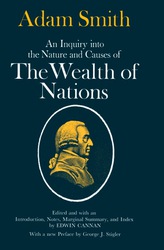
It was almost three years ago that I invited people to read Adam Smith with me. A couple weeks after I wrote that post, I started a new job (where I still work today), life caught up with me, and nothing came of that reading.
…until now.
I’ve been quite happily chugging away through Wealth of Nations. It is much, much more interesting than I ever would have guessed, because basically all anyone ever talks about in this book are a few quotes: the division of labor (starts on page 8), specifically the pin factory; self-interest (page 18); when businessmen meet, they always conspire to raise prices (page 144); and the invisible hand (page 477). The book is around 1000 pages long. Surely he has other stuff to say.
And indeed he does! I’d like here to single out just a few things:
- Macro dictates micro:
Masters of all sorts, therefore, frequently make better bargains with their servants in dear than in cheap years, and find them more humble and dependent in the former than in the latter. They naturally, therefore, commend the former as more favourable to industry.
I was really surprised to see that Smith appreciates the importance of macro conditions (how the economy as a whole works) on micro interactions (e.g., negotiations between boss and employee). That’s an idea that I more commonly associate with Paul Samuelson.
I also read this as an attack on the self-serving words of businessmen, and against the belief that what businessmen want is always what’s best for the society at large.
-
The importance of institutions. I don’t have a quote ready to hand for this, but he says somewhere that it’s obvious why business hasn’t returned to some country: the lack of a functioning government makes it impossible to conduct your affairs. I had thought that this idea was more associated with early-20th-century economists and their early-21st-century descendants.
-
While enumerating the different kinds of capital, we get this on page 297:
The Second of the three portions into which the general stock of the society divides itself, is the fixed capital; of which the characteristic is, that it affords a revenue or profit without circulating or changing masters. It consists chiefly of …
Fourthly, of the acquired and useful abilities of all the inhabitants or members of the society. The acquisition of such talents, by the maintenance of the acquirer during his education, study, or apprenticeship, always costs a real expence, which is a capital fixed and realized, as it were, in his person. Those talents, as thy make a part of his fortune, so do they likewise of that of the society to which he belongs. The improved dexterity of a workman may be considered in the same light as a machine or instrument of trade which facilitates and abridges labor, and which, though it costs a certain expence, repays that expence with a profit.
This is, in essence, what we today call “human capital”. I was shocked to read this idea in a 237-year-old book.
Now I’m eager to see whether other ideas which we consider more modern — like marginalism, say — got their start in Smith.
I’ve been obsessed for some years with the economist Sam Bowles, one of whose projects has been to return economics to its roots in larger philosophical questions. What’s important about economics is not downward-sloping demand curves, or whether people substitute chicken for beef when the latter becomes more expensive; what’s important is understanding how we build a functioning society out of members who have wildly differing conceptions of the good. More mechanical questions, like what the proper level of taxes ought to be if we want to encourage the development of renewable energy, are also important, but (as I understand Bowles) that’s not what animated our intellectual fathers.
In this light, I’m really quite charmed by how widely and deeply Smith casts his net. He’s not spending 1000 pages repeatedly informing us that the free market works best; he’s constructing a conceptual taxonomy of how economies work. It’s really a work of philosophy, studded at all points with empirical bits. If at points he’s repetitive (for instance, in the chapter distinguishing between real and nominal price levels), it’s because he’s clarifying these concepts for maybe the first time in history. (I’ll have to go read, say, the Physiocrats if I want to understand pre-Smith economics.)
It’s hard to write about this book without feeling like the worst kind of college freshman (of which I was one): “No, you guys don’t understand! The market, guys! The market!” I realize that nothing I say about Smith has gone unsaid before now. Please don’t read anything I say here as though it were novel; read it instead as one man’s revelation that Smith is just as good as everyone says he was. Reading him is going to inform my upcoming reading of, for instance, Amartya Sen.
P.S.: To understand Sen, I think I’m going to want to tackle the Theory of Moral Sentiments first. Approximately no one talks about this book, relative to the number who talk about Wealth of Nations, but I gather that Sen thinks it’s vital.

