Metrics for affordable cities — May 13, 2014

Metrics for affordable cities

This Atlantic Cities piece measures which metro areas are the easiest for middle-income folks to buy homes in. They define this by the fraction of homes that the median earner in the city could buy, assuming this earner stays within sensible limits for what he spends on a home. That is, the earner is expected to spend 31% or less of his income on a home. I never know whether the 31% number there refers to gross or net. Again, people often make the mistake of considering their homeownership decision outside the context of the rest of their finances. You want your whole financial picture, including retirement savings and so forth, to be healthy, not just your homeownership picture.

But setting that aside: by this measure, Boston is not very affordable. If you take even the looser standard of the fraction of homes that are affordable if the head of household (love that Victorian label) has a college degree, then Boston ranks 93rd out of 100.

Consistent with my impression, Pittsburgh is 45th, and Detroit is 17th. This gets at something: you really want to measure along two axes. Along the x-axis, measure affordability; on the y-axis, measure desirability. Detroit is affordable but not desirable. The Bay Area, let’s say, is desirable but not affordable. What one wants is the set of cities that are both affordable and desirable. Or maybe, within the set of desirable cities, one wants to maximize the amount of desirability from the marginal dollar. (You’d want to limit to desirable cities to avoid Detroit showing up on the list. If you’re willing to consider the possibility of living in Detroit, perhaps you can relax this in the thought experiment.)

I don’t know how one would measure desirability. Basically you’d measure it by how many people want to live there. But the only way you can measure that is by how many people *do* live there or *have* tried to move there. The price of housing is a decent measure of those things. But the price of housing measures the intersection of demand with supply, and supply is controlled by regulators. So I can’t think of how to measure desirability.

It’s odd, though, that Pittsburgh may well end up maximizing the combination of desirability and affordability.

What tequila “should” taste like — May 7, 2014

What tequila “should” taste like

This article is kind of annoying. It’s a bunch of people explaining what tequila is supposed to taste like. Apparently aging tequila too long is bad, because you end up tasting the notes of the aging and not tasting the tequila itself.

I mean, maybe. But we went through this with coffee. Back in the 90s and early 2000s, French roast was the thing, so people loved Starbucks. Then at some point the George Howell thing took over: now we’re only supposed to drink lightly roasted coffee, because “all those oils [that you see on the outside of a French-roast bean] ought to be inside the bean.” (For the record, I think Howell’s coffees are great as espresso, because the high-pressure / high-temperature extraction process gets more of the good stuff into the cup. I’ve not yet found a way to make them work well for French-press coffee.) Now maybe we’re in the full-city-roast era.

Whatever. Drink whatever you want to drink. Then there will be people who will tell you that you’re doing it wrong. Maybe you drink Cuervo, and maybe it’s shit. I don’t know; I’m not familiar with tequila. But maybe you’ll develop a real taste for tequila, and you’ll sip it neat, and eventually you’ll gravitate to other tequilas. Maybe some of those will be aged in oak for a long while; maybe others will be on the sweeter side, and will be less oaky.

Eventually you and I will both be dead, and it won’t matter at all whether we drank the “right” kind of tequila or coffee. Drink what you want to drink. Fuck those guys.

(I guess I’m feeling irritable today?)

Miscellaneous observation, 2014-05-04 — May 4, 2014
Why is it so expensive to get from Boston to Montreal? —

Why is it so expensive to get from Boston to Montreal?

I just looked into flights to Montreal, out of idle curiosity. The cheapest flights available on Matrix are $270, but that involves flying through Toronto — at which point I think a lot of people would decide just to hang out in Toronto. (It’s $201 round-trip, nonstop, Boston to Toronto.)

If you want a direct flight from Boston to Montreal, it’s $429 and takes just over an hour. Then add 45 minutes to get to Logan by T from Cambridge, an hour to go through security and such in the international terminal at Logan, some time to get through customs in Montreal, and half an hour to get from YUL to the center of the city. Call it four hours, door to door.

You could take a bus, but that’s 7 or 8 hours in the best case, and costs $188. Then 30 minutes to South Station on this side, maybe some hassle at the border, and another half hour on that end. 9.5-10 hours door to door. Your time is worth some money.

You could rent a car and drive there in 5 hours, apparently, plus some time at the border; call it 6 hours in total. I would have expected it to be longer. As for how much this option costs: a moment’s searching on the Budget rent-a-car site yields a car that costs $122.76. That’s for something akin to a Hyundai Accent; it claims to get 38 miles per gallon on the highway, and it’s 300 miles or so to Montreal, and gas is (let’s say) $3.60 a gallon, so that’s another $56 or so. So, like the bus, we’re up to about $180 round-trip.

(Incidentally, the IRS lets you deduct 56 cents per mile for business mileage. Assuming the mileage rate is a decent approximation to the actual cost of driving a mile, driving your own car there and back would cost somewhere north of $300.)

Finally, as far as I can tell, there’s no train going from Boston to Montreal. (And while we’re at it griping about travel difficulties: if you want to take a train or a plane from Boston to Burlington, VT, you’re going to go through New York City first. That makes very little sense to me.)

Shouldn’t it be just as cheap and quick to get to Montreal from Boston as it is to get to Toronto from Boston? Puzzling.

Apropos of nothing — April 24, 2014
You should go read Robert Solow’s review of Piketty’s Capital in the Twenty-First Century —
I have funny friends — April 23, 2014

I have funny friends

Quote #1 from today, after an iMessage conversation and involving a ton of context that I wouldn’t print here if you paid me:

> Only through that kind of multi-generational emotional torsion can you twist someone around far enough to have them believe they really want to wear inside-out bear costume feet someone named “Uggs”.

Quote #2, in re “Coakley lawsuit wants colleges ex-chief to repay millions”. I write,

> ‘Northeastern University investigative reporting students’!
>
> I’ll grant you that I only skimmed the article, but I don’t entirely get the grounds on which the state is suing him.
>
> Also, I don’t entirely understand how you can just get your organization to pay for a bunch of stuff without their knowing about it.

whereupon (here’s where the funny comes in) my friend replies:

> Right. Like: he founded a college, then spent millions on vacation homes and Mercedes, and then Northeastern students noticed when they made an Excel spreadsheet of public data and sorted by the “salary” column. Why didn’t I think of that?!?

Of all the stupid modern tribes to belong to, the tribe of the corporation is probably the silliest —

Of all the stupid modern tribes to belong to, the tribe of the corporation is probably the silliest

On the occasion of Apple’s releasing their revenue numbers, it’s fair to point out that lashing yourself to a particular company is really stupid. Daring Fireball, for instance, exists to defend Apple and lash its detractors. Which is fine as far as it goes: I read DF every day, and I like his style very much. John Gruber is very much a part of the corporate-tribalism nonsense, and he makes a good living from it: people invite him to give talks to defend and explain Apple, and there are rumors (unclear how accurate) that he makes half a million dollars a year from it. And good for him.

Of course there’s a tribe on the other side, namely the tribe of Android. Inasmuch as I use Apple products, I guess I’m not a member of the Android tribe. I like Apple products.

But here’s the thing: this has nothing to do with me as a person. Yet the weird stupid modern tribalism requires that your choice of technology have something to do with you as a person. If you use Android, you probably have a neck beard, for instance. If you use Apple, you’re probably effete and eat kale. Or whatever. (Turns out I eat a lot of kale, you guys.)

Starting from this base of letting the technology determine your personality, the next step is to care very much about the companies that make them. I am supposed to be personally invested in the success or failure of Apple Inc. Turns out I’m not, though. I like their products. I will keep buying their products because I like them. If they go out of business, I will be sad, because then I will have to use products that I wouldn’t otherwise have chosen. Only, it seems really hard to imagine Apple’s going out of business, so … I guess I have no reason to be sad. Problem solved!

Apple doesn’t need your support. Neither does Google. Apple and Google will do just fine even without bands of true believers furtively tossing grenades at the other side. Use their products if you like them; don’t use them if you don’t like them; lobby the company to change things (in its dealings with Chinese manufacturers, for instance) if that’s what you want. But defining yourself as an “Apple person” or an “Android person” is just pathetically demeaning to your stature as a human being.

Every word the Wall Street Journal op-ed page says about Capital in the Twenty-First Century is false, including “and” and “the” — April 21, 2014

Every word the Wall Street Journal op-ed page says about Capital in the Twenty-First Century is false, including “and” and “the”

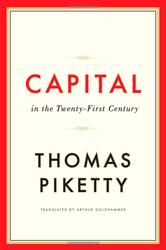
Red border, 'CAPITAL' in red, everything else in black. Nicely modern font (Futura, maybe?)
I was just minding my own, Googling for an image of the cover of Capital in the Twenty-First Century for inclusion in an eventual review, when I happened upon the [newspaper: Wall Street Journal] getting it horribly, horribly wrong, and I was awoken from my dogmatic slumbers. I guess I’ll be writing that review now, then.

I really cannot emphasize this enough: there is nothing in that [newspaper: Journal] piece that gets Piketty even half right. That the piece contains the phrase “this book is less a work of economic analysis than a bizarre ideological screed” is proof on its own that the author wasn’t even reading the same book that the rest of the literate Anglophone world was.

The best thing you can do to combat the [newspaper: Journal] piece is to go read Piketty himself. Really, you need to do that. If people aren’t still citing Piketty himself in 30 years, they will be citing works that would not have existed without him; it’s really that good.

If you don’t read Piketty, what you need to know is the single mathematical statement that dominates the whole book: the rate of return on invested capital historically exceeds the rate of growth of the economy. If that continues over a long enough time scale, the weight of the past (in the form of inherited fortune) comes to dominate the present (in the form of new growth, entrepreneurship, etc.). Over long time scales, the rate of return on capital has exceeded the economy’s rate of growth; the only times when capital’s share of national wealth has dropped have been times of global-scale war. War made necessary the systems of income taxation that we have today; war destroyed capital, in the form of land and factories. In normal eras, inheritance comes to be viewed as the only way to “make it”: entering “the professions” (law, medicine) and working hard is not going to get you into the 1%. In short: under ordinary circumstances, everyone knows that the only way to become part of the aristocracy is to marry an heiress. That’s why the works of Austen and Balzac play such a central role in Piketty’s book: they illustrate what everyone knew in their guts in the 18th and 19th centuries, even when they didn’t necessarily have economic data to back it up.

And we’re heading back to that world: the basic depressing thrust of Capital in the Twenty-First Century is that we’ll almost inevitably end up in the land of “marry an heiress” whenever the rate of return on capital exceeds the economy’s rate of growth, which it almost always does.

You can choose to respond to this, or not. Piketty has his doubts that a society in which the wealthiest 1% own 90-plus percent of the assets is politically stable. As an economist with some humility, and with a great many critical things to say about his discipline, he is at pains — again and again and again — to observe that the problems of whether and how to respond to growing inequality are not merely technocratic problems of optimal tax policy to be solved by convex maximization; they must be solved by democratic polities in command of all the facts. And every generation encounters different variations of the governance problem, which require constant democratic engagement to handle them. One problem our generation faces is the increasing mobility of capital, which makes taxation by a single nation-state feel increasingly toothless. Even measuring the problem we’re trying to solve, Piketty observes, is getting harder: the wealthy seem to be hiding an astonishingly large quantity of money in offshore tax havens.

To sum up, then: inequality may be a problem; if it’s a problem, it cannot be solved by infinitely wise economists, but must instead be solved at the ballot box; if it’s going to be solved at the ballot box, the electorate must know the extent of the problem it’s solving; and increasingly, multinational capital flows make it hard for the electorate to know the extent of the problem it’s solving.

One of Piketty’s solutions is a modest tax on assets, in large part just to get some record of how large inequalities are. This would require some international coordination, of course; money hiding in Swiss banks needs to be exposed to the sunlight. As Piketty archly notes, it’s no more utopian to expect this to happen than it is to expect European nations to come together and agree on a common currency in the absence of a common government, yet somehow they’ve managed to do that.

As you might expect, it’s the modest asset tax that gets the [newspaper: Journal] author’s panties in a bunch. Wealthy people don’t want to pay more money, and the cossacks have always worked for the czar; so it shouldn’t surprise anyone that the [newspaper: Journal] would be upset. And it may well be a safe bet that most people aren’t going to read a 600-page work on the economics of inequality, so maybe the [newspaper: Journal] will win by default. You, my intelligent reader, won’t allow that to happen, will you? The [newspaper: Journal] has been blinded by tears of rage, to the point of actual illiteracy. On the one side I might quote Upton Sinclair: “It is difficult to get a man to understand something when his salary depends upon his not understanding it.” On the other, more hopeful side, I’ll quote Jefferson: “let them stand undisturbed as monuments of the safety with which error of opinion may be tolerated where reason is left free to combat it.” Let’s approach the [newspaper: Wall Street Journal] as Jefferson would have, if for no other reason than that I think that’s what Piketty would want us to do.

The final thing to say about Piketty’s masterpiece is that its very durability derives from the fact that it is exactly the opposite of the “screed” that the [newspaper: Wall Street Journal] has manufactured out of whole cloth. Whenever possible, Piketty maps out all branches on the road ahead, and makes clear that the choice of path is not up to him; it’s up to democracies. He’s fair to a shocking and refreshing degree. As soon as the ideologues at the [newspaper: Journal] are done hyperventilating, perhaps they’ll be able to see that Capital in the Twenty-First Century is an astoundingly fair book, with ammunition aplenty for all sides in the debate. Indeed, much of what Piketty is saying is that democracies require knowledge for their effective functioning — not because that knowledge arms one side or the other, but because everyone on all sides needs it. Our perspective on inequality is a moral judgment that should be based on the soundest of reasons, and those reasons should be based on facts. Piketty doesn’t supply the judgment, but he does supply the facts.

P.S.: There’s really so much more to say about the book. For one thing, Piketty makes the point that you really need to distinguish between labor income and capital income in any analysis of inequality, so that naïve measures like the Gini coefficient hide more than they illuminate. And when you pick apart the numbers in this way, you find that the U.S. distribution of labor income — labor, not capital — is more unequal than at probably any other time or any other place in recorded history, because the wealthiest people are largely a new class of “supermanagers” rather than the basketball players or world-famous musicians that we might imagine. You really need to be in the top 0.1% or 0.01% before you find people largely living more off of capital assets than they are off of their labor.

Rather than explore all of the reasons why you should read this book, and all of the things that you’d learn, I’d just strongly recommend that you read it yourself. It’s seriously worth your time — again, because Piketty’s role is to inform democratic debate.

P.P.S.: Having now made up my own mind about Piketty, I can go and read the reviews I’ve been waiting to read, like Krugman’s.

P.P.P.S.: The title of the post, by the way, is a hat tip to Mary McCarthy.

The third Monday in April —