Dashiell Hammett, The Thin Man — October 13, 2010

Dashiell Hammett, The Thin Man

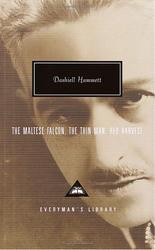
Standard Everyman's Library cover: a photo of the author with an effect over top as though you were viewing him through many very thin blinds on a window.

This is a bit more fun and quite a bit less dark than The Maltese Falcon. Though both here and there, someone is dead within the first couple pages, basically within mere moments of contacting the narrator or main character.

Here the narrator is a lovably lazy, bibulous man named Nick Charles. He used to be a private investigator, but he’s long since retired to attend to the investments left to him when his wife’s father died. Charles jokes on a few occasions about marrying her for the money, and you’re never quite sure if it’s a joke or a “joke.”

He comes semi-unwillingly out of retirement to investigate Just One More Case, when his old lawyer friend and war buddy calls him up to say that an old eccentric client has gotten back in touch; soon after, a confidant of that client is dead, and we’re immediately to wonder: did the crazy guy do it? (Answer: maybe!)

The Thin Man’s main allure is the nutty family from which the crazy man comes; they’re brilliantly drawn characters. Years ago he’d divorced his capricious, violent, unpredictable wife Mimi, who lights up this book’s pages (even if it’s a blacklight) and leaves you just a little terrified every time you meet her. She’s such a caricature that she belongs on stage where she can be rendered operatically. (I imagine this was deliberate. The Thin Man got turned into a series of six movies and a television show.) Mimi’s son reminds me of Elijah Wood’s character from [film: Sin City], only without the violence but with the capacity, lurking just below the surface, for utter terror.

Every Hammett novel in this collection must feature a gorgeous 20-something blonde. The one here is Mimi’s daughter, who has apparently grown from a gorgeous child to a delicious adult. At one point she passes out drunk, and Nick and his wife undress her for bed — seemingly for no purpose other than so that Hammett and the audience can gaze lovingly upon her “beautiful little body.” Whenever she shows up, someone is drooling over her; clearly we’re meant to as well.

Again, since we know that we’re going to be led bewilderingly through twist after twist and turn after turn, the plot is incidental. Phone calls, letters, and chance meetings seemingly deflect Nick from finding the killer, but we know that in the back of his capacious mind he’s keeping it all together and ploddingly unmasking the bad guy. Meanwhile he does some copious drinking. It’s great fun.

Quick note on Boston-area ramen — October 12, 2010

Quick note on Boston-area ramen

I’ve had ramen now at two Boston-area establishments: Sapporo, within the Porter Exchange; and now Ken’s, within the Super 88 Market in Allston. I’d heard from multiple sources that Ken’s was the best around here, but I was sorely disappointed. One item on the menu advertised a rather more intense pork flavor, and the waiter recommended that, so I got it. It was not intense. The broth was thin and uninspiring. The only real plus side to their ramen was the combination of boiled egg and nori. Plus the noodles were maybe a bit more substantial than Sapporo’s.

Sapporo … I’m kind of obsessed. They advertise their broth as being filled with “rich collagen” after cooking for “over ten hours.” It really is an intense, flavorful, buttery, full-bodied broth. That’s broth you want to bring home to mother. But you wouldn’t, is the thing, because it is soup rather than a person.

Next time I’m at Sapporo, I’ll ask them if they can throw in a couple sheets of nori to their house ramen. With that added, it won’t even be a contest.

__P.S.__: I need to check out Men Tei, it seems. I’m always glad to explore the area’s ramen.

__P.P.S. (14 October 2010)__: Verdict on Men Tei: Nice noodles, and a lot of noodles, but uninspiring broth. Also not much *in* the broth. I got the pork cutlet, which definitely felt as though it came from a package of frozen cutlets. This is of a piece with the octopus balls, which people on ChowHound suggests really do come from a frozen package. Men Tei seems to have very little kitchen at all, so this isn’t surprising. But in any case: nothing to write home about. I think my Sapporo homecoming will come soon.

Jill Lepore, The Whites of Their Eyes: The Tea Party’s Revolution and the Battle over American History —

Jill Lepore, The Whites of Their Eyes: The Tea Party’s Revolution and the Battle over American History

(Attention conservation notice: just about 1100 words, plus some block quotes, on the systematic perversion of American history to serve ideological ends, and Jill Lepore’s remarkable stand for viewing our history through clear eyes.)
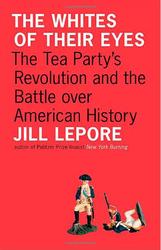
Tomato-red background. Title in bold white sans-serif, subtitle in black non-bold, author name in white bold. 'Author of Pulitzer Prize finalist _New York Burning_' in smaller print below. Two colonial figurines at the bottom of the cover. One is standing, looking sort of pensive and formal. The other is laying on his back, pointing his musket up towards the top of the book.

Let’s take it as an axiom, to begin, that the Constitution is not perfect. I’ll hand the mic here to Justice Thurgood Marshall, to whom Lepore handed it as well:

The focus of this celebration invites a complacent belief that the vision of those who debated and compromised in Philadelphia yielded the “more perfect Union” it is said we now enjoy.

I cannot accept this invitation, for I do not believe that the meaning of the Constitution was forever “fixed” at the Philadelphia Convention. Nor do I find the wisdom, foresight, and sense of justice exhibited by the Framers particularly profound. To the contrary, the government they devised was defective from the start, requiring several amendments, a civil war, and momentous social transformation to attain the system of constitutional government, and its respect for the individual freedoms and human rights, we hold as fundamental today. When contemporary Americans cite “The Constitution,” they invoke a concept that is vastly different from what the Framers barely began to construct two centuries ago.

The Civil War is refutation enough of the eternal wisdom of the Framers. The fact that the Constitution explicitly counts a slave as three-fifths of a human should have long since put to bed any rumors of its perfection. African-Americans are in a better position than most to recognize the Constitution’s defects.

Yet we accept the mythology that we’re dealt. In this country, the Constitution’s perfection, and the immortality of the Framers, is as close as we get to gospel (quite literally — see below). Everyone wants the Constitution for himself. Whenever someone wants to make a change to the existing order, the most resonant thing he can say about it is that it brings the U.S. closer to the perfection that lies latent within the Constitution and the Declaration of Independence. The [court: Brown v. Board] decision sought integration to bring us closer to the ideals of the Constitution, while at the same time parents in Boston who opposed forced busing declared Arthur Garrity’s decision the end of American liberty.

The history of the U.S. can in many ways be viewed as the history of misrepresenting our history. Everyone wants to make the story of the founding his own, so everyone has to find a way to mold the founding into his preferred shape.

Take, for instance, the famed “Christian nation” story. According to this story, the country was Christian at its founding, the Framers knew that religion is inseparable from good government, they knew that the purpose of government is to bring people closer to God, and the separation of church and state is a myth. In this Christian nation, Connecticut’s 1639 Fundamental Orders decreed that one of its purposes was “to mayntayne and presearve the liberty and purity of the gospell of our Lord Jesus.” Which is why it’s important to observe, as Lepore does, that

Following the faith of their fathers is exactly what the framers did not do. At a time when all but two states required religious tests for office, the Constitution prohibited them. At a time when all but three states still had an official religion, the Bill of Rights forbade the federal government from establishing one.

Meanwhile, when conservatives insist that we read the Federalist Papers, they seem less insistent that we read the parts where the Framers were inveighing against the evils of standing armies — hence the part of the Constitution which embodies that revulsion by giving Congress the power

To raise and support Armies, but no Appropriation of Money to that Use shall be for a longer Term than two Years

That two-year limitation is in there expressly because the Framers thought — like many classical small-r republican thinkers over the centuries — that standing armies were a great evil.

Lepore’s ingenious little book is meant to revisit points like these: to remind us that the Framers by no means spoke with one mind and that when they did speak with one mind they often contradicted their modern interpretation; and to ensure us that if they returned to us today they would probably not be horrified by what we’ve made of their document. It was broken at birth. The U.S. has spent centuries trying to repair it.

Lepore interviews dozens of Tea Partiers on a cold day when they visited Boston (Lepore’s town — she’s a professor at Harvard) in early 2010. Every time a Tea Partier says something about what the Framers would have wanted, or how liberals are destroying America, she steps back as a good historian would and studies the truth of their claim. Liberals believe that America is always wrong, say Tea Partiers? You need to go back a ways if you want to find the first person to believe that about the U.S. Try Frederick Douglass:

What, to the American slave, is your 4th of July? I answer; a day that reveals to him, more than all other days in the year, the gross injustice and cruelty to which he is the constant victim. To him, your celebration is a sham; your boasted liberty, an unholy license; your national greatness, swelling vanity; your sounds of rejoicing are empty and heartless; your denunciation of tyrants, brass fronted impudence; your shouts of liberty and equality, hollow mockery; your prayers and hymns, your sermons and thanksgivings, with all your religious parade and solemnity, are, to Him, mere bombast, fraud, deception, impiety, and hypocrisy-a thin veil to cover up crimes which would disgrace a nation of savages. There is not a nation on the earth guilty of practices more shocking and bloody than are the people of the United States, at this very hour.

If they’re even guilty themselves of hating America, liberals didn’t invent that hatred. Hating what the country stands for is as American as slavery.

So what the Tea Party advances is a strange kind of fundamentalism, in the literal sense of that word. Fundamentalism (the OED traces the word to 1923, when it was used to refer to American Christians) believes in returning to some original text which it believes to be flawless and true. Constitutional fundamentalists believe that they can find a single, true meaning in the original document, even though we know that the origins of that document were far from holy. The origin was a compromise between northern and southern states meant, for one, to keep the country from flying apart. (It did anyway, 70 years later). Yet this fundamentalism, for whatever reason, chooses to ignore the supporting texts and the all-too-well-documented history surrounding it.

Academic historians, for their part, have not helped. As Lepore notes, historians have long resisted the urge to “presentism” — the idea that you can naïvely map the past onto the present and draw some sort of easy moral. (One thinks of “The past is a foreign country; they do things differently there.”) The academy has become more cloistered, and as a result has stopped engaging with the public on the great themes. Instead, when historians interact with the world nowadays, they tend to narrow the lens as far as they can and write little biographies. The last historian to engage with the great themes, says Lepore, was my hero Richard Hofstadter, of the magisterial Anti-Intellectualism in American Life; it’s truly a stellar example of the great-theme brand of history. “The historians will have a field day [with his The American Political Tradition And the Men Who Made It]”, he said, “but I am in hopes that some of the non-academic people will like it.”

Having largely left the field, historians have allowed all manner of charlatans to move in and define what our history is. The Texas School Board could leap in and define Thomas Jefferson — “who once wrote about a ‘wall of separation between Church & State’” — out of our history, and instead add Thomas Aquinas to the list of thinkers who inspired the Revolution. (Poor Thomas Jefferson. The man has been endlessly defined into and out of American history so many times since his death; see The Jefferson Image in the American Mind for the final word on this score.)

Lepore, with The Whites of Their Eyes, has forcefully retaken the field. She’s a historian engaging directly with an anti-historical ideology. In a remarkably concise and deceptively simple way, it returns to the tradition of grand history. She clearly rushed it into print to engage with a current controversy, but didn’t skimp at all on historical rigor. It’s a treasure, and something you’ll want to hold in your back pocket for the next few troubled years.
Greg Mankiw overloads two words until they collapse —

Greg Mankiw overloads two words until they collapse

There’s been a bit of a debate about Greg Mankiw’s recent [newspaper: New York Times] column, with Kevin Drum giving it a rather nice smackdown. Mankiw comes back today with some responses. I didn’t get past the first one:

If no one is proposing eliminating taxes, why compare the Obama policy to a world without taxes?  Economists understand that, absent externalities, the undistorted situation reflects an optimal allocation of resources. […]

My first thought was that that’s a very narrow description of “optimal allocation of resources.” If you don’t pay taxes, the government doesn’t build roads, doesn’t fund a Defense Department to keep the borders safe, doesn’t keep your food safe via the FDA, doesn’t regulate airlines via the FAA, etc. How exactly will the corn (the “resource” in this example) arrive at your grocery store (that is, be “allocated”) without a system of roads to get it there? And how will those roads be built without taxes? This is the economists’ magical definition of “optimal allocation of resources”.

That’s when I realized: all the things I mentioned are hidden within Mankiw’s “absent externalities”. Those are two bizarrely overloaded words in this context.
As Justin Fox makes clear in his terrific Myth of the Rational Market, there’s been a long divide in economics between the institutionalists and the rest. (I think the rest have a name, but I’ve forgotten it.) The institutionalists emphasize that when Mankiw talks about “optimal allocation of resources,” he’s brushing aside most of what makes the world interesting.

Take contracts, for instance, which are the most basic weapon within the economist’s arsenal. Economists assume that transactions can be “completely contracted,” meaning that every detail of the transaction can be spelled out and its violation quickly detected. But a contract, so described, is an abstraction hiding a lot underneath it. What happens if I violate a contract that you and I signed? You take it to a court, presumably. The court rules against me and orders me to pay up. What happens if I don’t? The full weight of the state comes down on me to make me pay you. So even talking about “complete contracting” — which is an essential element leading to Mankiw’s “optimal allocation of resources” — requires you to talk about some sort of enforcement mechanism. That enforcement mechanism could be a government, or it could be a mafia that’s willing to break my legs, but in any case there’s an institutional structure underneath the contract. Getting the institutions to ensure complete contracts costs money: either the government has to be willing to bring cops with guns to my house to make me pay up, or the mafia has to employ dudes with baseball bats, but someone somewhere needs to be standing ready to enforce that contract.

Now then. I hope we agree that we need to give up something — be it taxes or Vinny’s valuable free time — in order to allow contracts to be signed and enforced. I hope we agree that signing contracts is vital to the optimal allocation of resources. Therefore, I hope we agree that we need to give up something to attain the optimal allocation of resources. So how does it even begin to make sense for Mankiw to say that a tax-free world is relevant in any discussion at all? I contend that it’s only relevant if you ignore institutions — which is exactly what Mankiw is doing.

(Note also that the most basic contract of them all — the labor contract — cannot be completely contracted, as has been known since 1951.)

Little iPhone UI details —

Little iPhone UI details

(__Attention conservation notice__: 800 words documenting the near-perfection of the iPhone user interface. Plus a small suggestion for how they could improve it still more.)

Things the iPhone does that I’ve not seen anyone else do:

* There’s a ‘.com’ button when you’re typing in a field that accepts domain names (like an email-address field, for instance). I only realized recently that you can press and hold the .com button to get .net, .edu, .org, and .us.

* It gets cooler. Add an international keyboard (Settings -> General -> Keyboard -> International Keyboards -> Add New Keyboard…), then go back to an URL field (like in Safari, say). Suppose you added an Arabic keyboard. Now look at what the .com button has: top-level domains for Arabic countries, like .ae. Similar things happen if you add French keyboards, etc.

* Spell-check will not flag words if those words are in your address book. It does better than just not flagging them, actually: if you type a friend’s name in lowercase, it’ll correct the case for you.

* Probably most every iPhone/Touch user has noticed by now that you can go into the Maps application and start typing the name of someone in your contacts for whom you have a physical address; the Maps app will offer you any matching physical addresses.

You’d expect — or at least, *I’d* expect — Google to get this right, too. After all, when you’re signed into your Google account, Google knows about your contacts; it should be easy enough to carry that contact information over into Google Maps. But they don’t.

* This next one is easier to describe by example. I have a friend, Chris Rugen, whom I’ve jokingly put into my iPhone contacts as “Chris Rügen”; my iPhone contacts sync with Google. In the iPhone, if I start typing “rug”, it offers up “Rügen” as a completion — even though the “u” that I typed has no umlaut over it.

I’ve found no other system that does the completion this intelligently. Thunderbird doesn’t. Google itself doesn’t, either: searching within my Gmail contacts for “rugen” doesn’t return the accented contact. In either Thunderbird or Google, I need to start typing Chris’s actual email address — which contains no accent, of course — in order for them to find Chris.

These are all just little things, but that’s *exactly* what makes the iPhone what it is: nearly all the little things are done perfectly. You get a sense of calm when you play with an iPhone (and “play,” by the way, is exactly the right verb), because nothing is out of line with what it should be. Computers have a habit of steadily accumulating frustrations; the iPhone does not.

One thing the iPhone does need to do differently is related to the Archive button in the email client, which only arrived in one of the new iOS releases (I want to say 4.0). If you have a Gmail account, the Archive button will do the same thing on the phone that the Archive button does on Gmail’s website. That’s great. But there’s no Archive operation available for non-Gmail accounts. Worse, the Archive button gets replaced with a delete button for non-Gmail accounts. So if you’re used to archiving messages by tapping the leftmost button, muscle memory alone will often make you delete messages accidentally. This gets especially to be a problem now that iOS 4 does a single combined universal inbox: you don’t know which account a given message is coming from (could be Gmail, could be not), so the very same inbox view can sometimes make that button do archival, sometimes do deletion. It’s a dangerous combination. (Though not too dangerous: you can always retrieve the deleted message from the Trash, if you notice soon enough that you deleted rather than archived.)

What’s odd is that fixing this to work with all account types wouldn’t be that hard, unless I’m missing something. Right now you can configure which folders on your remote server will be used for drafts, sent mail, and deleted messages: go to Settings -> Mail, Contacts, Calendars -> [account name] -> Account Info -> Advanced and look under Mailbox Behaviors. If the folders you’ve specified don’t exist, I believe the iPhone mail client will create them. It would be easy enough to add an ‘Archives Mailbox’ item under there.

I can see a reason why they might not do this. Gmail’s archives folder is called ‘All Mail’ on the server side, so a sensible default name for the archives folder would be ‘All Mail’. But on a non-Gmail account — IMAP, say, or Exchange — maybe that name would be confusing. Maybe on those sorts of accounts, it would be smarter to call the folder ‘Archives’. But then you’ve got an inconsistency between the name of the archives folder on different types of server; that may confuse users.

What Adam Smith really said: chapter-by-chapter study invitation — October 11, 2010

What Adam Smith really said: chapter-by-chapter study invitation

If I understand my intellectual history correctly, Adam Smith is much-misunderstood. We typically quote two passages from The Wealth of Nations:

It is not from the benevolence of the butcher, the brewer, or the baker that we expect our dinner, but from their regard to their own interest. We address ourselves, not to their humanity, but to their self-love, and never talk to them of our own necessities, but of their advantages. Nobody but a beggar chooses to depend chiefly upon the benevolence of his fellow-citizens.

and

By preferring the support of domestic to that of foreign industry, he intends only his own security; and by directing that industry in such a manner as its produce may be of the greatest value, he intends only his own gain; and he is in this, as in many other cases, led by an invisible hand to promote an end which was no part of his intention.

And that’s about it. But it’s a large book, no? Just about 600 pages, as a matter of fact. And he has a second book, The Theory of Moral Sentiments, that’s almost as long. That’s 1200 pages, from which we usually extract about two paragraphs. How about this other paragraph, in which Smith makes the case for what we’d today call progressive taxation?

The necessaries of life occasion the great expense of the poor. They find it difficult to get food, and the greater part of their little revenue is spent in getting it. The luxuries and vanities of life occasion the principal expense of the rich; and a magnificent house embellishes and sets off to the best advantage all the other luxuries and vanities which they possess. A tax upon house-rents, therefore, would in general fall heaviest upon the rich; and in this sort of inequality there would not, perhaps, be any thing very unreasonable. It is not very unreasonable that the rich should contribute to the public expense, not only in proportion to their revenue, but something more than in that proportion.

That’s three paragraphs, anyway. Let’s do all 1200 pages, shall we? Starting about a month from today — Monday, November 15th — I’m going to start reading The Wealth of Nations and The Theory of Moral Sentiments and offer a chapter-by-chapter excursus on this here blog. Let’s have a big old book group about What Adam Smith Really Said. I predict that we’ll be surprised. I expect that he’s not nearly the libertarian, every-man-for-himself, minimal-government-is-the-best government guy that we’ve come to know.

But I don’t know! I’ve not read Smith (apart from three paragraphs). It’ll be a surprise. Let’s do it.

The editions I’m thinking of are linked above, but again:

Get them out of the library, buy them from your favorite bookseller, etc. Starting in a month, let’s talk Adam Smith.

P.S.: My homedogg Paul noted that the initial Wealth of Nations link I provided was an abridged Great Minds edition. I’ve corrected that to the Modern Library edition.

Dashiell Hammett, The Maltese Falcon — October 9, 2010

Dashiell Hammett, The Maltese Falcon

Standard Everyman's Library cover: a photo of the author with an effect over top as though you were viewing him through many very thin blinds on a window.

Somehow I’ve been entirely innocent of detective novels, though I’ve really enjoyed what I’ve seen of the genre on film; I loved [film: The Big Heat] and [film: The Big Sleep], for instance. But somehow I’ve never seen [film: The Maltese Falcon] on film, even though I love Humphrey Bogart and have long been told that the movie is a must-see. So when my friend Dan Milstein emailed me to say that the book has some of the best dialogue he’s ever read ever, I had to pick it up.

It doesn’t disappoint. Actually, maybe there’s one disappointment, namely that I have no choice but to envision Bogart in the role of Sam Spade. Spade, if you’re not aware, is the prototypical (I wonder if he actually is the prototype) private detective. He’s practically a rock moving through the world: he’s entirely self-sufficient, impermeable to outside influences of any kind, and keeps his own council. The reader is just as uncertain as any of the characters about what drives him. Consequently, from moment to moment you have no idea what he’s going to do. But you can be sure that he’s never going to lose his cool. He’ll never strike anyone in anger, because it’s not clear that he ever gets angry. He’s cool as a cucumber, always plotting his next move. He’s always one step ahead of the bad guys. You know that everything will be wrapped up at the end with a nice bow, and that Spade’s hands will remain perfectly clean.

I used to frown on this sort of genre, because it’s very formulaic. Nowadays I’m inclined to believe that most popular entertainment (some of which deserves to be called “art,” some of which doesn’t) is formulaic, and that most innovation comes within formulae. You know a lot of things already about detective novels and movies. There’s going to be a drop-dead gorgeous dame who’s going to double-cross the hero, possibly before triple-crossing the bad guys and redeeming herself. All the women will be straight out of Hitchcock: bombshell seductresses who are strong-willed right up to the moment that they swoon into the protagonist’s arms. There are going to be many reversals of fortune. There’s going to be a MacGuffin that everyone’s going to be obsessed with chasing. You can’t be sure that the police are good guys. Finally, the character of the private dick himself will be sweet and sensitive beneath a surly exterior. So the plot is already very constrained; it takes a brilliant writer to keep the story gripping even within those constraints.

The Maltese Falcon is brilliant indeed — gripping and intensely readable the whole way through. The plot is basically incidental, but let’s summarize it anyway. Right from the start, the beautiful dame, a Miss Wonderly, is waiting for him in his office. She tells Spade that her 17-year-old sister has run off with a man named Floyd Thursby, and that Wonderly has a date with him that very night to convince him to bring her sister back. She asks Spade and his partner to follow Thursby, perchance to find her sister and bring her back before Wonderly’s parents find out what’s happened.

Spade’s partner is dead within the first eight pages, Thursby’s dead within 19, Wonderly’s name isn’t actually Wonderly, we never hear again about the sister, and everything is actually baroquely related to a priceless antiquity that gives the book its name. I think I’ll stop there; the great joy in this novel is finding out how everything unwinds and how Spade navigates it all without getting the slightest bit of muck on his suit.

It’s a sheer joy, and Hammett is a superb prose stylist. His writing is as deliberate and forceful as Spade: we picture Hammett walking into a room, quickly sketching out the people and objects within it, and chopping the dialogue out of blocks of marble with a few clean hits on the chisel. All the lines are clean and neat, and we picture every scene perfectly with seemingly no effort on Hammett’s part.

I foresee myself developing a Hammett-and-Chandler obsession.

P.S.: As you might be able to tell from the cover photo at right, The Maltese Falcon comes from a collection of three novels in a single Everyman edition. I’ll review them individually here.

“The object of power is power” — October 8, 2010

“The object of power is power”

Reading documentation of a case where the Obama Administration continues to subject a man to indefinite detention on the basis of highly unreliable evidence, one has to think of 1984:

The Party seeks power entirely for its own sake. We are not interested in the good of others; we are interested solely in power. Not wealth or luxury or long life or happiness: only power, pure power. What pure power means you will understand presently. We are different from all the oligarchies of the past, in that we know what we are doing. All the others, even those who resembled ourselves, were cowards and hypocrites. The German Nazis and the Russian Communists came very close to us in their methods, but they never had the courage to recognize their own motives. They pretended, perhaps they even believed, that they had seized power unwillingly and for a limited time, and that just round the corner there lay a paradise where human beings would be free and equal. We are not like that. We know that no one ever seizes power with the intention of relinquishing it. Power is not a means, it is an end. One does not establish a dictatorship in order to safeguard a revolution; one makes the revolution in order to establish the dictatorship. The object of persecution is persecution. The object of torture is torture. The object of power is power.

James Hamilton-Paterson, Cooking with Fernet Branca — October 7, 2010

James Hamilton-Paterson, Cooking with Fernet Branca

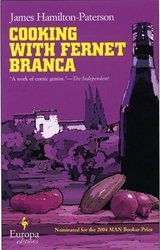
Plum-purple background. Book title in yellow, blockish, mildly comical font. Author's name in white. In the foreground is a bottle of the beverage named in the title, next to some tomatoes onions; they look to be sitting on a rough-hewn wooden table. In the distance is a villa on a hill with a few big pointy trees nearby. All of this is painted, by the way, in a rough -- maybe Photoshopped-to-look-rough -- way.

Roger Ebert is fond of saying that a movie is not about what it is about; it’s about how it’s about what it’s about. Likewise, what’s great about Cooking with Fernet Branca is not that it’s about meals made of dog and cat, but how it’s about meals made of dog and cat.

This is one of the most satisfying books I’ve read in a very long time, start to finish. Not only is it one of the funniest things that I wager you’ll read this year; it’s also enjoyably written from the perspective of unreliable narrators. In fact a lot of what’s funny and inventive about it is the wildly different takes that both narrators have on the same events.

Marta and Gerry occupy neighboring villas on the top of some remote Italian mountain, each looking for solitude for his or her own reasons. Gerry is a writer, pounding out ghostwritten biographies of vapid celebrities (race-car drivers, downhill skiers); Marta composes scores for artistically important films. From Gerry’s perspective, Marta is some frumpy Eastern European peasant with a vague command of English. From her perspective, Gerry is an insular, probably homosexual Brit with a strange, characteristically British absence where his bottom should be. Unexplained helicopters visit Marta in the dead of night. Gerry interviews one of his emptyheaded celebrities on the night of one of these helicopter arrivals, and his credulous-hippie mind swears that Marta has been visited by an alien. The confusions pile up between Marta and Gerry.

Most of what’s hilarious about Cooking with Fernet Branca, though, has nothing to do with a comedy of errors. Indeed, I think most of the plot is incidental; it serves as ornamentation draping off the outlandish stylistic frame and one of the absurd central premises of the book — namely, that you can cook anything with Fernet Branca.

Fernet, for those of you who are unware, is an Italian after-dinner bitters which the inestimable mrz tells me is used in Italian households to soothe an upset stomach; it quite often pulls off this trick by doubling as an emetic. (Personally, I love the stuff, and I find that it does wonders for the digestion.) Fernet shows up on most every page of Hamilton-Paterson’s book; not only does Gerry toss it liberally into all his dishes, but the characters consume quantities of the stuff that are well beyond the realm of reasonableness. [1] Glasses, bottles, cases of the stuff get slurped down throughout the course of this book — with, it must be said, truth-to-life about just how devastating that much Fernet would be to your head. Among the recipes containing Fernet:

  • Garlic and Fernet Branca Ice Cream, whose intended purpose is to make Marta get the point that she’s not welcome but instead awakens Gerry “with a series of awesome farts…on the ground by [his] front doorstep with dawn breaking all around.”
  • Rabbit in Cep Custard, containing “1 kg fresh rabbit chunks”
  • Alien Pie, containing “1kg smoked cat, off the bone”
  • Otter With Lobster Sauce, containing “1.5kg otter chunks”

These recipes are all, it seems to me, entirely possible, if horrifying. (Stay away from my cats.) I’m curious to what extent Hamilton-Paterson replicated them in his own kitchen.

Hamilton-Paterson’s sense of humor is wicked and completely tweaked. Some examples:

  1. On the plane just now I was toying with the idea of Poodles in Noodles. Who knows, its consonance may be more promising than the actuality and I’ll have to consult a Filipino friend of mine about it first. The same goes for Pekes in Leeks.

  2. Have you ever embarked on something that looked completely straightforward but which has turned out to be bafflingly technical? For instance, I was completely flummoxed some time ago in a dentist’s waiting room when trying to kill time with the crossword in the current number of [mag: JAPEDA], the [mag: Journal of the American Pedophilia Association] — a scholarly magazine I had not encountered before. … I labored in vain for half an hour, although it did occur to me later that American may spell “pyjamas” with an “a” in place of our “y”.

  3. Meanwhile, I have gone right off my beautiful idea of pears in Gorgonzola with cinnamon cream. It’s all Marta’s fault. Had she not drenched that putty ball of hers in the cinnamon cream I was experimenting with the other day it might still be a possibility. But the whole idea now reeks of linseed oil and bullying and has been ruined for me. Imagine Bach busy writing a soulful aria for the Saint Matthew Passion when in the street outside a butcher’s boy goes past whistling a popular ditty about three jolly swineherds. Suddenly poor old JSB realizes it’s the very tune he’s now writing, only much faster and in a major key. “God damn,” he mutters softly to himself as he slowly tears up the manuscript, having unwittingly had a preview of what in a hundred and fifty years will be known as the unconscious. That’s pretty much how I feel about the irreparable damage Marta has done my cinnamon cream.

I laughed constantly while reading this book — or, when on the T, where outright laughter is maybe frowned upon, I carried a devilish grin on my face at all times. Such a delight, this book. Go out, grab a copy, and enjoy the next few hours of your life.

[1] — (You drink maybe an ounce at a time. The people at Drink mixed me a flip based on it once. Looks like Cocktail Slut long ago discovered the Fernet Flip, as has Cocktail Chronicles.)

A cocktail I’m obsessed with and another one that is somewhat like the first but also different — October 5, 2010

A cocktail I’m obsessed with and another one that is somewhat like the first but also different

I’ve recently become obsessed with a cocktail they make at Drink called a Trinidad Sour (so named because Angostura bitters are from Trinidad). The recipe I use is

  • 1 part Angostura bitters
  • 1 part lemon juice
  • 1 part rye. I’ve been looking around for 100-proof Rittenhouse Rye, but what I have on hand is 90-proof Russell’s Reserve and 80-proof Old Overholt; I think higher-proof ones wouldn’t hide so easily under the rest of the ingredients.
  • 1 part orgeat. I use a brand called Ferrara, which sells it as ‘orzata’. Around these parts it’s available at Capone Foods (at least at the Cambridge location near Davis Square).

The recipe I started with used 3 parts orgeat, 3 parts bitters, 2 parts lemon juice and 1 part rye. Another variant used 2:2:2:1. I found that 1:1:1:1 suits me best; it’s a bit more astringent than the other recipes. Not that the Trinidad Sour is actually sweet; it’s really quite tart. It’s some bizarre magic trick whereby a full ounce or more of bitters lands in a cocktail that is … not bitter. One night I forgot to put in the orgeat; that was bitter. So the orgeat is the thing, I guess.

Last night Drink constructed for me a variant on the Trinidad Sour called Don’s Little Bitter, or DLB; it apparently originates at a pretentious bar I’ve been to in New York City called Please Don’t Tell, or PDT. Its recipe is

  • 1 part Peychaud’s bitters
  • 1 part Angostura orange bitters (available around here at The Boston Shaker, along with the Peychaud’s)
  • 2 parts Angostura bitters
  • 2 parts lemon juice
  • 2 parts Fernet
  • 2 parts simple syrup
  • 4 parts Barbancourt 8-year rum

It’s like a Trinidad Sour, but you can taste the bitters much more decisively — still not overwhelmingly, but they peek out over the top just a bit. If I had more of them, or had mulled more over the one I had last night, I might be able to tell you more about it. Fernet, for instance, has a distinctive taste, and I imagine I should be able to spot its effects more.

(My buddy Jon and I have a longstanding, lighthearted debate going over whether Fernet is, as the kids say, “narst.” In my queue is a novel called Cooking with Fernet Branca, which I gather is based around the absurdity of trying to cook with something which [newspaper: The New York Times] describes as “bottled bile.” Anyway, I really enjoy the stuff. After-dinner bitters are great for the stomach. Trust me on this. Or go buy a bottle.)

The idea of using more than a splash of bitters — of, in fact, making bitters central to the drink — is novel and awesome. I approve.