Anonymous Hedge Fund Manager with n+1, Diary of a Very Bad Year: Confessions of an Anonymous Hedge Fund Manager, and Satyajit Das, Traders, Guns & Money: Knowns and Unknowns in the Dazzling World of Derivatives — October 2, 2010

Anonymous Hedge Fund Manager with n+1, Diary of a Very Bad Year: Confessions of an Anonymous Hedge Fund Manager, and Satyajit Das, Traders, Guns & Money: Knowns and Unknowns in the Dazzling World of Derivatives

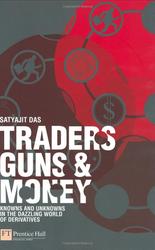
Red background. Title in black sans-serif capital letters, subtitle in white underneath. Silhouette of a businessman sitting on a folding chair, head in his hands. Behind him and to his left sits his briefcase, on which is written the words 'with n+1'.

Author, title, and subtitle written in white. The word 'money' is shot through with holes. In the background are several six-shooter bullet holders (what do you call those? I mean a collection of bullet chambers). In one of the chambers is a dollar bill; in another is the silhouette of a man running with a briefcase; in a third is a bullet

(Attention conservation notice: 1600 words reviewing two books from the perspective of securities traders. Run right out and read Diary of a Very Bad Year, and skip Das.)

These books need to be reviewed together, because they overlap in a lot of ways. For one, the author of Traders, Guns, & Money is unbelievably self-aggrandizing, while the subject of Diary of a Very Bad Year is just literally unbelievable.

Traders came out in 2006, before the world had fully melted down, so it gets some credit for being out in front about how incomprehensible certain derivatives, particularly the famed Collateralized Debt Obligations (CDOs) and Credit Default Swaps (CDSes) are. To review: a Collateralized Debt Obligation is essentially a piece of a mortgage (or some other asset backed by collateral, as opposed to something like credit-card debt). Typically these are assembled into “tranches,” which are groups of mortgages containing similar risk of default. If many mortgages default, one tranche — the “equity” tranche — gets wiped out first; its risk is therefore higher than that of the other tranches, so its return is correspondingly higher. As the defaults mount, the other tranches get wiped out in sequence. This is how you can end up with a collection of poor mortgages bundled into a security that gets labeled “AAA” (investment-grade): the later tranches, which are less likely to get wiped out, are AAA, while those which are first in line when the revolution comes are higher-risk. It looks like magic, but it’s actually sensible.

Mathematically, there are a few troubles with this. One is that you need to know some things about the correlation of the assets in the mortgage pool. That is, does knowing that one mortgage is in default tell you anything about whether another is in default? Suppose all the mortgages in your pool came from the same neighborhood; it’s likely that their defaults would be highly correlated. If the one mortgage defaulting means that all mortgages will default, then we say that their correlation is 1; if there’s absolutely no relation between whether one defaults and whether another does, then we say they have correlation zero. Obviously a lot depends on the correlation: if the correlation is 1 between the defaults of all the mortgages in your pool, then dividing into tranches doesn’t matter in the least: all mortgages will default at once, so all tranches will be wiped out at the same time, so it doesn’t make sense to call one tranch AAA and another junk. And it’s hard to estimate correlations when few people typically default on their mortgages. Recent experience suggests that correlation is near 0 most of the time, but near 1 when the economy is in a certain kind of recession; this is not helpful information. But in any case, you need to know the correlation if you hope to get any sense of how risky each tranche is. Since higher risk should yield higher return, you need to know the correlation to figure out what the yield on each tranche is.

A second, related problem with this sort of tranching is that it’s very sensitive to slight mis-estimation of the correlations. This is especially the case if you build new securities from a collection of CDOs, which are called “CDO-squared.” An excellent paper called “The Economics of Structured Finance” gives the clearest examples I’ve seen of this phenomenon. Bottom line: getting the correlations, or the individual default probabilities, just slightly wrong can drastically change the value of the security.

The people who assembled these complicated things are called “quants,” though Traders, Guns & Money and many other books make clear that complicated securities existed before quants did. So you’d think that Traders, Guns & Money would go easy on the quants. But no. Like a lot of books from the crisis, Satyajit Das likes to take cheap shots at the nerds hovering over their computers and their formulae. And like all the rest (I’m thinking, inter alia, of When Genius Failed, Roger Lowenstein’s depiction of the Long-Term Capital Management crisis), it misses the crucial question: maybe quantitative modeling is bad, but what’s the alternative? Does “going by gut feel” really have a better track record than using numbers?

Das’s own argument strongly suggests that the answer is no. Traders, Guns & Money is essentially a long litany of catastrophic explosions in the finance industry. Underlying all of them is the basic idea that you never destroy risk; you just shift it around. Or take the most recent mortgage meltdown. One problem seems to have been that the process went like this:

  1. A bank issues a mortgage.
  2. The bank immediately sells that mortgage to another company.
  3. The company packages up many mortgages into tranched CDOs, as discussed.
  4. The company constructs something called a Credit Default Swap (CDS) that’s sort of like, but importantly different from, an insurance policy. The CDS pays off if the mortgagee defaults. The company is now “hedged”: if they did the math right, they carry no risk at all — the insurance policy will cancel out any losses on the mortgages.
  5. Lots of companies follow steps 1-4, so lots of CDOs and lots of CDSes go out.
  6. CDOs and CDSes are profitable, so companies rush in to sell them, so banks are strongly encouraged to pump out mortgages as fast as they can. After all, they’re going to sell them right away, so they’ll hold no risk on their books but they’ll collect all the fees that go along with issuing mortgages.
  7. Banks are supposed to identify good and bad credit risks; they’re the ones that are issuing the mortgages, after all. But what incentive do they have to identify those credit risks if they’ll be selling the mortgages just as soon as they can? They have no “skin in the game,” as the saying goes. So they start issuing mortgages to people who probably shouldn’t have them. They don’t tell this information to the CDO issuers; again, what incentive do they have to do so?
  8. Mortgages start defaulting, and (to skip a bunch of steps) everything collapses.

Now the question for the class: which parts of 1-8 look to be the mathematicians’ fault? The mathematicians’ main nefarious role here, maybe, was to underestimate the default risk of a CDO. But they had nothing to do with the incentive structure that encouraged banks to issue junk mortgages. You can look through that list and find lots of failure points that have nothing to do with the geeks.

When it comes to doling out judgmentally wagging fingers, then, Traders, Guns & Money is on thin ice. Add in that Das is a remarkably self-serving author: whenever possible, he wants to convince you that he knew all along that finance was a bunch of hocus-pocus. He’s too cool for school, that Mr. Das, while all the rest of the industry are self-deluded assholes. The result is that Traders is an unsatisfying book that leaves me feeling icky. Its big strength is in describing, at a very detailed level, how various complicated securities work: swaps, swaptions, and the rest of the arsenal that we’ve become all too familiar with in the past couple years.

It was nice timing for me to move right from that to Diary of a Very Bad Year. The Anonymous Hedge-Fund Manager is everything that Satyajit Das is not. The HFM (as his interviewer at n+1 calls him) is erudite, calm, literary, and panoptic. He’s not stuck down in the muck of individual trades, although those are what he deals with day in and day out; instead he can take a broader view of the economy, and can identify when we should be scared and when we shouldn’t. He explains what commercial paper is, and why we should care when the CP market dries up.

He explains the contagious nature of financial crises, which is really the crucial detail to all of this. In earlier eras, the contagion was the sort of thing we see in [film: It’s a Wonderful Life]: word gets around that a bank is failing, and people line up at the doors to claim their money before it all disappears. So the New Deal created the FDIC, which guarantees that your money will be there if you come calling for it. The certainty that it will be there, as J.K. Galbraith noted in Money: Whence It Came, Where It Went, assures that no one ever needs to run to the bank to check that it’s there. The modern version of banging on the bank’s doors is when there’s a run on an investment bank, which has nothing like the FDIC to insure it.

The HFM explains all of this with almost George Clooney levels of cool. He’s just too cool, too scholarly, too journalistic in his ability to explain complicated concepts to a lay audience. I have a hard time believing he exists; if he does, he needs to drop the anonymity and use his skills for the greater good. By the end of Diary of a Bad Year, we find that the HFM has retired from New York City to Austin with his fiancée, so he’s got time. He’s used that time recently to sketch out his economic plans for Ezra Klein, so maybe he has a future as an educator. (I’m still not convinced that he’s real, even after writing for Klein. It seems entirely plausible to me that the HFM is a clever synthesis of the n+1 writers themselves.)

If you’re interested in the mechanics of constructing derivatives, by all means pick up the Das book. But the fact that the country even bothered to obsess about the details of swaptions and inverse floaters is a sign of great moral rot. Better to talk with the HFM, who unlike Das can see the forest for the trees.

Thomas Geoghegan, Were You Born on the Wrong Continent?: How the European Model Can Help You Get a Life — September 24, 2010

Thomas Geoghegan, Were You Born on the Wrong Continent?: How the European Model Can Help You Get a Life

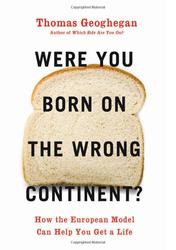
Author's name in red mixed case at the top. Book title below in big all-caps black. Subtitle at the bottom in red mixed case. Background is stark white, and there's a big piece of American white bread in the middle. (The back cover has a photo of a gorgeous baguette.)

(Attention conservation notice: 1600 words — honestly, I don’t try to write this much; it just comes out — on the second book I’ve read by the labor lawyer and one-time Congressional candidate Tom Geoghegan. You can’t go wrong with that guy.)

The short way to summarize this book is “Tom Geoghegan [‘the names pronounced gay-gun, which suggests a talent for coalition building‘] goes to Germany and gets his labor-lawyer mind blown.” Germany sounds like heaven for workers: lots of vacation, lots of manufacturing jobs (precision-made German products are still the envy of the world), health insurance for everyone (of course), free education, etc., etc.

The thing you have to remember about Geoghegan, going into this book, is how monumentally sad he is about the state of U.S. labor, without being a wimp about it. Anyone who’s read his earlier Which Side Are You On?: Trying to Be for Labor When It’s Flat on Its Back — and everyone really, really needs to read that book — already knows this. Geoghegan’s been working as a labor lawyer for probably 30 or 40 years, at various times for the Mine Workers and the Teamsters. He seems to have known forever that labor is doomed, doomed, doomed, but unlike virtually all of us he’s continued to fight for it. He’s probably foregone a few million dollars in income by now, all so that he could fight for what he believes in. When Rahm Emanuel vacated his seat as the Congressman from Illinois’ fifth district, Geoghegan jumped into the race and became the darling of liberals everywhere. Sadly, he lost out to someone who will surely not fight for regular people nearly as much as he would have.

Now take this guy and bring him to Germany: unions cover a sizable fraction of the population, and there are works councils complementing the unions. The German welfare state has been in the making since Bismarck, with a sizable kick from the American New Dealers who ordered German companies to make nice with labor after World War II. It’s a labor lawyer’s dream.

Geoghegan stumbles through this dream with a mix of awe, confusion, and disbelief. Surely this can’t work. Surely this is going to be replaced soon enough by American-style capitalism, where few people trust that they’ll have jobs when they wake up the next morning. Because Americans absolutely lack job security, they work longer hours every year: you don’t want to be the guy who leaves at 6pm when all your coworkers are burning the midnight oil. If you get fired, there are plenty of people pounding at the gates to take your job. This leads to a very predictable downward spiral: we all work more just to avoid losing our jobs (not to mention raises, of which there are none).

A natural way out of this is some sort of coordination: either the union, or the government, or whoever, tells your company that it can’t make people work more than, say, 40 hours a week. This would be natural in a country other than the United States, where the default stance favors the company. If you want to give it theoretical justification, it goes something like this:

  • Companies whose workers are covered by unions are less productive than non-unionized ones, essentially because unions are a form of monopoly of the labor force.
  • In a free market, competitors will come in and produce the same goods for less money.
  • Ergo, in a free market, unions will eventually disappear.

This does lead one to ask why places like the [newspaper: Wall Street Journal] turn this from a descriptive to a normative claim: not only will the free market kill unions, but the government should do all it can to bust up unions. There are many questions one could ask here — for instance, why workers shouldn’t be able to engage in whatever kind of voluntary organization they want — but we’ll set those aside for now.

What I want to get at here is that, in the U.S., we start our economic discussions at the individual-laborer or individual-firm level. We focus on individual widgets, and the most efficient production thereof. We focus on individual economic transactions, executed atomically. And the only way that we allow people to interact in a market is by way of price signaling: prices go up in the market for some good — let’s say steel — and everyone downstream from that good reacts appropriately: producing fewer cars, producing cars with marginally more plastic, etc.

There are problems with this model, which I’ve been writing about for quite a while (see Bowles and Stiglitz, say). But my point is more about the way we discuss these things: the U.S., no matter the state of the economic frontiers, starts with this particular atomic view of economics.

The Germans apparently start from entirely the opposite side of things, with an entirely different set of givens. For instance, suppose you know that you won’t be fired for a long while. This is going to lead to a much different world than the American one, where (as Geoghegan notes) we change jobs six times, on average, by age 30. Think of how much more willing we’d be to invest in skills and really view our companies as our partners.

Or, to really blow your mind, how about this: half of the membership in German boards of directors is named by the employees. Geoghegan gives the example of a Barnes & Noble: half of the directors of B&N, in Germany, would be named by its minimum-wage clerks. Consider the wide-ranging effects this would have, both on the way the company is run and on the very meaning of the word “democracy.” You’d have a say in how your work is run. Considering that half of your waking hours, or more, are spent at your job, any full-throated democracy should democratically control the workplace.

Thinking about economics in this broader way — over decades, over scores of products, over the entire cycle of education-employment-retirement — is just not something that the American economic discourse is ready to do. Every discussion essentially has to start with atomic transactions carried out by atomic laborers and signaling to one another only by means of prices.

In consequence, Germany blew Geoghegan’s mind just as much as it would have blown mine. Actually, I think maybe Geoghegan was faking it a bit, for the sake of his audience, in the same way that the fine folks at Planet Money do a lot of the time: He asks, “Now wait a second: you’re telling me that you could rise up from being a bookstore clerk to being on the board of directors?” just so that his interviewee can cast a genial smile upon him and say that verily, it is so.

Geoghegan casts himself as the naïf, wandering about in a perpetual daze. It’s absolutely charming. And his writing here carries the same folksy attitude that charmed everyone in Which Side Are You On?. He’s just a friend of yours, walking with you around Germany and asking everyone if he’s really stumbled into the dream world that he thinks he has.

Of course he wants to bring some of that world back to the U.S., but right now a true U.S. social democracy can only be described as a pipe dream. Lots of us (though not, I wager, Geoghegan) dreamed that Obama would bring New Deal version 2 to the U.S. after what looked like Great Depression version 2: the banks only continued to exist because the U.S. taxpayer paid for them to live, and a Democrat convincingly trounced the crotchety representative of the ruling party. Two years later, we ended up with sort-of-universal health insurance that hopefully won’t be revoked by the time it’s supposed to kick in, and the banks are more powerful than ever.

Actually, there’s another good example of where economics needs to consider the larger picture: we had a great chance to weaken the banks’ political power, and we didn’t take it. Banks have always been a special kind of entity, because (not to sound like too much of an idiot) that’s where the money comes from; no other industry can say that, and it gives banks a special role in the economy that no one else can claim. It also gives them political power that no one else has. For a short time, we had the power to neuter them politically and cut them down to size, thereby weakening their control of our leaders and making future bailouts less likely. But this entire line of thought doesn’t make sense unless you can picture companies in the context of an economy overseen by a government, and unless you can picture money as a special kind of thing that’s different from any other kind of commodity. (It wasn’t until Keynes, in the 1930s after economics had been around for two centuries, that the discipline started treating money as altogether different from wheat or rice.)

So it doesn’t look very likely that the U.S. will resemble Germany anytime soon. The best Geoghegan can hope for is that the rest of the European Union will follow Germany’s social-democratic lead. Maybe, if that happens, our closest industrial competitors will finally push us in the right direction.

There’s no one you want on your side more than Tom Geoghegan to understand this world. He’s funny, he’s smart, his ethics are on the side of the angels, and he’s been fighting for you for a long, long time.

Wenceslas Square Google Street View happy discovery of the day —

Wenceslas Square Google Street View happy discovery of the day

Years ago I went to Prague by myself and took a lot of (in retrospect very earnest and juvenile) notes in a diary. I remember very clearly being overwhelmed as I sat on the steps of the National Museum: in front of me was a very simple memorial to Jan Palach, who had committed suicide by lighting himself on fire in front of the Museum. The memorial was a tattered wooden cross embedded in the cobblestones on the street. Right across the street from the memorial … is a McDonald’s. My brain couldn’t handle the dissonance, and even now I get a little sick thinking of it.

I decided to see if both these details were in Google Street View. Indeed they are. Check out the Palach memorial, then turn about 45 degrees to your left.

The simplicity and solemnity of the one, against the ugliness and plasticity of the other, is haunting to me in a way that few other things are.

A note on genetically-modified foods and central planning — September 23, 2010

A note on genetically-modified foods and central planning

Reading Marion Nestle’s note on how hard it is to identify which foods are genetically modified, I can’t help but think of James Scott’s Seeing Like A State. Scott lumps industrial agriculture in with schemes to rationalize the organization of a nation. From the perspective of a central planner, putting people into an order that the state can understand is a great virtue. The state can’t appreciate that underlying the apparent chaos of a city is great order, in the sense that the city is exactly attuned to the needs of the people using it. (Istanbul, the most amazing place I’ve ever been, must scare the sleep out of Turkey’s leaders.)

Likewise, agricultural central planners can’t stand the chaos of a tangled mess of plants; they replace it with long geometric rows of single crops stretching off to the horizon. Of course, the natural chaos disguises great order underneath: often the multiple crops at a single site are food for multiple species of insects that eat one another remain in a kind of equilibrium. Get rid of the natural order and you’re required to spray pesticides to keep away the now-dominant species of insect. This leads to all the horrors we’re used to by now, like pesticide runoff into the Mississippi River, leading many miles later to a dead zone in the Gulf of Mexico.

When I read about the prospect of genetically-modified foods, those are the sort of traumas I think about. We make one change to something basic, like our food supply; it seems locally rational, but in the aggregate it’s disastrous. (Those in favor of GMOs need to explain why we need them. The onus is on them to tell us why they won’t be a disaster and why our non-genetically-engineered food supply doesn’t do the job.)

Industrial civilization is good for a lot of things, and has led to a breathtaking increase in the quality of life in Western civilization. I’m not decrying industrialization, and besides: what would be the point? Despite the justified awe we feel in the face of a small, local, sustainable closed-loop farm like Polyface, which Michael Pollan lovingly documents in The Omnivore’s Dilemma, there’s no way we’re going to shift our entire food supply back to that.

In an industrial democracy, we respond to this kind of agricultural lunacy with regulation. We recognize that acts of individual rationality often lead to large-scale destruction, so we use the compulsive power of the government to stop the large-scale failures. Maybe we forbid GMOs, say. Or maybe we make it cheaper for customers to buy sustainable food, thereby shifting the micro-level incentives to get a better macro-level outcome.

What frightens me, though, is that the bad actors seem to always have a leg up on the government. Write your legislation carefully, but the bad guys will find the loopholes. Set your penalties too low, and it’ll be in the bad actors’ interests to break the law. Use tort law as the instrument of capitalist justice, but whom do we sue about the destruction of the Gulf of Mexico?

These are the industrial cards we’ve been dealt, so there’s nothing to do but play them.

Rosecrans Baldwin, You Lost Me There —

Rosecrans Baldwin, You Lost Me There

Cover of _You Lost Me There_: crimson background, white type, everything looking hand-drawn. There are also antlers studding the page. (It's possible that they're crossing axons.)
This is the debut novel for Rosecrans Baldwin, who in 1999 cofounded the always-excellent Morning News; it’s a charming first work. I’ve spent a couple days trying to figure out what’s so captivating about it. I’ve not entirely worked it out; but herewith, some thoughts.

The narrator, Victor Aaron, is a old-ish (not sure if he ever mentions his age, but it’s in the 60s) Alzheimer’s researcher on Maine’s Mount Desert Island at a presumably fictional research lab. His wife Sara has died in a car crash at some point in the recent past, though you wouldn’t know it by watching how people interact with him. Sara’s aunt, with whom Victor spends a lot of his time, hardly mentions Sara’s death, and Victor himself has been getting private performances from a 25-year-old curvaceous burlesque performer for a good long while — possibly even while he and Sara were married, or maybe just soon after she died.

That’s part of my confusion: is everyone just really selfish? Maybe Victor himself is just selfish? Maybe, as the narrator, he just doesn’t mention those things that don’t occur to him, and maybe he’s not thinking terribly much about his late wife. If others are bestowing sympathy on him, maybe he’s just not seeing it.

Victor is a busy researcher, spending most of his time writing grants and attending meetings and so forth. He’s working 20-hour days, and one gets the sense that he worked that much when he and Sara were married, too. For large fractions of their childless marriage, she never saw him. Somewhere along the way, though, Sara got her own stellar career: her screenplays took off, and one of them — [film: The Hook-Up] — got turned into a movie starring Bruce Willis. (The scenes where Victor chats with Willis at cocktail parties, or dreams about the man’s wisdom, are hilarious little snippets.) The tables turned: now Sara was the jet-setting one whom Victor never saw, and his jealousy got the better of him. They drifted further and further apart.

We find out about all this through a work of inspired narrative brilliance: Victor hunts through Sara’s office after her death, and finds a set of index cards that she prepared for her psychologist, describing important turning points in her life; each chapter of You Lost Me There corresponds to Victor’s reading the next index card. This serves three purposes. First, it’s just suspenseful. Second, it helps you get to know Sara; you wouldn’t have gotten to know her otherwise, because the narrator is off in his own world in which Sara may as well never have existed. Finally, and connected to the second: it gives you and Victor a glance at what others thought of him. What Victor discovers about himself is often ugly. And the characters’ solipsism disappears for a few minutes, as Victor realizes that there are others in the world whom he’s wronged and ignored.

So in a way, this is the first novel I’ve ever read that’s written from two distinct perspectives. We learn as we go along that Victor just cannot be trusted as a judge of his own life. As he realizes this, he slowly falls apart.

If such a flashlight were turned on any of the book’s other characters, it’s likely they’d feel just as much pain as Victor. Everyone in You Lost Me There seems selfish in his or her own way. Everyone’s drifting, from Victor’s teenage goddaughter who comes to stay with him for the summer, to the goddaughter’s father who hops from one bed to the next, to Victor himself, reclaiming his youth in a young girl’s bed. Everyone’s flailing around, trying to figure out what he’ll be when he grows up.

(Baldwin is in some ways the anti-Philip Roth, by the way. Victor can’t attain an erection despite several tries throughout You Lost Me There, whereas you can’t read a Roth novel without some male character — typically old, transparently a stand-in for Roth himself — having completely implausible sex with a beautiful woman who’s helpless before the narrator’s powers. Even when Roth writes about the aging man’s loss of potency, as in The Dying Animal, the Roth-stand-in still ends up having sex with voluptuous women young enough to be his daughter. Victor can’t get it up by the time we meet him, and he can’t get it up by the end.)

There are touches of enlightenment as we go along. Our characters get smacked around some, and come out bruised but maybe a little smarter and a little less self-involved. It’s never schmaltzy or sentimental, though: You Lost Me There is a realistic look at getting your head straightened out.

Unified messaging on the iPhone (or anywhere, really) — September 22, 2010

Unified messaging on the iPhone (or anywhere, really)

Know what would be really handy? To include all your friends’ and acquaintances’ contact info — including Twitter handles, Facebook profiles, phone numbers, email addresses, RSS feeds, und so weiter in some global address book (like the nice Gmail contacts list, which you can sync with a mobile device, and which I sync quite happily with the iPhone), then gather together all those items and make them on the device. Quite often a conversation starts via text message, moves over to email, maybe ends up in a voice chat, turns into a blog post, etc. Wouldn’t it be nice if the device could record your voice chats, or at least transcribe them?

Barring that, just being able to search text messages at the same time as you search emails would be a big win. Didn’t BitPim do this?

Choosing low-calorie meals (at the margin) — September 21, 2010

Choosing low-calorie meals (at the margin)

It’s one of the largely unpublicized but seemingly very important parts of the Affordable Care Act that restaurants with more than 20 establishments will have to start attaching calorie counts to their menu items. (This is in section 4205 of the bill. Because THOMAS links are still, bizarrely, after 15 years, inscrutable and impermanent, I’ve included that section below the fold.) I find this completely excellent. It may not end the obesity epidemic in this country, but it will certainly help at least some people make healthier decisions at restaurants. Quite often one just doesn’t know which items are unhealthy. It’s shocking how often a seemingly healthy menu item really isn’t; for instance, I got a Cobb salad from Cosí/Così just about every day for a few months, until I found on their website that it’s a 700-calorie salad. I no longer order that. At any lunch place that lists calories on the menu (Au Bon Pain, say), I routinely look for the lowest-calorie item. Even if I don’t pick that item, I look around the menu with that as a baseline. (The descriptor “low-calorie,” unfortunately, often means the same thing that “diet” does on soft drinks [which I also never drink]: “a natural-tasting ingredient has been replaced with the finest gross-tasting chemicals that Northern New Jersey petrochemical plants could churn out.”)

So I give huge thumbs up to this innovation. It may not solve anything, but it’ll help.

Continue reading

David Foster Wallace, “Consider the Lobster” and Other Essays — September 20, 2010

David Foster Wallace, “Consider the Lobster” and Other Essays

Cover of _Consider the Lobster_: stark white background, title and subtitle in black, author in red, then 'Author of Infinite Jest' below the author's name. Finally, a photo of a deeply red lobster at the bottom of the page

(Attention conservation notice: 1700 words, having reached the end of the line with David Foster Wallace’s brand of free-associative rambling.)

I’ve spoken with a great many people by now who’ve found Weezer’s last few albums so terrible that it’s made them reconsider whether the Blue Album and [album: Pinkerton] were as great as we all thought at the time. I’m sad to say that “Consider the Lobster” has made me do the same for David Foster Wallace.

What makes Wallace really charming is him, as a person. His best essays are really about him. Take the title essay in A Supposedly Fun Thing I’ll Never Do Again, for instance; it’s one of the most enjoyable essays I’ve ever read, and what makes it so is a) that Wallace is funny, b) that Wallace is neurotic and aware of his neurosis, and to a much lesser extent c) the funny commentary Wallace deploys about society in general and what cruise ships have to say about life in late-20th-century America among upper-middle-class folks whose every want is basically already taken care of. Even on that last point, though, Wallace is at his best when he talks about his own experience as a microcosm of the larger point. He’s spoiled on a cruise ship, and he finds himself getting more and more annoyed at the little deviations from perfection that would, land-side, never have bothered him in the slightest — e.g., that all they have is Dr. Pepper rather than Mr. Pibb, when everyone knows that the former is just no goddamn substitute at all for the latter. Being spoiled beyond comprehension has made Wallace sensitive about far too much. I submit that almost none of what’s memorable in “A Supposedly Fun Thing” has to do with the world beyond Wallace’s own head.

That’s not true of that entire earlier essay collection, though. A Supposedly Fun Thing has some neat thoughts about the role of television on fiction writing (I believe that was in “E Unibus Plurum” [sic]), has an obsessive little essay about David Lynch, and so forth. Wallace is definitely a smart guy. But he’s really just run out of steam in “Consider the Lobster”. There’s an obscenely long essay reviewing an English-usage guide, ably torn to shreds 8 years ago on the Languagehat blog; most of that takedown can be reduced to “Wallace just goes on and on and on, but he doesn’t actually know what he’s talking about.” And that critique extends to most of the rest of what’s in “Consider the Lobster”. Much of it sounds like a college bull session committed to paper. For instance, on page 85, in the middle of “Authority and American Usage” (the essay that Languagehat took down), we have Wallace saying that

Even in the physical sciences, everything from quantum mechanics to Information Theory has shown that an act of observation is itself part of the phenomenon observed and is analytically inseparable from it.

Well … I’m no physicist, but I’m fairly certain that this is what happens when you get a guy who’s trained in critical theory and let him read In Search of Schrödinger’s Cat. I invite physicists to critique my interpretation here, but I believe QM says that only at very small scales does the act of observation change the thing observed. That’s because when you, e.g., shine light on a particle, you impart momentum to the particle and thereby move it. So the act of observing the particle has changed the state of the particle. Our observing the Sun has no effect at all on the Sun.

The extra-special irony here is that on page 56, in an otherwise great essay on John Updike’s self-centric, penis-centric writing, Wallace takes Updike to the woodshed for similar sins:

[One of Updike’s characters] is particularly keen on subatomic physics and something he calls the theory of “many worlds” — which actually dates from 1957 and is a proposed solution to certain quantum paradoxes entailed by the principles of Uncertainty and Complementarity, and which is unbelievably abstract and complicated but which Turnbull seems to think is roughly the same thing as the Theory of Past-Life Channeling, apparently thereby explaining the set pieces where Turnbull is somebody else. The whole quantum setup ends up being embarrassing the way something pretentious is embarrassing when it’s also wrong.

(I’ve assumed all along that Wallace’s Everything and More, which purports to cover Georg Cantor and the various shocking, counterintuitive results about infinity, would be more Wallace bull-session wankery. Nothing in “Consider the Lobster” encourages me to read Wallace’s thoughts on higher math.)

Wallace’s demeanor is so folksy and charming that I found myself not normally paying attention to whether what he says makes any sense at all. Then the Languagehat blog comes along and pricks the balloon, and suddenly I realize that Wallace just doesn’t have much to say in a lot of this book. Much of it starts to feel like a man who’s talking and talking and talking to delay something that’s not clear to the reader (and may not be clear to the author).

And talk he does. He needs an editor more than ever. Infinite Jest apparently started out as a 1,500-page work, which eventually got chopped down to just over 1,000, according to David Lipsky’s biography. Infinite Jest was great, but it would have been even greater had it been half as long. “Consider the Lobster” could be reduced from 300 pages to maybe 200 without a lot of substantive loss.

While I’m here, I have to comment on Wallace’s footnotes; they’re one of the most noticeable features of his writing. They are terrible. I have always found them terrible, especially in Infinite Jest. There, the footnotes were mostly endnotes, so one had to keep two bookmarks going and continually interrupt the flow of the novel to read some 20-page excursus about the director’s oeuvre. It made Infinite Jest actually cause mental pain, of exactly the same sort that you feel when you’re trying to think hard about some important problem at work and get interrupted every couple minutes by some well-intentioned but annoying coworker.

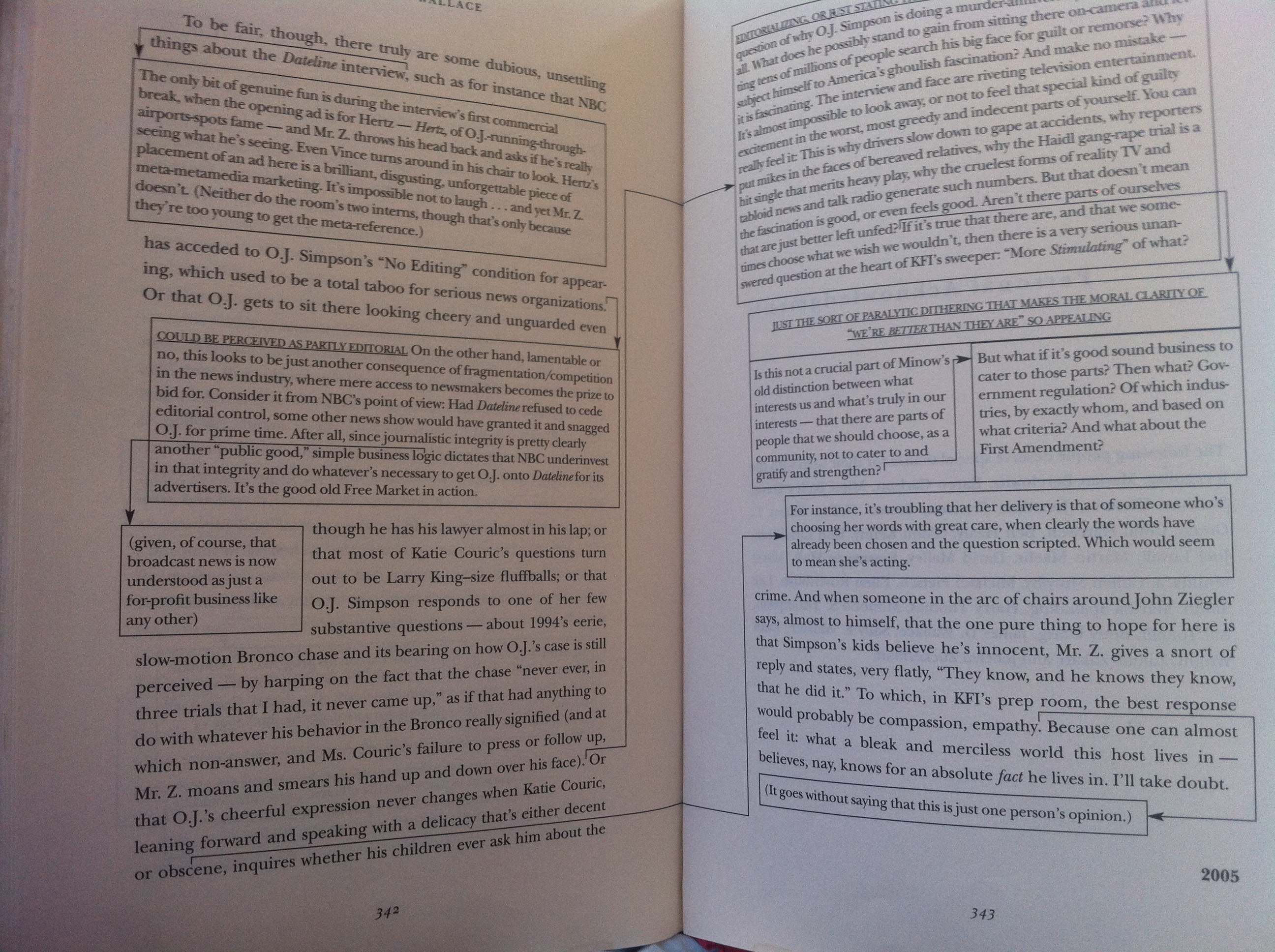
Come to find out, in Lipsky’s book and dramatically confirmed in “Consider the Lobster”, that this similarity was not coincidental. Wallace’s contention in Lipsky is that the world we live in is so fragmented, with so many streams of information coming at us at once, that literature has to reflect this somehow. There don’t exist enough capital letters, enough bolding, and enough italics in this world for me to express just how terribly wrong I think this is. The world is fragmented and saturated with news, yes, which is precisely why literature — and for that matter, the rest of our institutions — needs to provide filtration, perspective, and order. When I read a book, I want to get lost; I want to forget, for a time, the maddening flicker and noise of the outside world. I want to submerge myself in the author’s world. Wallace’s strategy, and apparently his philosophy, are to keep me from ever getting immersed in his work. The strongest evidence I can amass for this claim is the very final essay in “Consider the Lobster”, whose final two pages look like this:

Two pages from _Consider the Lobster_. There are boxes offset from the text, with arrows pointing to boxes from inside other boxes on different pages. It's a recursive, distracting mess.

(click to enlarge)

This takes Wallace’s footnote habit and runs off a cliff with it. Like the footnotes, which sometimes have sub-footnotes, the boxes and arrows sometimes have their own sub-boxes and sub-arrows; as you can see from this example, sometimes you need to follow arrows onto other pages, then trace your way back to the page where you started. I don’t believe this image captures one further annoyance of the boxes-and-arrows system, namely that sometimes a box precedes the text it refers to, so you have to train yourself to skip the boxes until the arrows tell you it’s time to read them.

Maybe you find the notes charming. After all, they’re a natural extension of what’s often charming about Wallace: you feel like you’re getting direct access to his mind and the funny things that he thinks from moment to moment. Clearly his own mind is fragmented, so his writing is the same way.

Me, I just find it lazy, and I’ve found it lazy as far back as Infinite Jest. A more disciplined writer would find a way either to flow the content of the notes into the body of the text, or would just strike out those digressions that don’t add to the content of the work. That Wallace clearly disagrees with me here, and that this isn’t laziness but is entirely deliberate, is exactly the problem: Wallace believes that the digressions and the footnotes are absolutely crucial to the body of the work.

This particular final essay, with the structural experimentation and the arrows and boxes, features Wallace sitting for a night or a few nights in a Los Angeles-area conservative talk-radio station, telling us all sorts of things: the particular mechanics of beaming a story from the station to the millions of L.A. listeners, with particular reference to which machines get used for which purposes; the sound engineers and their mastery of special devices that speed up and slow down sounds to fit within a precise window and give advertisers their allotted on-air time; the radio host himself, and what he’s like when the mic is turned off; some notes on the Fairness Doctrine and what its end had to do with the rise of talk radio; and some college-bull-session-level out-loud meditations on What It All Means.

A lot of this stuff is good, but a lot is just needless digression. When Wallace applies the same formula to John McCain, in what became “Up, Simba!”, it essentially has one through-line with a lot of useless ornamentation. The story is that John McCain spent five years in a box in Vietnam, and explicitly refused to be released from prison just because his father was a bigshot in the military; he waited to be released after others who’d gone in before him. Wallace asks us to imagine the psychological and physical torment McCain underwent, and the sense of duty that must exist inside McCain to make that sacrifice for his brothers. McCain has become a politician since then, so it’s hard to know whether what he says is just salesman bullshit, or whether maybe he really is the Leader that he wants us to believe he is. In the world we live in, it’s hard not to impart cynical motives to everyone around us — especially politicians — but Wallace holds out hope that McCain might be the real deal.

All of that is wonderful. Adorning it, though, are pages and pages of Wallace’s ramblings. I’ve reached the end of my patience for that. Much of “Consider the Lobster” feels like I’m reading a series of blog posts, albeit written by a very smart friend. The world supplies me with enough blogs; when I read a book, I want to read a book.

Karl Polanyi time-travels and addresses the Great Recession — September 17, 2010

Karl Polanyi time-travels and addresses the Great Recession

Basically a generic cover, with one little cute bit: the background is a giant dollar sign, where the inside and outside of the 'S' are composed of blocks of grey and brown.
(Attention conservation notice: Just under 1100 words, plus a long quote from the book, about one of those rare books that makes sense out of the long sweep of history, and takes your breath away in the process. And this isn’t even the final review!)

I am going to enjoy reviewing The Great Transformation once I’ve finished it. In the meantime, it suffices to note that every few pages I run into a new idea that either brings a major swath of history into clear focus, or that clarifies my side of a debate.

Before quoting something that falls into the latter category, I should explain Polanyi’s overall goal in The Great Transformation. He starts with quite a long introduction, trying to explain at a high level how Europe went through 100 years of peace between Napoleon and World War I (this is an era that whose beginning Kissinger covered brilliantly in A World Restored). To do that, Polanyi needs to cut back to the beginning of the Industrial Revolution and work his way forward. A large part of the intellectual suspense in The Great Transformation is curiosity over how he’ll get from there back to where he started. What kept the peace together, and what broke it apart?

Among the guiding structures in The Great Transformation are that

  1. The Industrial Revolution, by its very logic, required that labor, land, and money each be turned into commodities. The implication of this is that the most basic parts of any society — its people, and nature itself — must be made fungible. (Wheat and other commodities on the labor market aren’t actually all identical to one another; they’ve been cut and shaved and folded and spindled and mutilated — and, more concretely, contracted — into a uniform shape so that they may be treated as though they were identical. I read a recent blog post on this, referencing a book on the topic that seems interesting; I can’t find it on a quick skim now.)
  2. Every European nation discovered on its own that it needed to slow the societal destruction that the Industrial Revolution inevitably caused. The Revolution led to a great deal of good eventually, but a shift of this magnitude destroys everything in its wake.

In presenting these ideas, Polanyi brings a style like wind through an open window to the kind of arid economic talk that fills all of our minds nowadays. If someone tells us, for instance, that “the recession is caused by people not taking lower-paying jobs,” we’re apt to come back with mini-lectures on the economic benefits that accrue to the world when unemployment insurance gives people time to find a better-fitting job.

Fie to all that, says Polanyi:

Economically, English and Continental methods of social protection led to almost identical results. They achieved what had been intended: the disruption of the market for that factor of production known as labor power. Such a market could serve its purpose only if wages fell parallel with prices. In human terms such a postulate implied for the worker extreme instability of earnings, utter absence of professional standards, abject readiness to be shoved and pushed about indiscriminately, complete dependence on the whims of the market. Mises justly argued that if workers “did not act as trade unionists, but reduced their demands and changed their locations and occpations according to the requirements of the labor market, they could eventually find work.” This sums up the position under a system based on the postulate of the commodity character of labor. It is not for the commodity to decide where it should be offered for sale, to what purpose it should be used, at what price it should be allowed to change hands, and in what manner it should be consumed or destroyed. “It has occurred to no one,” this consistent liberal wrote, “that lack of wages would be a better term than lack of employment, for what the unemployed person misses is not work but the remuneration of work.” Mises was right, though he should not have claimed originality: 160 years prior to him Bishop Whately said: “When a man begs for work he asks not for work but for wages.” Yet, it is true that technically speaking “unemployment in the capitalist countries is due to the fact that the policy both of the government and of the trade unions aims at maintaining a level of wages which is out of harmony with the existing productivity of labor.” For how could there be unemployment, Mises asked, but for the fact that the workers are “not willing to work at the wages they could get in the labor market for the particular work they were able and willing to perform?” This makes clear what the employers’ demand for mobility of labor and flexbility of wages really means: precisely that which we circumscribed above as a market in which human labor is a commodity.

Such clarity: when Mises and all the other heroes of laissez-faire tell us this sort of thing, they’re treating us like bushels of apples or bales of hay. We’ve become a nameless thing called Labor which can be infinitely subdivided and used for whatever purpose the factory-owner decides on. When the fundamental assumptions beneath laissez-faire are laid bare, it becomes so obvious that we wonder why we never thought of it before. And it becomes immediately clear just how odious those assumptions are. Polanyi reminds us that we still need to think about ethics, even in a world dominated by economics. Yet this “just accept a lower-paying job” argument is still with us.

It was with us during the Great Depression, too, when I believe Keynes addressed it in the General Theory. Part of the great clarifying joy that comes from Polanyi is the realization that there really aren’t that many new arguments about fundamental economic problems.

Much of what’s astonishing and literally breathtaking about The Great Transformation falls under this category category of “humanizing the economic”. To give a taste: colonization destroyed the colonized peoples, at least for a time, but they got a lot of money. So what’s the problem? Well, in order to get a lot of money, the colonized countries typically had to radically industrialize. This meant moving people out of the agrarian lifestyles they’d been used to for hundreds or thousands of years and relocating them into urban factories. Yes, they got money, but in the process they were uprooted, their lives were destroyed, and millions died. In a few generations they typically adjusted. And that’s exactly the point: industrializing Western democracies knew enough to lay on the brakes to prevent utter social collapse; they weren’t so generous with their colonies. Our modern focus on the economic, rather than the social, obscures our view of the Industrial Revolution’s ravages. Its gains were substantial, but so were its costs.

This is far more than just an academic look back at the way the world was and where it settled after some initial torment. You can’t wade an inch into a debate about economics today without running into the laissez-faire point of view. “Just let the market settle where it will,” they say, “and you’ll do far better than any central planner could.” The fact is that Western societies have never allowed the market to manage itself unimpeded, and it’s to our everlasting benefit that they haven’t; if they’d let the market manage itself, we would most likely not have a society anymore.

This gets at a conceptual distinction that Polanyi emphasizes, which (again, par for the course with this book) I hadn’t previously kept straight in my head: laissez-faire — the doctrine that the market should be entirely left alone — is different from support of the free market. The West has long realized that, in order to get a well-functioning market, we often need to intervene to make it work. War is too important to be left to the generals, as Clemenceau put it, and free markets are too important to be left unmanaged. Indeed, as Polanyi spends a great deal of time detailing, the very birth of the Industrial Revolution owes everything to state intervention.

I’ve already gone on longer than I intended to. When I get to writing it up in full, I’ll fill in more details and hopefully make the connection back to World War I and the 19th-century post-Napoleonic peace.

P.S.: When I do get around to writing this up for real, I’m going to have to include references to Ernest Gellner’s Nations and Nationalism (another “let’s take in the big picture” examination of capitalism and its effects), Eric Hobsbawm’s epic, multi-volume “long 19th century” series, and James Scott’s Seeing Like A State. Thinking of these other books, when you’re in the middle of Polanyi, is unavoidable. They’re all well worth your time.

A neat identity I remembered from college calculus — September 15, 2010

A neat identity I remembered from college calculus

begin{eqnarray*} tanleft(frac{pi}{4}right) &=& 1 frac{pi}{4} &=& ta... ...+1} &=& 1 - frac{1}{3} + frac{1}{5} - frac{1}{7} + cdots end{eqnarray*}

(Proofs of any of the individual steps are available upon request, should you find yourself thinking that I’m pulling a 1=0 trick.) So then

begin{displaymath}pi = 4left(1 - frac{1}{3} + frac{1}{5} - frac{1}{7} + cdotsright).end{displaymath}

This converges very slowly, though, because for every two steps forward you take
a step back. (More precisely: for every 1 step forward, you take $(4n+1)/(4n+3)$ steps back.) You can make it converge faster by combining the forward step and the smaller backward step into a single, smaller, forward step:

begin{eqnarray*} frac{pi}{4} = sum_{n=0}^{+infty} frac{(-1)^n}{2n+1} &=& ... ...n+3} right) &=& sum_{n=0}^{+infty} frac{2}{(4n+1)(4n+3)} end{eqnarray*}

whence

begin{displaymath}pi = 8left( frac{1}{3} + frac{1}{35} + frac{1}{99} + cdotsright)end{displaymath}