A free market for traffic — September 14, 2010

A free market for traffic

Matt Yglesias has been making the point consistently for a long time, and he should keep drilling it in until its obviousness becomes apparent: traffic is caused by improperly priced roads.

As he’s said on a few occasions (can’t find the exact posts right now): when we see video of long bread lines in the former Soviet Union, we know why they exist. They exist because the price of bread has been set artificially low. Since the price is artificially low, more people go hunting for bread than would go if the price were allowed to find its level. Since the price is artificially low, companies produce less bread than they would if the price were allowed to find its level. There’s a mismatch between the number of people seeking bread and the number of loaves of bread available for sale.

But we never think of that when we see traffic, for some reason. Clearly, though, the same mechanism is at work: there’s a scarce resource (slots for cars on the road), there’s a fixed supply, and there’s a certain demand. If people had to pay more to ride on the roads, they’d presumably drive less. What you want is that the last person to get on the road is just willing to do so — if the price were just a tiny bit higher, he’d find other means of getting to work.

So the roads are clogged, and traffic is unbearable, because prices aren’t being set by the market. They’re being set artificially — at zero, in fact — by the government. As Jamie Galbraith put it in another context, “this process is so simple that the mind recoils from it.”

If libertarians should be shrieking about anything, it should be the artificially low price of driving. The environmental consequences of this are stark: more people get on the road than would otherwise, so more smoke goes in the air; more people drive than probably would otherwise, so development patterns change to accommodate cars; so the landscape gets scarred with new, wider highways, new subdivisions, new Wal-Marts, etc.

I can’t let my speculation run too rampant there. Suppose roads were privately run. Maybe people would have no problem paying more; as it is, they seem to tolerate longer and longer commutes, which impose a less-obvious but still great price on drivers (less time with their families, more frustration, road rage). Maybe private companies would build extremely wide roads, thereby incurring a large fixed cost but basically negligible marginal cost for each driver on the road. The cost of driving might then look like the fixed cost amortized over the expected number of drivers, plus some profit margin for the corporation. And maybe that cost wouldn’t be so high.

But the point is that we don’t know, and the continually worsening state of traffic gives us reason to believe that the price hasn’t been set appropriately. If it were any other commodity being allocated, the presence of long lines would indicate a failure of central planning. Somehow Americans don’t jump to that conclusion with their roads, and they should.

Yglesias seems to have taken up a Carthago delenda est approach with traffic pricing. I’ll join him in it.

What are the long-lasting truths from your discipline? —

What are the long-lasting truths from your discipline?

That’s a question I’d like to ask of many different disciplines. Right now, for instance, I’m reading a Matt Yglesias piece about how poorly tax breaks for the wealthy work as stimulus. I believe this has been known for a very long time — I’m tempted to say since Keynes — though I’m not certain. It would be interesting to go around to lots of different disciplines and ask them which truths have been established for 50 years or more. (Mathematics, you’ll have to sit this one out; all your truths are permanent, and many are very old. You’d win by default.)

I’m reminded here of the famous story, which appears to come from “The Way of An Economist”, though I don’t have access to it, in which someone asked Paul Samuelson to name an idea from economics that is both true and not a tautology. It took him some years to respond with the doctrine of comparative advantage. That’s been accepted as true for 200+ years, so it seems to count as a disciplinary truth. I wonder what others might be.

I probably have to narrow this down, because I’d want truths that aren’t based on obviously unrealistic premises. For instance, there are a lot of results in economics that depend on constant returns to scale — for instance, that if you double the quantity of inputs, you double the quantity of outputs. But many phenomena in our world depend on *increasing* returns. Doubling the number of users in AT&T’s network more than doubles the value of that network. The very existence of cities is proof of increasing returns to scale: Silicon Valley isn’t the world capital of software development because it’s somehow better equipped to build software; it’s the capital because it had some initial burst of development, which led to a snowball effect that drew more developers to it. (The classic economic example here is Dalton, Georgia, which by historical accident has become the carpeting capital of the America.) If you can’t understand the existence of cities using easy economic assumptions, then you need to re-examine your assumptions. Yes, I realize that constant returns to scale are easier to model, but in any case: if we’re looking for accepted wisdom from a discipline, theorems about the real world cannot be accepted as true if they’re based on premises that are known to be far off the mark. (That gives another reason why mathematics has to sit this out: strictly speaking, mathematics isn’t *about* anything. It’s a collection of tautologies.)

I’ll start bugging people about this.

Daniel Dennett, Brainchildren: Essays on Designing Minds — September 12, 2010

Daniel Dennett, Brainchildren: Essays on Designing Minds

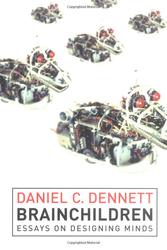
Cover of _Brainchildren_: repeated image of a robotic dog with its 'skin' removed so that you can see its innards. It's a friendly-looking robotic dog, with red LED eyes. The author's name is in red, and its title is in black, within a black box-bordered box at the bottom of the title page

(Attention conservation notice: Seriously, I don’t intend to sit down and write 1,400 words (plus about 600 quoted words) about artificial intelligence, but … it just happens that way.)

Daniel Dennett is the philosopher whom geeks love. In this, and in a couple other respects, he is the heir to Betrand Russell’s throne. One of Russell’s many claims to fame was a philosophical program built around applying scientific and mathematical methods to philosophical questions, in the hopes of giving them definite answers. That didn’t really work out so well, but, as I’ve mentioned before, mistakes are valuable; we tend to sneer at them more than we should.

Dennett’s approach is based around natural selection, whereas Russell’s was based around mathematical logic. For my money, natural selection is more likely to tell us enduring truths about human knowledge than the predicate calculus. Dennett ran as far as he could with the implications of natural selection in Darwin’s Dangerous Idea, where he contended that Darwin’s discovery is “universal acid”: if you accept it at the level of speciation, then you’re forced to accept it at every other layer — all the way up from the structure of atoms to the large-scale structure of the universe.

In Darwin’s Dangerous Idea, and in Brainchildren, Dennett continues to repeat his refrain that philosophers are deeply uncomfortable with the idea of bringing Darwin to the last holdout, namely the human mind. Dennett says philosophers hate the idea that the mind might be seated in the brain, hate that they might lose their hold over another corner of the intellectual universe when another part of the world loses its mystery, and hate that what separates the human mind from that of other species might just be a difference of degree rather than of kind.

When judging whether other humans, or machines, or animals are intelligent, Dennett advocates taking what he calls “the intentional stance”. I can’t do better than Dennett at explaining what this is:

Here is how it works: first you decide to treat the object whose behavior is to be predicted as a rational agent; then you figure out what beliefs that agent ought to have, given its place in the world and its purpose. Then you figure out what desires it ought to have, on the same considerations, and finally you predict that this rational agent will act to further its goals in the light of its beliefs. A little practical reasoning from the chosen set of beliefs and desires will in most instances yield a decision about what the agent ought to do; that is what you predict the agent will do.

Note the empirical content of this stance. If you want to judge whether a robot is rational, you make some predictions about how it would behave if it were acting rationally; then compare the predictions to the actual behavior. There’s no a priori assumption in here about how a robot “in principle” could never act rationally. There is only the comparison of predicted rational behavior to actual behavior.

Dennett’s claim throughout Brainchildren is that artificial intelligence has brought much of philosophy to the “put up or shut up” stage: if you want to argue about cognition, you will soon enough have to compare your arguments to the results of programming a mind on a computer.

Of course, the potential from computer experimentation doesn’t just extend to making philosophers look bad. When we speculate that various problems in human cognition are “easy,” we get to try to solve those problems on a computer and see (as it turns out) how wrong we were. The most interesting difficulty of this sort in Brainchildren is the “frame problem”. It’s best too illustrate this with a delightful example from the book:

Once upon a time there was a robot, named R1 by its creators. Its only task was to fend for itself. One day its designers arranged for it to learn that its spare battery, its precious energy supply, was locked in a room with a time bomb set to go off soon. R1 located the room and the key to the door, and formulated a plan to rescue its battery. There was a wagon in the room, and the battery was on the wagon, and R1 hypothesized that a certain action which it called PULLOUT(WAGON, ROOM) would result in the battery being removed from the room. Straightaway it acted, and did succeed in getting the battery out of the room before the bomb went off. Unfortunately, however, the bomb was also on the wagon. R1 knew that the bomb was on the wagon in the room, but didn’t realize that pulling the wagon would bring the bomb out along with the battery. Poor R1 had missed that obvious implication of its planned act.

Back to the drawing board. “The solution is obvious,” said the designers. “Our next robot must be made to recognize not just the intended implications of its acts, but also the implications about their side effects, by deducing these implications from the descriptions it uses in formulating its plans.” They called their next model, the robot-deducer, R1D1. They placed R1D1 in much the same predicament that R1 had succumbed to, and as it too hit upon the idea of PULLOUT(WAGON, ROOM) it began, as designed, to consider the implications of such a course of action. It had just finished deducing that pulling the wagon out of the room would not change the color of the room’s walls, and was embarking on a proof of the further implication that pulling the wagon out would cause its wheels to turn more revolutions than there were wheels on the wagon — when the bomb exploded.

Lots of problems turn out to be much harder than they look at first sight, because we humans solve them without any difficulty. Build a mind from scratch, though, and you realize the awesome complexity of what we do “without thinking.” (My friend Dan Milstein captured and expanded upon this idea in a captivating talk a few months back. I only wish it had been captured on tape.)

There is one final, ultimate test for robot intelligence that no one has really succeeded in dislodging, namely the Turing test. This famous test places a human in one room with a teletype machine, a robot in another, and a judge in a third. The judge is asked to have a conversation with both the robot and the human, and to guess which one is the robot. If the judge can’t do so with better-than-chance odds, the robot is deemed intelligent. The basic insight here is that carrying on an intelligent conversation brings in so many other elements of human intelligence that it would be impossible to sound intelligent without actually being intelligent. You’d need lots of experience from living in the world, some humor, the ability to understand the context behind what someone asks you, and millions of other things besides — things that we’re not even aware of because we do them so easily (the frame problem again).

Needless to say, we’re nowhere near writing a computer program that passes the Turing test — a caveat that Dennett lays out up front. Indeed, the least satisfying part of Brainchildren is that, despite its pretensions about replacing a lot of vague philosophy with scientifically grounded results on human minds, Dennett lays out surprisingly few such results. Those he does lay out are

  • a bunch of robots failing the Turing test
  • the schematic — prior to any building — of a robot he and colleagues are working on called “Cog”
  • a trip he took into the wilds of Kenya with a couple animal researchers, wherein Dennett claims that he taught them the intentional stance. Now, this struck me as unbelievable:

But what does the [Moving-Into-The-Open] grunt [from vervet monkeys] mean? I suggested to Robert and Dorothy that we sit down and make a list of possible translations and see which we could eliminate or support on the basis of evidence already at hand.

Robert and Dorothy hadn’t already thought of this on their own? I’d be curious to interview Robert and Dorothy, to see whether they find the intentional stance quite as novel as Dennett makes out.
* Robert Hofstadter’s Fluid Analogies Research Group, found in Hofstadter’s Fluid Concepts and Creative Analogies and in Melanie Mitchell’s Analogy-Making as Perception. These sound like real steps forward, and I’m excited to read them. I’ve violated my earlier promise, and have gone ahead and reserved these from the library. (This is how it always goes.)

If Brainchildren needs anything, it is more science and less philosophy. The desire for more empirical results is inevitable, and makes Brainchildren self-undermining, given how much time Dennett spends castigating his own colleagues in philosophy for their lack of empirical rigor. (He really has it in for Jerry Fodor, about whom I know nothing.) I have to assume that this was deliberate on Dennett’s part, and I expect that he views his role as more of a ground-clearer: dispense with a lot of silly ideas (e.g., the “Chinese Room”) about why intelligent robots are impossible, so that others can then move in and get actual work done.

Brainchildren suggests that a lot of this work has divided between “top-down” and “bottom-up” approaches. Top-down approaches would begin, in essence, from the intentional stance: we want to solve a particular problem (vision, or boundary detection, or understanding context-filled sentences), so we write a program that can do this. The bottom-up approach would instead start at the level of neural hardware: build a device that looks like a brain — maybe a large collection of McCulloch-Pitts neurons — and don’t work on the top-level problem until the lower levels have been established. If we want any model of the mind to be complete, and we want it to say something about actual human minds (rather than about, say, artificial intelligence considered as an abstract problem), the top level will need to be consistent with a bottom layer that looks like a human brain; that is, if the top-level program could only be implemented on a supercomputer the size of the Pentagon, it probably doesn’t have much to say about human minds. So the top-down and bottom-up approaches both have their merits.

It seems likely that any progress toward an artificially intelligent machine will involve some intermediate steps where the machine doesn’t act like a full-scale human, but acts like what you might call a toy human. It can’t carry on an intelligent conversation about any topic that might reasonably come up, say, but maybe it can talk about wombats. (Imagine writing a computer program that simulates a conversation with a kid who has behavioral problems.) We’ll learn some things from this, which we’ll fix in the next iteration.

Indeed, one of the great lessons I learned from Brainchildren was the further wisdom of “less thinking, more testing”: a lot of rather silly arguments could be short-circuited by developing rough, ugly prototypes that solve a small corner of a problem; instead of talking about “machine intelligence in principle”, we could then talk about performance relative to an existing benchmark. Let’s not talk about a phantom; let’s talk about this, here, now, and how we could improve upon it.

While others push toward that goal, Dennett clears some room for them to work. He deserves our thanks.

P.S.: Cosma Shalizi has, of course, a brilliant review of Brainchildren as well.

Jamie Galbraith and the NAIRU — September 10, 2010

Jamie Galbraith and the NAIRU

I linked on Twitter to Jamie Galbraith’s old NAIRU paper, but explaining why it’s important to people who don’t care about economics, in 140 characters or fewer, turns out to be really hard. Here’s a quick note.

Basically, economists envision that there’s a tradeoff between the rate of unemployment and the rate of inflation. Suppose unemployment is very low. Now workers have more bargaining power. So they can demand higher wages. Enough of them do this, and prices rise. Eventually one can even end up with the dread “embedded inflation”: workers anticipate lots of inflation in forthcoming years, so they ask for wage contracts that guard against that inflation. Let’s say inflation was 10% per year. Now their contracts command, say, 11% raises per year. Now, inasmuch as prices depend on the costs of labor, prices will rise even more. And so the spiral goes.

There’s supposed to be a “natural rate” of inflation, an idea which apparently goes back to Milton Friedman’s 1968 presidential address to the American Economic Association and Phelps’s paper from the preceding year. This natural rate corresponds to a particular rate of unemployment called the NAIRU, for the “non-accelerating-inflation rate of unemployment”. As the name suggests, it’s supposed to be the rate of unemployment at which inflation stays where it is.

The only problem, says Galbraith, is that no one knows where the NAIRU is, and what economists say about it changes over time. Oh wait, there’s another problem: it’s not clear that labor costs have actually been responsible for inflation; it may just be that we got inflation when an “external shock” like a war or an oil embargo intervened. [1]

Most importantly, the focus on the tradeoff between inflation and unemployment takes our eyes off other, more-important things, like the unemployment-inequality tradeoff. Galbraith presents an alternative to Friedman’s “natural” rate of unemployment, which, again, is a rate above which inflation is supposed to start accelerating; Galbraith’s “natural” rate is the one above which inequality is supposed to start increasing, and he estimates it “quite stably” at 5.5 percent.

I need to emphasize just how important this is. The Federal Reserve emphasizes one goal — price stability — to the exclusion of others. Which would be fine — price stability is in the Congressional mandate — if the Fed weren’t using a phantom to achieve that goal. And the Fed is too cautious, too worried about the effects of labor costs, which likely keeps unemployment higher than it needs to be. Which, in turn, is a weapon to maintain increasing inequality.

[1] — It’s oddly unremarked-upon that the U.S. government took very active control over the U.S. economy during World War II. With the government printing so much money and dumping so much of it into the economy to get war production going, inflation would be inevitable. To avoid that end, the government had to enforce strict price controls. Jamie Galbraith’s father, the great John Kenneth Galbraith, was one of the folks in charge of these controls; he writes a bit about this in Money: Whence It Came, Where It Went, and probably in other works.

At another time, I will write about how silly I find the usual American mythologizing of World War II. Yes, maybe it had something to do with “Americans coming together, as never before, to defeat a common enemy.” A more straightforward explanation is that World War II was the natural endpoint of two centuries of capitalist development, centralized control, and the deployment of industrial processes toward warmaking. “Total war,” the idea that an entire nation’s resources are devoted toward destroying one’s enemies, and that war should naturally be brought to bear against the civilians of other countries, helped. There may be room for patriotically beating hearts in here, but these other explanations seem more fruitful.

Perhaps my favorite quote of all time — September 6, 2010

Perhaps my favorite quote of all time

It is a profoundly erroneous truism, repeated by all copy-books and by eminent people when they are making speeches, that we should cultivate the habit of thinking of what we are doing. The precise opposite is the case. Civilisation advances by extending the number of operations we can perform without thinking about them.

— Alfred North Whitehead in his Introduction to Mathematics

(which reminds me that Bertrand Russell’s Principles of Mathematics, which predates his and Whitehead’s Principia Mathematica by 7 years or so, has been on my queue for a long while; anyone who’d like to read it along with me is hereby welcome to)

Joshua Ferris, The Unnamed — September 5, 2010

Joshua Ferris, The Unnamed

Cover of _The Unnamed_: blue-sky background, black birds flying around it, book title in white, author's name in black (sans serif throughout)

This is the first nontrivial (as compared to, e.g., Ant Farm) book that I’ve read in a long while in a single day. It’s a strange kind of captivating, in that you wonder “what’s going to happen to this poor guy next?”

The single idea in The Unnamed, drawn out brilliantly by Joshua Ferris, is that Tim Farnsworth sometimes just can’t stop walking. His legs start moving, and at that point he can’t stop. If he’s lucky, when it happens he’ll have a backpack already packed containing all the supplies he’ll need for hours, possibly days. During the winter, if he’s even luckier, he’ll already be wearing a parka and a hat. No matter how he’s prepared, his body will send him walking, and there’s not a damn thing he can do about it. Eventually he’ll grow exhausted and collapse into blissful sleep on a park bench or in a forest or wherever he happens to have landed. He’s often confused for a bum, except that he’s a high-powered New York lawyer who drops hundred-dollar bills here and there to get done whatever he needs to get done.

Is this a mental problem? Tim insists that it’s not. He’s at war with his own body: as his feet set off down the road, his rational mind tries to patch up the world around him. He asks the security guard at his law office to walk alongside him and do some favors for him while he’s off on his walk; he dictates orders to fellow lawyers as he’s marching away from them, while they stand confused and expect him to come chat.

Eventually the world is going to catch on to this. Tim is defending one of the firm’s longtime clients on a murder charge, but Tim can’t sit down long enough to talk with him. He makes up an excuse that his wife is dying of cancer and that he has to be by her side. But even that doesn’t explain why, in the middle of a client meeting, Tim stands up, unprompted by any phone call or text message, grabs his backpack, and heads off into the streets of New York.

The murder case goes to trial, and its lead attorney has been AWOL for weeks. The client is found guilty. Tim is dismissed from his job. He keeps walking. His wife considers leaving him, after so many years of waking in the middle of the night to find him gone, desperately driving around looking for him asleep under bridges or behind dumpsters. His life continues to swirl down the drain.

It’s not clear what any of this is “about,” really. Initially I thought it might be an allegory about American corporate life: a man keeps walking, and for what? But it’s not; his time as a lawyer ends, and he comes to enjoy the little things in life, but his life continues to collapse. It could well have some broader religious meaning about overcoming the absurdities of the body through the mind’s discipline.

But I don’t think any of that is why you read The Unnamed. You read it because of Ferris’s gifts for pulling you into the story and never letting you go. On the basis of The Unnamed, and of many friends’ recommendations (not to mention Jay McInerney’s), Ferris’s And Then We Came to the End moves high up in the queue … after I’ve worked through 106 others, that is.

Thomas Pynchon, Inherent Vice — September 4, 2010

Thomas Pynchon, Inherent Vice

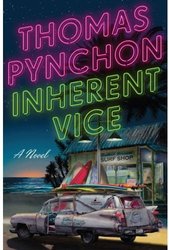
Inherent Vice cover: old beater of a car, with surfboards on its roof, sitting in front of a surf shop on the beach. Lots of loud pink colors, almost neon. The title of the book is in fact written in neon-type letters.

This is the book that would result if [film: The Big Lebowski], Chevy Chase’s [film: Fletch] series, and 1940s-era noir films were combined, if the classic noir blonde bombshell were updated into a 60s-free-love hippie chick, if the private-detective aspect of [film: Fletch] were kicked up a notch and made somewhat more serious, and if the whole thing were then novelized and relocated to 1969.

Our hero, a stoner private eye, ambles around late-60s L.A. after the Sixties have run their course and everyone in authority — cops especially — hates the hippies. Nixon is in the White House and Reagan is in the California governor’s mansion. His ex-girlfriend visits him on the very first page, announcing that her new boyfriend has disappeared and she needs help finding him. I’m not giving away terribly much if I tell you that they eventually have sex but it’s all, like, whatever, man? In any case, he can’t resist his dame (as an earlier generation of private-eye novels might have put it), so he stumbles around looking for clues. Despite smoking a really overwhelming quantity of pot (scarcely a page goes by when he doesn’t light up), he somehow manages to know a lot of people and ask the right questions. The cops hate him, but also seem to respect him. One of the pervasive mysteries in this book is how our hero manages to be both quite the slacker and also a reasonably competent PI.

People are always ending sentences with question marks? Even when it’s, you know, a declarative utterance? The endless mocking of California, and California stoner culture more specifically, is quite funny, but does bleed over into slapstick at points. This initially bothered me, but I suspect it’s Pynchon letting us know that we shouldn’t take any of it too seriously. So I didn’t. It’s a private-eye comedy, and it’s tons of fun.

This is the first Pynchon that I’ve managed to make it all the way through. I gave Gravity’s Rainbow a shot many years ago. I was a teenager at the time, which probably means I wasn’t ready for it in any case. But I think that would also be a tough read no matter when I read it. I distinctly remember giving up when the narrator dives into a toilet, goes for a long swim, and gets a turd stuck in his nose.

Not sure what made me grab this Pynchon when the author’s very name had been, for me, a mark of self-indulgent wankery. It could be the positive [mag: New Yorker] review. More likely it was that I stumbled into the Harvard Book Store while happily buzzed off strong Craigie on Main cocktails one night, and I couldn’t help myself. The purchase, given that background, was entirely appropriate.

The high cost of free parking — September 2, 2010

The high cost of free parking

The Cato Institute has been debating, bizarrely, with Donald Shoup over his book The High Cost of Free Parking. It’s bizarre because Cato is ostensibly libertarian, yet they’re trying to argue that government-mandated parking (in zoning laws and so forth) is okay because, essentially, the market would have arrived at the same solution on its own. They have no reason to think that.

The discussion started when Tyler Cowen, an economist at George Mason and contributor to the Marginal Revolution blog, took to the [newspaper: New York Times] to channel Stroup’s High Cost of Free Parking. Randal O’Toole came back with a bizarrely non-libertarian post that purports to be libertarian. (Might I suggest that the Cossacks work for the Czar?)

Shoup came back yesterday with what can only be described as an epic takedown. It is well worth your time. Short version: it helps to have the faintest idea what “evidence” means before you try arguing with someone who wrote a 700-page book on parking regulations. Shoup’s rejoinder is wonderfully well-written, too.

Books I own that I haven’t read —

Books I own that I haven’t read

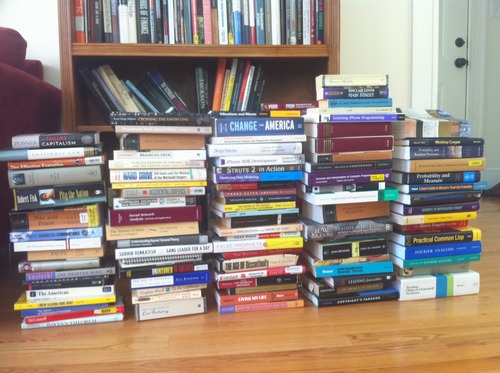
The other day I went through one of my periodic bouts of OCD, wherein I grab all the books off my shelves that I’ve not yet read. Turns out there are 100 books on that list; they’re below. It occurred to me that I went through the same exercise back in the day; I looked and found that indeed, I made such a list in 2006. There were 27 books on the list at that time. Of those, I’ve read five. I’ve decided that I’ll never read nine of them. That means I’ve added … uh … 87 books to the list. Yikes. This is not working out well. Here’s what the new, shameful pile looks like:

Five stacks of books, each probably two 20 inches high

The list of books in those piles is below the fold.

Then there’s the to-read list, which contains 540 books at the moment and which overlaps quite a bit with the list below. Oh, and I have a shelf full of math books that I will, in truth, probably never read (e.g., Munkres’s Topology). Not a hopeful scene at all.

I also have three books checked out of the library at the moment:

  • Probability with Martingales, on the recommendation of a Twitter follower
  • Google’s PageRank and Beyond, just to refresh my memory
  • Joshua Ferris’s novel The Unnamed, on Adam Kessel‘s recommendation.

Finally, I’m in queue for four books at the library:

Objectively speaking, this collection of books bespeaks almost pathological packratitude. So now I have my unread-but-owned book stack out in the open, sitting guiltily on the floor in front of my bookshelves. I’d like to say that I won’t buy another book until I’ve polished all of those off. A boy can dream about the end of his own pathologies.

  • Richard Posner, A Failure of Capitalism
  • Posner, Antitrust Law
  • Peter Drucker, The Effective Executive
  • Drucker, The Age of Discontinuity
  • Augustine of hippo, The City of God
  • Robert Fisk, Pity The Nation
  • Tolstoy, War and Peace
  • Joshua Angrist, Mostly Harmless Econometrics
  • Henry Adams, The Education of Henry Adams
  • Goethe, Faust
  • Faulkner, Absalom, Absalom!
  • Faulker, The Sound and the Fury
  • Jerzy Kosiński, The Painted Bird
  • Camus, The Stranger
  • Henry James, The Ambassadors
  • Henry James, The American
  • Sheldon Axler, Linear Algebra Done Right
  • Steve McConnell, Professional Software Development
  • Richard Swinburne, Bayes’s Theorem
  • William Bowen, Matthew Chingos, Michael McPherson, Crossing the Finish Line: Completing College at America’s Public Universities
  • Jon Bentley, Programming Pearls
  • Cervantes, Don Quixote
  • Daniel Dennett, Brainchildren
  • Michael Szenberg, Lalla Ramrattan, and Aron Gottesman (editors), Samuelsonian Economics and the Twenty-First Century
  • James Wallace and Jim Erickson, Hard Drive: Bill Gates and the Making of the Microsoft Empire
  • H.M. Schey, Div, Grad, Curl, and All That: An Informal Text on Vector Calculus
  • Robert X. Cringely, Accidental Empires
  • Joseph Schumpeter, Capitalism, Socialism, and Democracy
  • Stanley Wasserman and Katherine Faust, Social Network Analysis: Methods and Applications
  • Marshall G.S. Hodgson, The Venture of Islam, Volume 1: The Classical Age of Islam
  • Brendan Sheehan, Understanding Keynes’ General Theory
  • Sudhir Venkatesh, Gang Leader for a Day
  • Feynman, The Character of Physical Law
  • Susan Sered and Rushika Fernandopulle, Uninsured in America: Life and Death in the Land of Opportunity
  • Gérard Debreu, The Theory of Value: An axiomatic analysis of economic equilibrium (available in its entirety online; I took it to Kinko’s and had it bound nicely)]
  • Eric Hobsbawm, The Age of Extremes: A History of the World, 1914-1991 (part of his study of the impacts of the French and Industrial Revolutions on world history)]
  • Virginia Woolf, To The Lighthouse
  • James Joyce, A Portrait of the Artist as a Young Man
  • Tolstoy, Great Short Works of Leo Tolstoy
  • Sinclair Lewis, Main Street
  • Lawrence, Lady Chatterley’s Lover
  • Melville, Great Short Works of Herman Melville
  • Atwood, The Handmaid’s Tale
  • Kafka, Amerika
  • Pushkin, Yevgeny Onegin
  • Carl Boyer, The History of the Calculus and its Conceptual Development
  • Feynman, QED: The Strange Theory of Light and Matter
  • Thucydides, The History of the Peloponnesian War
  • José Zalabardo, Introduction to the Theory of Logic
  • David Frum, Dead Right
  • Frum, Comeback: Conservatism That Can Win Again
  • James Hoopes, False Prophets: The Gurus Who Created Modern Management and Why Their Ideas Are Bad for Business Today
  • Toni Morrison, The Bluest Eye
  • Søren Kierkegaard, Fear and Trembling/Repetition
  • Emma Goldman, Living My Life
  • George Scialabba, What Are Intellectuals Good For?
  • Bernard Bailyn, editor, The Debate on the Constitution : Federalist and Antifederalist Speeches, Articles, and Letters During the Struggle over Ratification (2 volumes)]
  • Mill, The Basic Writings of John Stuart Mill: On Liberty, the Subjection of Women and Utilitarianism
  • Martin Lewis and Karen Wigen, The Myth of Continents: A Critique of Metageography
  • Abelson and Sussman, Structure and Interpretation of Computer Programs
  • Georges Perec, A Void
  • George Akerlof, Explorations in Pragmatic Economics
  • Aristotle, The Basic Works of Aristotle
  • H.W. Brands, Traitor to His Class: The Privileged Life and Radical Presidency of Franklin Delano Roosevelt
  • E.M. Forster, Howards End
  • John Brunner, Stand on Zanzibar
  • Howard DeLong, A Profile of Mathematical Logic
  • Albert Hourani, Arabic Thought in the Liberal Age: 1798-1939
  • Sam Intrator and Megan Scribner, Leading from Within: Poetry That Sustains the Courage to Lead] (Intrator is the best teacher I’ve ever had)
  • Arthur Schlesinger, The Coming of the New Deal: The Age of Roosevelt Volume II, 1933-1935
  • Schlesinger, The Age of Jackson
  • Neil Netanel, Copyright’s Paradox
  • Vergil, The Aeneid
  • John Carlis and Joseph Maguire, Mastering Data Modeling: A User-Driven Approach
  • Don Brown, Chad Michael Davis, and Scott Stanlick, Struts 2 in Action
  • Bill Dudney and Chris Adamson, iPhone SDK Development
  • Alasdair Allan, Learning iPhone Programming
  • Gamma et al., Design Patterns
  • Joseph Hofbauer and Karl Sigmund, Evolutionary Games and Population Dynamics (to reread/read more thoroughly)]
  • Mark Green and Michele Jolin, editors, Change for America: A Progressive Blueprint for the 44th President
  • Robert V. Binder, Testing Object-Oriented Systems: Models, Patterns, and Tools (described in Test-Driven Development as the canonical book on software testing)]
  • A.P. French, Vibrations and Waves
  • Friedrich Nietzsche, Basic Writings of Nietzsche
  • T.W. Körner, Fourier Analysis
  • T.W. Körner, Exercises For Fourier Analysis
  • Peter Seibel, Practical Common Lisp
  • Robert C. Tucker, editor, The Marx-Engels Reader
  • Samuelson, The Collected Scientific Papers of Paul A. Samuelson (5 volumes)]
  • Mark-Jason Dominus, Higher-Order Perl (though I’m really more interested in it as a book about functional programming generally; my Perl days are over)]
  • David Griffith, Introduction to Electrodynamics
  • Cover and Thomas, Elements of Information Theory
  • Halmos, Measure Theory
  • David Pollard, A User’s Guide to Measure Theoretic Probability
  • Patrick Billingsley, Probability and Measure (Grimmett and Stirzaker is a prerequisite, Pollard may be another)
  • Grimmett and Stirzaker, Probability and Random Processes
  • David Harville, Matrix Algebra from a Statistician’s Perspective
  • Lewis Mumford, The City In History
  • Alicia Munnell and Steven Sass, Working Longer: The Solution to the Retirement Income Challenge (started reading it the other night; seriously one of the most depressing book introductions I’ve ever read)
  • Thomas Pynchon, Inherent Vice (I’m in the middle of it now)
  • Boccaccio, The Decameron
Upon hearing that a four-story New York City Barnes & Noble is closing — August 31, 2010

Upon hearing that a four-story New York City Barnes & Noble is closing

(…as reported in the [newspaper: New York Times]), it is perhaps appropriate to include a graphic which, while it doesn’t prove anything, is *suggestive*:

Stock prices of AMZN (Amazon), BGP (Borders), and BKS (Barnes and Noble) from late 2005 to now. B and N has fallen about 58.92% in that time; Borders has fallen 95.1%; Amazon has risen 198.21%

“BGP” here is Borders, “AMZN” is of course Amazon, and “BKS” is Barnes & Noble.

Borders’ market cap — the total value of its stock — is $67.1 million. Barnes & Noble’s is $838.49 million. Amazon’s is $55.44 *billion*. Granted, Amazon is not just a bookstore. But these numbers aren’t, I think, all that misleading.

While we’re on the topic of Amazon, it occurred to me the other day: there’s essentially nothing that makes Wal-Mart distasteful while making Amazon desirable. Both try to squeeze their suppliers as much as possible to get the cheapest prices for their customers. Both use their size as a weapon to get those low prices from their suppliers. Both are killing off neighborhood stores; it just happens that Wal-Mart does it rather more obviously than Amazon. Amazon would probably have labor troubles as well, if it had as many low-paid employees as Wal-Mart does.

And yet I buy from Amazon sometimes [1], while I wouldn’t be caught dead inside a Wal-Mart. This is partly an unconscious class thing: Wal-Mart is associated, among folks in my particular urban milieu (a friend calls us “SWPLs”, from Stuff White People Like), with trashy suburbs and poorer folks. Until recently, it hadn’t consciously occurred to me that that might be the issue, but I think it is.

That said, in both Amazon’s and Wal-Mart’s case we shouldn’t romanticize what came before. Amazon didn’t replace a nation of Harvard Book Stores; it replaced a nation of Barnes & Nobles and Borderses. B&N and Borders may have begun the trend of eliminating local bookstores [2], but they also eliminated Waldenbooks. Waldenbooks, in turn, had been a K-Mart property since 1984 (according to the Wikipedia). Likewise, Wal-Mart — at least in my limited experience — didn’t replace a nation of shopkeepers; it replaced a nation of K-Marts.

I have no real point here. I’d recommend that you buy books where you enjoy buying books. Everyone’s going to have his own tradeoff between price and localness. My cutoff is around $20: if the same book is $20 cheaper on Amazon, I’m likely to buy it there. I hope there comes a point when my income is such that I don’t pay attention to differences of that magnitude, but I’m not there yet.

Harvard Book Store facade

Around here, the Harvard Book Store is such an institution, and adds such color to the area, that its disappearance would be an incalculable loss. It’s hard to imagine Harvard Square without that beautiful black-and-gold façade; I hope I never have to imagine it.

A friend suggested a couple years ago that all the damage had been done: the market-share division between Amazon and the rest of the world was about where it was going to settle. I was hopeful then. I’m less hopeful now. Electronic books look like a real killer; Amazon made waves recently when it noted that it sells more electronic books than it does hardcovers (*new* hardcovers, presumably). That market is only going to grow, and there’s no reason to think that the Harvard Book Stores of the world can compete there.

So I’m worried. All I can do is continue to buy local when possible, and hope for the best. I’m lucky to live in a town where a Harvard Book Store is even possible; most places aren’t nearly so lucky. And even the local-bookstore market has thinned dramatically around here in recent years. When Wordsworth, the Harvard Square institution, closed six years ago, its founder bitterly noted:

> “In the 1980s … on Memorial Drive, you’d see people coming out of dorms and heading toward Harvard Square. In the 1990s, what you’d see in the windows of dorms was a Doppler effect of blue lights from computer screens, and you knew students were at their computer, hitting a key to order from Amazon.com. The only reason they’d come out of their dorms was to have Chinese food and mate.”

[1] — I normally get my books from the library. If I buy new books, I buy them from the Harvard Book Store just up the street. If I buy used books, I buy them off Amazon when they’re significantly cheaper than the Harvard Book Store’s copies. Also, Amazon’s used-book selection is just much better than any local store’s would be, particularly if I’m looking for obscure academic texts; HBS doesn’t carry those at all.

[2] — Those of us who grew up near Burlington, Vermont remember Chasman & Bem. In retrospect, it was a beautiful bookstore. At the time, I remember the service being terrible. If it were still around, and I still lived in Vermont, I’d be shopping there rather than at the Borders or Barnes & Noble up the street. It’s too late for that, though: Barnes & Noble moving in a couple miles up the street killed them off.

I visited my brother in Boston back in probably 1993 or 1994 and hit up a gorgeous bookstore with him in Faneuil Hall (the last time I actually hung out in Faneuil). I believe that was Waterstone’s, part of a British bookstore chain. It, too, is gone.