Albert O. Hirschman, Exit, Voice, and Loyalty: Responses to Decline in Firms, Organizations, and States — August 23, 2010

Albert O. Hirschman, Exit, Voice, and Loyalty: Responses to Decline in Firms, Organizations, and States

There is basically nothing on this cover but some 70s-style text: author, title, subtitle
There should be a category on bookstore shelves for “little, dense, incisive, ingenious books.” Exit, Voice, And Loyalty would be one; Herbert Simon’s The Sciences of the Artificial would be right next to it.

Hirschman here examines three methods for addressing an organization’s deterioration: “exit,” the option of leaving the organization, not buying its products anymore, etc.; “voice,” the option of sticking with the organization and protesting in the hopes of improving it; and “loyalty,” which is really more a property that encourages you to stay with the organization longer (thereby probably delaying exit and giving voice more of a chance). Normally we think of exit and voice as separate powers: exit is what you use in a market economy, while voice is what you use when dealing with a government (which is typically hard or even impossible to exit). Hirschman asks a simple question: how do these powers interact?

The interaction turns out to be fascinating. Consider parents dissatisfied with the performance of their children’s public school. The parents who are most focused on school quality are likely to leave first and put their kids in private schools, leaving behind only the less quality-focused parents who are less likely to speak up. So the exit option (parents abandoning the school) diminishes the use of the voice option (speaking up). This is likely to accelerate the school’s decline.

Or consider a product (maybe a brand of automobile is a canonical example here) whose quality has diminished over time. Again, exit is likely to be used before voice: the customers most concerned about quality will bail first. If too many customers bail too fast, the company won’t have enough time to fix the product before it’s gone out of business. Whereas if too many customers don’t bail out quickly enough, the company will never learn that its products need to improve. So one can postulate a certain optimal level of quality-sensitivity in customers: not too high to kill the company before it fixes things, but not so low that the company stagnates. Modeling this formally would naturally use an analogue of price elasticity; whereas price elasticity measures the percentage decrease in sales that results from small percentage increase in price, quality elasticity measures the percentage change in sales for a small percentage change in quality.

Indeed, one of the neat little accomplishments in this neat little book is that it uses formal economic models to study the interaction of exit, voice, and loyalty even when the context is, say, the decline of a government rather than that of a company. The indifference curves are mostly confined to appendices, and Hirschman’s writing is clear enough that normally you can get the gist just as easily — if less rigorously — from his words as from his charts.

A government would be a classic case where exit is basically unused: yes, you could leave the United States in protest — and some large fraction of our countrymen promise to move to Canada at every presidential election — but would you? So the main option available to you in a democracy is voice. Similarly, you’re likely to raise your voice in a political party before you’d exit it, particularly if the alternative party is far away from you ideologically.

Here Hirschman consults a famous model by Harold Hotelling, metaphorically applied to ice-cream stands lined up along a beach. Imagine that beachgoers are distributed uniformly along the beach, and two ice-cream stands are trying to decide where to place themselves to capture the most customers. Imagine that the ice-cream stands initially start on opposite ends of the beach, but are free to relocate. The leftmost ice-cream stand realizes that if it moves a little bit toward the center, it can continue to pick up customers to its left (because those customers are still closer to the leftmost ice-cream stand than to the rightmost) while picking up those customers that lie less than halfway between the leftmost and rightmost stands. The rightmost stand realizes, similarly, that it can move to the center and continue picking up those customers to its right while picking up a few more in the middle. This process continues until both ice-cream stands are almost exactly at the middle, separated by a tiny sliver of distance.

Replacing the beach with some measure of political ideology, the conclusion is that it’s always in political parties’ interests to move to the center. There are initial obvious reasons why the analogy isn’t quite right. It’s not obvious that voters are uniformly distributed across the ideological spectrum, for one. For another, the Hotelling model assumes that customers don’t care about the cost of walking down the beach: they’ll pick the nearest stand, regardless of how far they have to walk to get there. In a political context, this would imply that voters don’t especially care which beliefs their parties hold; they just want the party to be “closer to me than the other party is.” Which isn’t obvious: perhaps people on the right or left ends of the political spectrum really want parties on the extremes, and will opt out of party politics altogether if they’re forced to pick among centrist alternatives.

Hirschman ends up rejecting the Hotelling model as it applies to political parties, for the reasons laid out above (more to the point: because it fails to work empirically). Here he’s rejecting what is apparently known as Hotelling’s Law, not to mention the median-voter theorem.

For such a small book and so few atoms (three, in fact: exit, voice, and loyalty), Hirschman’s is remarkably dense with interesting ideas. Highly recommended.

Speaking of Lukas’s Common Ground — August 22, 2010

Speaking of Lukas’s Common Ground

(…as we were), it helped me realize another thing that’s really annoying about Ann Patchett’s novel Run: it’s ripped directly from Common Ground, only it loses all of the latter’s majesty and honesty toward its characters, and replaces them with cheap sentimentality. One of the families that Lukas follows in Common Ground, for instance, ends up suffering a crime so horrifying that thinking about it has denied me sleep on a few occasions; Lukas depicts the crime matter-of-factly, because his whole project is to turn an honest eye on race and on cities. A ghastly crime simply wouldn’t fit within Patchett’s world; it’s not treacly enough for her, and Run is trying so hard to Say Something that it avoids being honest when it should.

I’d invite you to read Common Ground and then Run, and tell me that Patchett didn’t ape the former in writing the latter. It would be one thing if she’d aped it with any respect or skill; as it is, she colorized it and replaced the soundtrack with carnival music.

J. Anthony Lukas, Common Ground: A Turbulent Decade in the Lives of Three American Families —

J. Anthony Lukas, Common Ground: A Turbulent Decade in the Lives of Three American Families

Cover of 'Common Ground': a school bus with a big squadron of police standing in front of it
I’ve been horribly remiss in not writing a review of Lukas’s monumental Common Ground: A Turbulent Decade in the Lives of Three American Families. To say that it’s a book about Boston’s 1970s-era busing crisis is to be, at some level, accurate, but to miss the immense, teeming landscape that Lukas has painted. Common Ground is nothing less than a history of race in the United States. It is a landmark. It is among the two or three nonfiction books that you really must read, along with Caro’s Power Broker and Rhodes’s Making of the Atomic Bomb.

Common Ground views race through three lenses: the Divers, white pioneers into Boston’s South End; the Twymons, black and living in the South End projects; and the white Irish McGoffs of Charlestown. The Divers are what you might call yuppies, though it is to Lukas’s extreme credit that he would never let a character be reduced to a label. The Divers, in any case, are some of the brave white folks who ventured into the South End when it was no place for white people, to try to build a neighborhood and a community. The Twymons — mother and children — are not destined for a happy life in the projects. The McGoffs are right in the thick of — and active participants in — the most virulent Charlestown racism.

Lukas is sympathetic toward his characters, and has the gift of telling their stories exactly as they themselves would tell them. And like Love in the Time of Cholera, Lukas takes the time, at every moment when it’s necessary, to step back and explain a bit of history if it’s important to his characters. Time and again we pause from the present moment to learn about someone’s poor Irish ancestors, or someone’s slave grandparents. The effect is that we’re not just reading three stories; we’re reading a web of interconnections. Boston, which so often gets tamed into an abbreviated “There was the Boston Tea Party … and then MIT came! … And now we have software. … Let’s walk the Freedom Trail!”, gets rightfully recast as the “blooming, buzzing confusion” that it really is.

Along the way, we meet many, many people. Probably the two strongest characters are Louise Day Hicks, member of the Boston School Committee, daughter of an iconic judge, and symbol of virulent anti-busing racism; and Arthur Garrity, the judge who wrote the momentous decision mandating busing for Boston’s schools. Hicks comes across looking opportunistic, brilliant, and willing to attach herself to the most despicable ideas if they’d advance her career. Garrity stands aloof from the havoc that he arguably created, calmly resisting all efforts to avoid busing. These two wildly different people are beacons in the storm.

A blurb on Common Ground’s cover by Studs Terkel, that master of ground-level history, says that it tells a truth about “all large American cities.” That is very true, but like most any attempt to describe Common Ground, this vastly understates the scope of its accomplishment. Common Ground tells the story of race in America as only a book about American cities can. Cities are the crucible where all of America’s problems get worked out — or not. If the problems get solved, they get solved here; if they fail, they fail here. Lukas documents the failure of American racial integration, and the arguably noble experiment that led to that failure.

I can’t emphasize enough, though, that one of the things that makes Common Ground so powerful is that, while Lukas may have set his sights on the stars, he knew that the only way to reach them was to start down in the dirt. At no point in Common Ground do you feel as though Lukas is trying to Make A Point. He probably is trying to do so, but he’s too disciplined a writer to give in to cheap moralizing or easy grandiosity. What’s grandiose in Common Ground are its people — each of them down in the shit with everyone else, surviving and maybe thriving as well as they possibly can. If their survival or their failure has any larger meaning, Lukas lets the characters and their history bring out that meaning.

American history has been, in large part, the history of race, the history of America’s original sin, and the history of its attempts to expiate that sin. In Common Ground, Lukas has condensed this history into the interrelated lives of a few Bostonians. In 200 years, Common Ground will be on the shelf along with a select few other books that mapped out where America came from and where it tried to go.

Carmen Reinhart and Kenneth Rogoff, This Time Is Different: Eight Centuries of Financial Folly — August 20, 2010

Carmen Reinhart and Kenneth Rogoff, This Time Is Different: Eight Centuries of Financial Folly

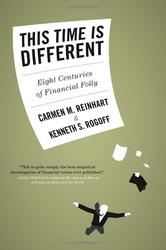
Neat cover. Avocado-green background, with a cartoon image of a man in a suit who is free-falling through the sky. His briefcase has detached from his hand, it's open, and there are papers flying out. The papers are scattering to the winds, and one of those papers carries the book's title and authors.
This book is selling very well and has initiated lots of conversations, so I can’t say that it’s a failure. Its authors are in high demand all over the place for their observations on the current economic crisis. Good for them. If I were a policymaker, I’d probably really like this book. As an educated lay reader, it turns out this isn’t the book for me.

It’s more of a compendium — an almanac, really — of financial statistics, with not very much narration layered atop. What it brings to the world is a large database of financial crises, painstakingly compiled from lots of sources. The data mostly span 200 years in the cases of banking crises and international defaults, reaching the full 800 years advertised in the subtitle only in the cases of things like hyperinflation or currency debasement. It’s interesting, but it’s not the kind of thing you want to take with you on a bus ride.

It is, with some justice, focused on the misbehavior of governments. We start out learning about government external defaults — reneging on debts owed to foreign governments. Reinhart and Rogoff note one outstanding puzzle: why do governments default when, in many cases, their debt-to-GDP or debt-to-revenue ratio is not terribly high (c. 10% or 20%)? If you examine also their internal defaults, Reinhart and Rogoff note that a lot of the puzzle goes away: governments often default to external partners when they can’t afford to pay their domestic creditors, either. But governments have an advantage over their domestic creditors in a way that they don’t over their external partners: they can put domestic creditors in jail, or kill them. It’s much harder to collect data on internal defaults, if only because such defaults will often be hidden beneath executions.

Governments have other tricks to get out of paying off their debts. One way is to hyperinflate the economy, thereby inflating their way out of debt. Another, similar way is to debauch the currency; this has been happening for hundreds, if not thousands of years, the earliest examples involving slicing tiny bits off gold and silver coins and decreeing that the coins are worth what uncut ones were. The invention of paper “fiat currency,” Reinhart and Rogoff note, has been a boon for rulers who want to inflate their money: it’s much easier to print more paper than it is to adulterate gold coins. No country has avoided defaulting on its debts by inflating its currency; the U.S. did so, rather stealthily, when it went off the gold standard after World War I.

The final category of “financial folly” that Reinhart and Rogoff tackle are the banking crises. The world thought we’d figured out how to avoid these — through banking-insurance systems like the FDIC — until the “shadow banking” system did us in during the current crisis.

In all these cases, Reinhart and Rogoff make a thorough, detailed case that there is nothing new under the sun: the crises that we had hundreds of years ago are the same ones we have now and the same ones we’ll probably have hundreds of years from now. There’s some slight hope that economic knowledge really will improve our policies, but it’s only slight.

Being largely a compendium of charts — typically one every other page, or more — the biggest sin this book commits is that the charts are just not that readable. My kingdom for some bolding in the chart captions; as it was, my eye flailed around on every chart, trying to pick out the things I was supposed to read. Each chart came with a hefty caption, detailing the many sources where its numbers came from. Each chart was subtly different: raw billions, percent of GDP, counts of crises since some specified time. Tons and tons of charts to read, yet the amount of time devoted to designing the charts was clearly much less than that devoted to the book’s overall design — which is gorgeous. (I let Princeton University Press know, by way of Twitter, how beautiful this book is; they thanked me, and told me that they’d pass along the good word to their designer. I’m happy to hear that; I don’t imagine book designers get much credit, usually.)

If you’re a policymaker, you probably want to read this book. Though I wonder if your time would be better spent with something like Dean Baker’s Plunder and Blunder; it’s short, and it contains a few rules of thumb to detect bubbles: principally price-to-earnings ratios above a certain threshold and property values growing very much at all. This Time Is Different seems like it will turn out to be more useful for the data it’s compiled, which others will put to use preventing future bubbles. It may not be a practical tool on its own.

The Kids Are All Right — August 19, 2010

The Kids Are All Right

(__Attention Conservation Notice__: 1,200 words trying, and failing, to explain why [film: The Kids Are All Right] is boring and trite and self-satisfied and annoying. The bulleted list below contains the full plot of the movie. Most of the judgments I pass on the film are outside the bullets, so you may just want to read the non-bulleted bits.)

I sat and stared at the screen for a long while, trying to explain what was so … *un-awesome* about [film: The Kids Are All Right]. Somehow that turned out to be really hard. If you take only one thing away from this review, please take away that [film: The Kids Are All Right] is super-overrated, and that I don’t understand why people are into it.

Maybe I’ll get some traction on explaining its lack of goodness if I just make a bulleted list of what happens in the movie. I’m going to summarize basically the entire plot here, so there will be spoilers aplenty. Don’t read on if you intend to see the movie.

I will include bolded question marks (like “__?__”) whenever some part of the movie just puzzled me.

* There’s a boy (“Laser”) and a girl (“Joni”) and their lesbian mothers, played by Annette Bening and Julianne Moore.
* The boy does some coke. He’s hanging out with a Bad Dude.
* Laser tells Joni that he wants to meet the sperm donor who was … uh … involved in their creation.
* Joni has to make the call because she’s older than Laser is (she’s 18, he’s 15), and … I guess you need to be an adult in order to make this sort of phone call? (__?__)
* Joni digs through her moms’ filing cabinet to find the sperm bank’s number, she calls that number, the sperm bank gets in touch with the donor, and they agree to meet.
* The sperm donor, Laser, and Joni meet. Things are a little hesitant and awkward at first. Laser thinks the donor is too self-satisfied. Joni likes him.
* Meanwhile, Laser is spending more time with a Bad Dude. The Bad Dude leads Laser into all kinds of trouble, the first bit of which is that they find the moms’ porn collection. It features men having sex. Earlier, we’ve seen the moms start getting it on while they watch dude porn. (__?__)
* The moms have been suspicious that Laser and the Bad Dude are gay together. After they catch Laser and his Bad Dude friend with the porn, they sit him down to have an Intervention and ask if he’s gay. It turns out he’s not gay. Laser asks why they watch dude porn when they are lesbians. They explain that it’s complicated, but it has to do with how female sexuality is internal, so they sometimes need to watch externalized sexuality. Or something. (__?__) Even within the world of the film, that explanation made no sense: the moms seemed confused why they themselves enjoyed it, and they couldn’t explain it clearly to their kids. Clearly the director, Lisa Cholodenko, didn’t expect the audience to understand the explanation, so it’s puzzling to me why she included it.
* The moms discover that their kids have met the sperm donor. The moms decide to meet him too. So everyone gets together for a terribly awkward dinner, wherein Annette Bening asks him, “So … when did you know you wanted to be in the food-service industry?” (He runs a restaurant. It seems successful. He also seems like a stoner.)
* The kids continue to hang out with him. Laser plays basketball with him. Eventually they get close enough that the donor can tell Laser that the Bad Dude is no good, and that Laser should stop hanging out with him. Laser takes umbrage at this.
* Shortly thereafter, Laser and the Bad Dude are walking along in a Bad Part Of Town, and they happen upon an old mangy stray dog. Laser gets down on one knee and starts to pet him. The Bad Dude insists that Laser hold the dog while the Bad Dude pees on the dog (__?__). Laser says no. The Bad Dude calls Laser a pussy. Laser shoves the Bad Dude and calls him a dick. The Bad Dude punches Laser. Thus ends the friendship of Laser and the Bad Dude. The sperm-donor dad has thereby proven his bona fides. Laser and the dad can now be friends.
* Julianne Moore’s character is trying to start a career as a landscape designer. She’s unsure of herself. The sperm-donor dad, Paul, invites her to help design the backyard at his house.
* Needless to say, eventually they bone. Even though she’s lesbian. (__?__)
* Annette Bening finds out about the sex. She is devastated.
* Paul tries to visit the Lesbian House to make amends. Annette Bening tells him to go and make his own family and get out of hers. That is the last we see of Paul. Other movies would have thought that Paul was maybe more important than that, and wouldn’t have dropped his character so artlessly.
* The painful process of reconciliation continues between Bening and Moore. Moore gives a little tearful speech to her family about how much marriage sucks, and how it’s so easy to take your partner for granted, and so yeah, sorry, cry cry cry. This is the scene that they’ll show when [film: The Kids Are All Right] is nominated for an Oscar; mark my words.
* The moms drive their daughter to college to start her freshman year. She asks them to leave her room because she’s been chafing under their grip (been going to parties, drinking, trying to make herself into a hypersexualized being that she probably isn’t), spends some time alone, and then semi-desperately comes looking for them after thinking they’ve abandoned her and gone home. She thereby proves that she’s still mamas’ little girl. Everyone has a big reconciling group hug, moms get back in the car and head home, Joni goes off to college, all is well, fade to black.

I think what bugs me most about this is that if it didn’t feature lesbians, it would be an utterly boring movie about the perils of a boring domestic life. But we all know what a boring domestic life is like; we live that life every day. What this movie contributes to that storyline is … lesbians. Its entire premise is basically “See? Lesbians have complicated lives too.” But this is not a discovery.

As for the portrayal of lesbians: throughout [film: The Kids Are All Right] and afterward, my ladyfriend and I agreed that there hadn’t been any actual lesbians involved in the making of the film. The web tells me that Lisa Cholodenko is, herself, actually lesbian, so my lady and I were wrong. What this movie teaches us, in any case, is that a) lesbians like watching guy porn, b) lesbians sometimes need to have sex with a penis, c) lesbian problems are just like straight-couple problems.

And throughout the movie, it’s a bunch of self-satisfied upper-middle-class Californians eating healthy, delicious meals in jaw-droppingly gorgeous homes and kitchens. The kids and the lesbian moms all sit down together every night to share dinner like a good, happy, boring domestic family. We’re watching any number of 1950s sitcoms, re-enacted with lesbians and dude porn.

Having written all this, it still doesn’t feel like I’ve captured the utter annoying banality of this movie, but I’ll have to let it go. [film: The Kids Are All Right] is transcendently boring; all descriptions of its banality are condemned to understate just how trite it is.

My only post on the mosque controversy — August 18, 2010

My only post on the mosque controversy

Here’s what I don’t get. Ideally, in a well-run society of intelligent people, you need to advance arguments for your position. You can’t just wave your arms up and down, claim “It’s not right!” and expect that to be the end of it. And your own personal disgust isn’t grounds for anything. When you enter the public sphere, you’re supposed to present *arguments*.

Now, granted, sometimes — often — personal disgust sells things. It shouldn’t, but it does. I’m convinced that the fundamental belief underlying opposition to gay marriage, for instance, is that opponents believe anal sex between men is disgusting. (If the gay-marriage debate were about *lesbians’* right to marry, I doubt it would be nearly this acrimonious.) There have been lots of purported “arguments” over the years against gay marriage, but none of them amount to anything at all. “Marriage is about raising children”: sure, but what about childless couples? “But won’t this lead to pedophilia and bestiality?”: obviously not, because obviously we only support marriage between consenting adults. And so forth. The problem with these arguments isn’t that they’re wrong, it’s that they’re *incredibly* wrong. They’re remarkably simple to swat down. It’s so simple to swat them down that they don’t even count as arguments. They’re not arguments; they’re reflexes. They’re meant to make other people raise their fists in agreement; they’re culturally evocative totems, not arguments. I’m not obliged to respond to your culturally evocative totem, and you’re not obliged to respond to mine. We’re only obliged to respond to arguments made in good faith. And so far as I can tell, no one has made any such arguments against gay marriage.

Nor have they made any such arguments against the “mosque” in lower Manhattan. The only “argument” I’ve seen is essentially that the wound from 9/11 is too raw, and that the area around Ground Zero is holy in some way. But clearly the “mosque”‘s opponents would have no problem with a Christian or Jewish (or Buddhist, or Zoroastrian) place of worship in that area. So the fundamental argument against the mosque, so far as I can tell, is that *Muslims as collectively guilty for 9/11*.

That’s it, right? Everyone knows that that’s the subtext beneath the entire dispute. If you can find some other, deeper reason why the “mosque” shouldn’t be built there, let me know, but I’ve certainly not seen it. And when Newt Gingrich says that “There should be no mosque near Ground Zero in New York so long as there are no churches or synagogues in Saudi Arabia”, it’s clear that he means exactly what I’ve suggested. All Muslims are responsible for 9/11, so there’s some kind of global [foreign: quid pro quo] that requires the Muslims everywhere to pay for the crimes of Muslims anywhere.

Put that way, I hope everyone would acknowledge that it’s a profoundly stupid, offensive, and false proposition. A tweet asking whether, since Tim McVeigh was Catholic, no churches should be allowed near the Murrah Federal Building sums it up as well as anything could.

And that’s it. That’s all they’ve got.

The debate became immediately confused, like they always do, by the meta issue of how this will affect [choose your favorite politician] in [choose your favorite upcoming race], or more specifically whether this will make Democrats look like pussies on what should be a morally clear issue (answer: yes). But all of that is immaterial. And doesn’t it just needlessly exhaust you? It exhausts me. There are a lot of things to think about in this life. There are a lot of things to get mad about. There are a lot of arguments to have about a lot of really important things. Becoming a morally aware adult, it turns out, is really hard.

If a lot of people are upset about the “mosque” in lower Manhattan, that is their business. If so many people are upset about it that it will cause some politicians to lose their jobs because they’re insensitive to others’ concerns, it is the politicians’ business to care about that. It is not my business to care about that. It is my business, as a rational member of a democratic society, to look at the arguments put forward against the Cordoba House and judge them on their merits. And there are no arguments. Shouldn’t that settle it?

Forgive me if this is an oversimplification of how democracies work. It certainly is. There’s a time and a place to engage in spirited rat-fucking. Other times, you just have to claw through the confusion on these issues, acknowledge that they really have no argument, and move on.

A question about Keynesian stimulus — August 16, 2010

A question about Keynesian stimulus

Here’s my dime-store understanding of Keynes (which tells me, by the way, that I need to go reread the General Theory):

  • Companies aren’t investing because they expect that in the near future, customers won’t be buying. They expect this for the completely justified reason that customers aren’t buying right now.
  • So companies don’t put their money into new factories and new machines and so forth. Instead they put it in the bank.
  • So they don’t hire new workers to man the new machines.
  • Now there’s less money in the pockets of the workers. So they buy less.
  • So rational companies look ahead and see more of the same: nobody’s buying, so they won’t be investing.
  • And so on down the drain.

So the government steps in to halt the self-fulfilling prophecy. The government hires workers to pave the roads, build bridges, paint murals, etc. They give those workers, let’s say, $10,000 apiece. Since they’re largely on the poorer end of the economic ladder, they spend most of that money on food and other necessities. Let’s say they spend 80% of what the government pays them. So they spend $8,000 of that $10,000. Someone else has then earned $8,000; assuming the recipient is situated similarly to the spender, 80% of that $8,000 then becomes new spending. And so forth. The initial $10,000 becomes $50,000 through this process of multiplication. (In general, if people spend r% of what they earn, the initial investment gets multiplied by 100/(100-r).)

Now companies expect that things will be different. They expect that next quarter will look a lot like this one, and this one turned out not to be too bad. So they invest. They hire more workers. Those workers spend money. That money gets multiplied, as above. The pump has been primed, the economy is rolling again, and yay.

Here’s my question, though: shouldn’t we expect companies to know that the good times won’t last? Companies must be expected to know that business will only keep moving so long as the government is supplying the jobs, right? Likewise, those employees working at government-provided jobs know that their jobs — paving roads, building bridges, painting murals — are only temporary. To the extent that they have any control over it, they’re going to try to save that money for a rainy day; they know that a rainy day is just around the corner.

The only honest way I can see out of this is for the government to credibly commit to a certain amount of continuous job-creation until the economy has reached some pre-determined goal (GDP increasing by a 3% annualized rate per quarter or whatever). Once the economy is moving on its own, the government promises to stop making work; until then, it’ll do everything it can. This creates the right expectations.

On the basis of this argument, including the bit about the multiplier, I don’t see what the difference — from the perspective of getting the economy moving — would be between a) the government mailing $10,000 checks to a million newly unemployed people, and b) the government creating jobs for a million newly unemployed people. In both cases you’re putting money in the unemployed folks’ pockets, and you expect that they’ll spend roughly the same fraction in each case.

Obviously there are non-stimulus reasons to prefer employment to mailing a check: work is good for people’s self-esteem, crime goes down when people are occupied, and in any case we should be spending money to fix things that need fixing. But toward the goal of setting expectations about the future, the cash and the work seem identical.

So is there any stimulus explanation for not just giving people a check? And, to get to the earlier question: is the idea of a one-time stimulus — any one-time stimulus — just doomed from the start? If you don’t set the expectation that you’ll pay whatever is needed, for however long it’s needed, won’t minimally rational economic actors be too cautious about spending what they have?

David Mitchell, The Thousand Autumns of Jacob de Zoet — August 12, 2010

David Mitchell, The Thousand Autumns of Jacob de Zoet

A wildly colored portrait of Nagasaki harbor
If you’ve read any of David Mitchell’s earlier books, specifically Cloud Atlas, I imagine you’ll think — like I did — that The Thousand Autumns of Jacob de Zoet takes place over literally a thousand years. I should burst that bubble for you now: it doesn’t. Somewhere in the middle of the book, you learn that Japan is the land of a thousand autumns.

To your and my surprise, then, this is a completely straightforward novel. I think Mitchell may have been compelled to convince the world that, yes, he can write novels that start one place, end another place, and don’t try to mess with your mind. He does it very well, as it turns out.

The title character lands in the Dutch outpost on Dejima, just off the coast of Nagasaki. (Right here, I expected that by the end of the book we would be in Nagasaki when the Bomb fell in 1945. The book starts [and, as it turns out, ends] in the 1700s, so I was immediately puzzled: how will Time-Traveling David Mitchell hit 1,000 autumns when we only have a couple hundred years to play with? Honestly, this left me with an odd feeling of anxiety.) He’s been beckoned there to help clean up the books: Dutch authorities believe that there’s been some mischief in the import/export accounting, and de Zoet is just the sort of upright man to clean things up.

Stop here and, being a good economist, consider the incentives. How much luck is a morally upright man going to have in such corrupt circumstances? If everyone’s in on taking a little out of every shipment, our hero will certainly have to be politically astute to avoid dashing his career (if not himself) on the rocks. He’s on a lonely island, surrounded by people he may very well make his enemies. The suspense of watching de Zoet wend his way through this battlefield is where the bulk of the book’s ample charm comes from.

There’s also, of course, a love interest: de Zoet falls curiously in love with a nurse whose face is mysteriously disfigured. I was going to go into some more detail about the difficulties they face in getting together, but I think I won’t. They face difficulties aplenty, needless to say, and the source of those difficulties turns out — as the story goes on — to be horrifying. If I said anything more, I’d risk giving away some of Thousand Autumns’s captivating plot twists.

It’s an absolutely riveting book; I couldn’t put it down. I might gripe that the ending is too pat (it’s almost as though Mitchell is responding sarcastically to those who believed he couldn’t write a more-standard novel), but that’s small beer: go grab a copy and be absorbed for the next few hours.

Loren Graham and Jean-Michel Kantor, Naming Infinity: A True Story of Religious Mysticism and Mathematical Creativity —

Loren Graham and Jean-Michel Kantor, Naming Infinity: A True Story of Religious Mysticism and Mathematical Creativity

Something like an oil painting of what looks like a monk and a scowling dude in a suit, walking together through a pastoral scene.
There’s great promise in this book, which it fails to live up to. It offers too little mathematics to appeal to even recreational mathematicians, and more mathematics than non-mathematically-inclined readers would be able to stomach. At the same time, it offers basically no interesting theology. It does, on the other hand, spend loads of time name-dropping Russian and French mathematicians for no good reason, and tells us all about persecution of academics during the Soviet era. It ought to be called “Russian Mathematicians: Some Things That Happened To Them For 75 Years Or So.”

The book’s fundamental assertion is that religious mysticism in Russia helped fuel the Russians’ great mathematical discoveries, and drove Russia ahead of France by the early part of the 20th century. That’s fine as far as it goes, but it obviously needs more than just some correlation to prove it. All Graham and Kantor have to offer is correlation: this one episode of mysticism happened, and this other episode of Russian mathematical flowering happened. We’re meant to conclude that the one caused the other.

It’s seemed to me, on the other hand, that at least since the great Kolmogorov, Russians have been particularly fond of abstraction for its own sake. This has allowed them to go off in mathematical directions of which the French daren’t dream. Did the Russian talent for abstraction drive their mathematical accomplishments as much as mysticism did? It seems to me that there could be many causes for the Russian mathematical flowering; Graham and Kantor focus on just one.

The reason they focus on just the one is that they’re interested in a particular Russian sect of Christianity, persecuted before and during the Soviet era, called the Name Worshippers. The Name Worshippers apparently believed that one could reach a trance-like state and come closer to god by repeating a particular prayer endlessly. The mathematics of infinity, pioneered by George Cantor, seemed to them a natural fit, for reasons that Graham and Kantor never make clear.

Cantor is most famous for his demonstration that certain infinities are larger than others — an idea that is very hard for many people to stomach, but which is rather easy to demonstrate and utterly commonplace in mathematics today. It was Bertrand Russell, I believe, who used a very straightforward example to demonstrate this. Suppose, said Russell, that you have a village in which a) every man has exactly one wife, b) every wife has exactly one husband, and c) no one marries outside the town. Then it doesn’t matter whether there are finitely many or infinitely many people in the town — you can be certain that there are just as many women as men. Mathematicians say that there is a “bijection” between the set of men in the town and the set of women in the town. If, on the other hand, there were an unmarried woman in the town and no unmarried men, then you could conclude that there were more women than men.

That’s where Cantor starts, in a discussion of very general objects called “sets.” A set is a collection of things bearing some properties in common — say, the set of all people alive and standing within the legal boundaries of Cambridge, Massachusetts at 11:28:00 a.m. on August 12, 2010, along with their couches. Two sets have the same “cardinality” if there exists a bijection between them. Cantor goes on to establish that can exist no bijection between the set of integers and the set of real numbers — that is, that the real numbers (rational numbers plus irrational numbers) is larger than the set of integers. He uses a very clever trick called the diagonal argument in which he first supposes that there does exist a bijection between the reals and the integers, then shows that such a bijection always leaves out some real numbers. It is unavoidably true that there are more reals than integers, which is to say that the reals are larger. Which is a special case, finally, of the assertion that some infinities are larger than others.

A lot of mathematicians at the time had trouble with this argument; abstract objects like sets seemed so far removed from the world of human experience that there were bound to be weird paradoxes and strange infinities. Better to stick with objects that were indubitably real, like the integers, and leave the abstract madness out of mathematics. Graham and Kantor blame French and German unwillingness to embrace abstraction for their falling behind the Russians. (The German mathematician Leopold Kronecker is famous for saying that God created the integers and that all else is the work of man.) It was Germans, Russians, and Hungarians, however — the German Gauss, the Russian Lobachevsky, and the Hungarian Bolyai — who had discovered non-Euclidean geometries 40 or 50 years before. Doesn’t this show two things? First, Germans and Hungarians were capable of letting their imaginations roam free, by casting off the Euclidean restraints that humanity had held sacred for 2000 years; they didn’t need Russian mysticism to make it happen. Second, did the Russian Lobachevsky need mysticism to achieve his breakthroughs? If not, then much of Graham and Kantor’s book reduces to “Some Russians needed mysticism. Others did not.” It becomes a documentary about an interesting coincidence, rather than something with any causal importance. Graham and Kantor clearly believe (see the final chapter in particular) that the Name-Worshipping episode is important to the development of mathematics, whereas to me it looks like a coincidence.

Returning to our story, though: the Russian Cantor’s set theory revolutionized all of mathematics. You can’t do serious mathematics now without encountering axioms posed in terms of sets. Look at the definition of a “topology”, for instance. Or what defines a “measure” (a mathematical generalization that covers ideas like “distance” and “weight” and “volume” and many others). You can compute the probability that a billion coin tosses in a row will all come up heads using only finite mathematics; but if you want to answer complicated questions like “what is the probability that a Brownian-motion path is continuous?” [1], you need infinities.

Graham and Kantor name-drop mathematicians and mathematical concepts, but rarely try to explain them; they gesture generally toward “functions of Baire class n” on a few occasions, without ever making it clear what these things are or why we should care. One gathers that a Baire class has something to do with discontinuous functions (the most pathological example of which is f(x) = 1 when x is rational, f(x) = 0 when x is irrational). And on a few occasions, Graham and Kantor suggest that the Russians found discontinuous functions freeing — that continuous functions somehow confine human will. Forgive me if I see absolutely no connection between the two. Graham and Kantor don’t help clarify what the connection might be.

So we get mathematical terms without mathematical understanding, and mysticism that’s mostly mystification. I could do without this book.

P.S.: I see that my friend Cosma Shalizi has also reviewed Naming Infinity, but I’ve not read his review yet.

[1] — Brownian motion shows up all over the place. It’s named after Robert Brown, who was studying the motion of pollen particles in water. Einstein used it to help estimate Avogadro’s number. Being physical objects, it’s reasonable to argue that pollen particles must move continuously (i.e., if they go from point A to point B, they must move through every point between A and B — they can’t just jump from one to the other). So then, if Brownian motion is an accurate model for the motion of pollen particles, you’d want to show that the probability of a Brownian-motion path’s being continuous is 1 — that is, that if you picked a Brownian-motion path “at random,” that you’d never pick a path wherein the pollen particle takes discontinuous jumps.

There are obviously infinitely many paths that a particle of pollen could follow; in fact, there are uncountably many paths. One is then forced, when judging models with the appropriate degree of skepticism, to hit up against Cantor’s infinities.

An axiom for life in the era of Twitter and Facebook — August 11, 2010