Why to get a smart phone — August 10, 2010

Why to get a smart phone

My friend Carl a while ago expressed some confusion about why he’d ever want to get a smart phone. It’s a reasonable question: carrying a computer on your person at all times is remarkably distracting. If you don’t send text messages, it may seem pointless.

This morning, as I edited the details on a calendar entry on my phone, it struck me that that’s the main thing I couldn’t do without. I enjoy when my phone rings to tell me that I have some event coming in an hour. I enjoy editing events on the phone and knowing that they’ll be synced up with the Google Mind, so that I’ll see the same information right away if I visit the Google Calendar website.

You might justify getting a smart phone by the sheer efficiency of the thing: if you’re carrying an iPod and a phone, why not combine them into one device (manufactured by Apple or otherwise)? Nowadays that efficiency argument seems weaker to me: if it helps me avoid spending endless time online, I’d prefer to have an iPod separate from a dumb phone. But then, iPod+camera+telephone+texting device? I wouldn’t want to carry four separate devices. And it’s really great to have a camera on me at all times. Taking photos and then uploading them immediately to some public service is something I don’t need; people can wait an hour or two to take a look at the food I just ate in a nice restaurant. So it’s not the instant nature of the photos that makes camera phones valuable; it’s being able to take photos at all.

The aggregate effects of omnipresent technology are interesting. For instance, some guy exposed himself on the T the other day, and Twitter helped catch him. That wouldn’t have been possible without omnipresent camera phones and (to a lesser degree) omnipresent social networking on mobile phones. We’re all carrying cameras nowadays; that has to have a marked effect on lots of things (think “police brutality”).

Texting is an interesting phenomenon: as has gotten a lot of notice recently, people are using their phones for voice calls a lot less nowadays, and replace those calls with quick texts. I certainly use my phone that way: for most anyone other than my girlfriend, I make initial arrangements for outings via email, then send little texts as the time approaches: “I’ll be 20 mins late”; “I’m there”; etc. These don’t take away from real in-person socializing at all; I certainly feel like my social life is better than it was 10 years ago when cell phones and texting weren’t so omnipresent.

When I hang out with my girlfriend’s 13-year-old son, I realize that this sort of *what does it all mean* conversation will be completely gone in 15 years, and that the 13-year-old would look at me as though I were the world’s dumbest man if I tried to have it with him now. Kids text much more than they speak on the phone. Period. We can try to shake our fists at the sea on this issue, but it would be incredibly pointless to do so. (Likewise, arguing against MP3s and in favor of physical media, or inveighing against casual file sharing between friends, has long since become the most wasteful use of your time. People share MP3s. Period. We may be unhappy about this because it denies artists some money, but it is a fact.)

One thing I definitely don’t miss from the dumb-phone era is that silly thing where you lose your phone and then email all your friends, “Hi, I lost my phone. Please send me your contact information.” That is totally played out. I sync all my contacts to Google now; if I lose my phone or get a new one or wipe and reinstall the OS, I take 30 seconds to create a new Google account on the phone, then start it syncing. Within a couple minutes I have all my contacts and all my calendar entries on the device. I enjoy that very much.

“Contacts” here also includes a lot of businesses; for some of those businesses I only have a physical address. It’s awfully handy, for someone with a sense of direction as bad as mine is, living in a non-Euclidean city like Boston, to be able to use a map, compass, GPS, and Google Maps to find my way from wherever I am to a favorite café.

The rest of what’s on my phone count as nice-to-haves. It’s nice to be able to write email from my phone, but I can certainly wait until I get in front of a full computer for that. It’s nice to have a web browser, so that I can settle some point of curiosity in the middle of a conversation; but as I think we’re all discovering, it would be a lot better for society in general if we put the phones away during any outing. So I’d actually contend that a mobile browser turns out to be a slightly net negative. Having Facebook and Twitter apps on the phone is probably a net negative: they’re little distracting games.

I’d say, then, that the main reasons to get a smart phone are

* never again needing to bother your friends with requests for contact information
* your calendar and contacts, available at all times and synced with an external service
* not needing to carry a separate camera, iPod, and phone

Everything else is nice to have, or actively harmful to your attention span.

I’ve certainly found that having a mobile computer has reduced my attention span. When I’m reading a book, I typically pull out my iPhone every few minutes: email, Facebook, Twitter, repeat. Sometimes I put my iPhone and laptop in another room while I’m reading. When I go on vacations, I leave all technology behind and bring a stack of books with me. (My lovely girlfriend, bless her heart, realizes that all I want to do on vacation is read books and spend time with her, and she’s more than willing to accommodate me on both.)

These reactions to my own distraction are possible because I remember when it was otherwise. I’m very curious how life will be for Stephanie’s sons, who didn’t exist before the Web and who became conscious entities during the era of the cell phone. They may not realize that a world with longer periods of focus is even possible or desirable.

Lest you think that I’m going to predict doom and gloom, I’m not going to. When I read John Ruskin, I saw an earlier generation of this descent-into-darkness brand of pessimism. Ruskin saw his beloved pastoral England destroyed by mass production and the dark satanic mills, and assumed that cities would always be destructive to the human soul. It’s possible that he was right: maybe, if you transplanted me back into late-18th-century England, I’d be brought to tears by the beauty of that lost world. Granted, though, that macro changes often bear no resemblance to the desires of any individual actor, I think people tend to adapt the world around them to what they want. The city I live in now serves my needs pretty well.

In 150 years or so, I suspect the techno-pessimists of today (like George Packer) will look a lot like Ruskin: correct in some points, maybe tragic in their correctness, but shortsighted and naïve and futile.

Constance Reid, Neyman: From Life —

Constance Reid, Neyman: From Life

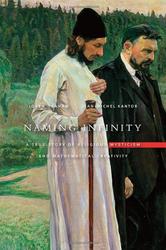
Standard boring academic cover, with basically just the words on a yellowy cover
Jerzy Neyman is one of those epochal researchers who developed tools that working scientists use every day, without necessarily knowing that they’re doing so. In 200 years they’ll still be using his tools, and he’ll have descended even more into the obscurity of constant use: mathematicians don’t need to write “quadratic reciprocity (Gauss, 1801)”; likewise, even when people have forgotten that it’s the Neyman-Pearson Lemma, they’ll still be using the Neyman-Pearson Lemma.

What this famous lemma gives us is a rigorous reason to use the particular statistical methods that we’d been using on intuitive grounds previously. It shows that in a certain well-defined sense, the best statistical test we can use is one based on likelihood ratios. A likelihood ratio, in turn, is the ratio of two probabilities: the probability that the data you see before you would have arisen under one hypothesis, divided by the probability that it would have arisen under another hypothesis. [1]

Neyman’s work laid the foundations of mathematical statistics, in the sense of deriving statistical results with the rigor of mathematicians. The decades following Neyman and Pearson’s work saw probability theory become rigorously grounded in measure theory, and saw statistics rigorously grounded in probability theory. And it saw statistical methods applied to countless problems well beyond gambling and agriculture. Neyman was at the center of all of this: he started what quickly became the world’s greatest center of statistical research, at Berkeley, and applied rigorous methods all the way from the foundations of statistics up to the structure of galaxies. He was, by any measure, an awe-inspiring scientist.

Constance Reid managed to catch Neyman while he was still alive. She interviewed him every Saturday toward the end of his life, and published the book soon after he died. Her biography isn’t scholarly, in the sense of digging very far into the content of his work. I think it’s fairer to call it an “academic” biography: it spends most of its time following Neyman’s university career, the conferences he organized, and the spats he got into with other statistical luminaries — principally the legendary R.A. Fisher, whose immortality in genetics is just as assured as it is in statistics. Fisher doesn’t come out looking very good under Reid’s lens: he’s bitter, condescending, egomaniacal, imperious, and unwilling to brook even the slightest disagreement on his work.

Reid has a bit of a fine line to toe: go into too much detail about the content of Neyman’s work and she’s likely to alienate general readers; go into too little detail and she’ll alienate technical readers. (Neyman: From Life is published by Springer-Verlag, the canonical publisher of math textbooks, so it’s clear that she has a technical audience in mind.) I think she stays too far on the non-technical side: we learn a lot about the conferences Neyman traveled to and the bureaucratic dust-ups he started at Berkeley, but very little about what, exactly, got Fisher and him so angry at each other. Was it that Fisher came from an earlier era when intuitive derivations of statistical results were acceptable? Was it that Fisher found Neyman’s methods appropriate for large samples but useless for small ones? Did it have something to do with “fiducial inference,” which is a Fisher innovation that I’ve never seen anyone explain clearly? (Check out its Wikipedia entry and try to explain to me what “fiducial inference” even means.) It’s not always clear that Reid herself knows the answers to these questions, and from time to time she describes Neyman glossing over some details during their interviews; he may not have thought much of her technical chops either.

That’s really a small gripe, of course: most people really will not need the kind of intellectual biography that I hoped to find. Instead they’ll meet a statistician who’s still unfairly productive in his 80s, whom the university can’t possibly let go of without forfeiting hundreds of thousands of dollars in grant money and a world-renowned conference every year. [2] Neyman seems like a perfectly lovable [foreign: mensch], ambling about with his cigarettes, prodding students into doing math at the blackboard, and traveling everywhere with his “long-time collaborator and constant companion”, Professor Betty Scott.

(Reid’s coverage of Neyman’s private life is hilariously restrained. It would seem, on the basis of a few hints from others throughout the book, that Neyman was something of a ladies’ man. Reid seems to have shied away from asking Neyman’s wife what she thought about this; either that, or she avoided writing any of it down.)

Reid’s book has certainly rekindled my love for mathematical statistics, which I enjoyed studying so much at Carnegie Mellon. I’m definitely going to revisit the subject now that I’m older and maybe marginally smarter.

[1] — Here I simply must link to Cosma Shalizi’s clever derivation of the Neyman-Pearson Lemma on economic grounds.

[2] — The full text of the Proceedings of the Berkeley Symposia on Mathematical Statistics and Probability is available online? That’s several thousand pages. It contains many groundbreaking papers, among them the one in which Charles Stein introduced what we now call Stein’s Paradox. Amazing.

David Lipsky, Although Of Course You End Up Becoming Yourself: A Road Trip With David Foster Wallace — July 31, 2010

David Lipsky, Although Of Course You End Up Becoming Yourself: A Road Trip With David Foster Wallace

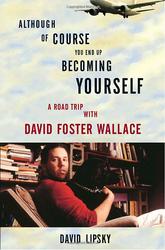
A photo of David Foster Wallace in his study/office. His chair faces our right, and his head is turned right to face the camera. He's holding his black lab on his lap. Wallace's face looks a bit tired.
Anyone who loved David Foster Wallace while he was alive will find this book both very charming and very painful. What Although Of Course You End Up Becoming Yourself shows very clearly is that David Foster Wallace was the same person in real life that he was on the page. His fans already knew this: the great charm of A Supposedly Fun Thing I’ll Never Do Again — particularly the title essay, which is one of the most gut-bustingly hilarious things you’ll ever read — is that Wallace is like an extremely smart, articulate, verbose, overeducated, humorous friend of yours, walking alongside you and pointing out things about the world around you that you would have missed. You figure out right away that there’s no way Wallace could have faked this on the page.

In Although Of Course, we join Wallace on a book tour for Infinite Jest, his magnum opus about late-20th-century America. [mag: Rolling Stone] has asked David Lipsky to follow Wallace around for a few days on the tour; a road trip ensues. We follow Wallace and Lipsky in cars, on planes, on smoke breaks outside of hotels, and in diners, and we get the largely unedited transcript of their conversation.

The effect is that I love Wallace even more now that it’s over, and could do without David Lipsky. I wanted Lipsky to disappear from the narrative, except that I wanted him to ask more interesting questions. He spends what seems to me like an absurd amount of time asking Wallace how he was dealing with so much fame: Wallace here was at his peak, having been featured on the cover of [mag: Time] magazine (among others). Lipsky’s probing here feels like he’s following around a starlet who’s known for trips into and out of rehab, and continually asking her, “Do you miss alcohol? Would you really like a drink right now? Oh man, you must be thirsty. How about a drink? No, just water. Ha ha. Mind if I have some gin from this flask? Don’t mind me, I’ll just have a drink.” Lipsky is after something, and it’s not clear what. Yes, Infinite Jest — the instant cause of the road trip — is about American addictions, including addictions to fame, but Lipsky’s questioning goes well beyond what the book itself warrants. He detects in Wallace a fear that becoming famous will take away from his writing, so he keeps poking and poking and poking at it — in the hopes of eliciting what, I don’t know.

The experience of reading a book like this is akin to that of watching a “behind-the-scenes” video from, say, the White House. If you’re like me, you never forget that there’s a camera there, and you never forget that everyone in the room knows a camera is there, and you never forget that no matter how much you tell people to “act natural,” they’ll always behave as though there’s a camera in the room. This book calls attention to the camera more than most, or in this case to the microphone: Lipsky transcribes every moment when Wallace asks him to turn off the mic, every moment when the recorder runs out of tape, every moment when Lipsky turns to the mic and adds some context to the transcript (“Here David is talking about…”). Wallace himself often remarks upon the device, and notes how flattering it is to have his every snort, sigh and eye roll scrupulously taken down.

While maybe interesting from some postmodern perspective (the camera turns back on itself ::spooky involution::), this makes for exceedingly distracting narration. The book was very consciously laid out as a nearly unedited travelogue, and you can think of various reasons why this might be a good way to do things. But most of the time, I wanted Lipsky to use some authorial discretion. We don’t need to know every time that Wallace coughed. I am sorry to break this news to Lipsky, but it is true.

All that said, Although Of Course You End Up Becoming Yourself is worthwhile reading because Wallace himself is such a fascinating subject. There’s probably no one with whom I’d rather have gone on a road trip. If Lipsky is up for it, I’d gladly edit this book into a better one that doesn’t feature Lipsky at all. Probably no use waiting by the phone for his call.

P.G. Wodehouse, The Best of Wodehouse: An Anthology — July 10, 2010

P.G. Wodehouse, The Best of Wodehouse: An Anthology

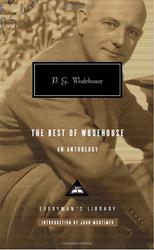
Wodehouse sitting in a suit, hunched over somewhat, or maybe sitting Indian-style, elbows on knees, looking to his right at the camera. It's hard to see in this image, but it's as though we're viewing Wodehouse through many very fine Venetian blinds.

I finally got around to reading Wodehouse! I’ve not known where to start for so many years, and as I’ve mentioned before I’m highly sensitive to the first book I read by an author. If it’s a terrible book — if, say, I’d started my Philip Roth career with the quite awful Plot Against America — I’m likely never to read anything by that author again. I was concerned that the same would happen with Wodehouse.

I needn’t have feared. My sense, after reading this absolutely delightful story, novel, and autobiographical-essay anthology, is that the bulk of Wodehouse’s stories are essentially the same and are all pure joy. It’s not fair to call Wodehouse a “one-trick pony,” because the real trick that makes all his stories work is an effortless command of English prose. It’s just that the skeleton of the stories, if this anthology is any indication, is more or less the same. I couldn’t have been happier during the hours I spent in Wodehouse’s company.

The structure is like so. Some young member of the English upper class is hard up for money, his allowance from a rich uncle having been frittered away gambling on horses. He’s not so bad off, you’ll understand — his valet still attends to his every need, and his time is spent sauntering from one leisurely meal over one linen tablecloth to another. In fact his needs are so taken care of that he pines — whether or not he acknowledges it — for a bit of spice.

The spice typically comes in the form of a girl he wants to marry, or in some scheme that his (likewise entirely-taken-care-of) aunt hatches. The novel that begins this anthology, for instance, is entirely ridiculous and centers on a “cow creamer” that Wooster’s aunt covets. She commands Wooster to steal it. And why would he do such a thing? Well, because she holds the sword of Damocles over his head: if he doesn’t steal it, she’ll deny him any future meals prepared by her godlike French chef, Anatole. That settles it for Wooster: he will steal that cow-creamer. Anything for Anatole.

A black British policeman's helmet, the strap peeking out from under, big silver badge on the front From there we head down endless ridiculous paths. Wooster, during an earlier moment of debauchery, tried to steal a policeman’s helmet and thereby drew the judge’s undying enmity. Through various [foreign: dei ex machina], he ends up needing to do the very same thing again. I think he gets engaged a couple times in there.
What exactly happens doesn’t matter. What makes these stories endless fun is watching Wodehouse pull the strings and lead you through ever more confusing paths. It’s maybe the reverse of a mystery novel: you keep your eyes peeled throughout a mystery novel to see where the big important clue is, knowing all along that it’s The Person You Never Expected at the very end; in Wodehouse you convince yourself, at every fleeting “well, I guess that mess is over with” moment, that the mess really is over with, only to find a moment later that Wooster is back in the soup.

Jeeves saves everything at the end, of course. Jeeves saves things repeatedly throughout all the Jeeves/Wooster stories. He’s the ultimate, patient, wise, unerring butler. Once during this anthology, Jeeves was off on a vacation somewhere, but eventually Wodehouse realized that this just wouldn’t do: Jeeves came back and saved the day again.

The novel near the end of this anthology — Uncle Fred in the Springtime — does without Jeeves or Wooster. Instead it features the kindly, doddering old Ninth Earl of Emsworth and the perpetually youthful Fifth Early of Ickenham. These are two wonderful characters who recur in several stories throughout the collection; as with every other story here, they are pure delight. Emsworth is basically senile and mostly deaf; he lives with Constance, his harpy of a sister. She controls everything he does, except for those occasions when she steps out for a bit and the old man does something silly, like shoot his private secretary with an air gun (see “The Crime Wave at Blandings” — see, in general, any number of entertainments that take place at Blandings).

The Earl of Ickenham is similarly situated but not so doddering as the Ninth Earl; whenever his relative (wife, sister, it doesn’t really matter — she exists in these stories to step out at opportune moments) disappears, he finds an excuse to pull his shy, perpetually nervous nephew, Pongo, into a trip to London. These trips rejuvenate the old man, and he finds some new inventive way to make trouble every time. In one story he schemes his and Pongo’s way into a house while pretending to be parrot groomers. Uncle Fred in the Springtime, by contrast, is 200 pages of Ickenham’s scheming — a smile on his face throughout, pretending to be someone new as the situation calls for it, getting everyone out of scrapes through his ingenious improvising. He’s the Jeeves character in these stories, though he’s sprightly and voluble while Jeeves is as careful and standoffish as you’d expect from the perfect valet. In any case, they both specialize in using their speedy brains to get others out of trouble.

The plot matters little in these stories. One, “The Amazing Hat Mystery,” goes like this: two gentlemen — one tall with a massive head, the other short with a little head — buy hats from London’s premier hat-maker; this is the king’s own hat-provider, we’re given to understand. The hats are delivered a short time later. There is a mix-up, with the small hat going to the big man and the big hat to the small. The gentlemen each head out to woo their respective love interests: the tall man is in love with the short woman, the short man with the tall. The respective ladies tell their respective gentlemen that their respective hats are vastly mis-sized: the one looks like a thimble atop the massive man’s head, while the other comes down to the small man’s knees. Both gentlemen take great umbrage at the shot that’s been fired across the bow of London’s premier hat-maker. Both assert the impossibility of a mis-sized hat. Both storm out of their partners’ company, declaring the end of each love affair. They retire to the same public house to drown their sorrows. They hang up their hats on the hat rack. As they leave, they each pick up the right hat. On the street, the tall man runs into the tall woman, the short man into the short woman. Each woman compliments each man on the perfection of his hat. Each man and each woman finds his or her proper mate. No one ever figures out why the hats initially failed to do the trick. The end.

You know from the start of this story how it’s going to work out. The great trick that Wodehouse pulls off is that he’s a magician of the obvious story. He’s laid out all his cards within the first couple pages, yet you are unavoidably hooked. Over and over throughout this anthology, I lost myself in the story — and in Wodehouse’s effortless prose — within moments. 800 pages, containing two novels, 14 short stories, and an autobiographical afterword, flew by.

Now I’m a member of the Church of Wodehouse. I have no choice but to read everything he wrote.

Ben Greenman, What He’s Poised To Do: Stories — July 9, 2010

Ben Greenman, What He’s Poised To Do: Stories

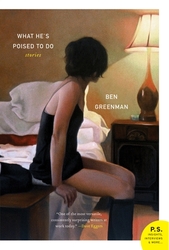
Oil painting of a woman in negligee and knee-high stockings or boots, looking away from the camera toward a table lamp situated on a night-table. You can't see it from this photo, but the image continues over the spine and onto the back cover of the book; on the back cover, we see a man in a somewhat rumpled suit with a turned-down mouth. The woman sits on a rumpled bed, and the man stands on the bed's other side; looks like he's on his way out after a hotel-room assignation

Reading this collection of short stories, I felt a lot like John Mayer narrating a baseball game that he didn’t understand. This was a series of short stories that ended with my saying, “Aaaaand that happened!” One of them, for instance, features characters who have — yes, right — moved to the moon. But it’s like … they haven’t really moved to the moon. Or maybe they have, but the moon behaves a lot like Nebraska. So … that happened.

Most every story involves people at some emotional distance from their loved ones. There’s the husband away on an extended business trip and listlessly sleeping around while he’s there; he tries to have a phone conversation with his wife, but both of them burst into tears almost immediately. So they settle for writing letters or postcards to one another. That’s how the book works in general: people write letters to one another that sound listless, distant, and a little broken. Sometimes people are so distant from one another that all they can manage is a postcard.

But then sometimes the stories are just plain funny. A guy and his wife head off to a cottage for a romantic getaway; the guy is overwhelmed by the beauty of his surroundings, so he flounces about sniffing honeysuckle and taking in the natural whateverwhatever of it all. Meanwhile his wife is dragging their luggage along to the cottage, glaring at him. He thinks he knows what she means by that glare: sex is on. He rushes up to the bedroom of their cottage, leaving her to deal with the luggage. He throws the bedroom window open, takes in the perfection of the natural scene, gets naked, and reclines upon the bed to await the inevitable carnality.

The fellow who reviewed What He’s Poised To Do for The Bookslut was overwhelmed. He had the same experience with this book that I had with Nabokov’s Lolita: he was so affected by it that he had to step away often, take a breath, and think about what he’d just read. I did not feel that way. It took me a couple hours to tear through What He’s Poised To Do — not wasted hours, certainly, but basically ho-hum hours. Greenman’s characters are so beaten down by life, and (except for one, an African-American man who revisits his roots in Malawi in the late 60s) have such flat affects, that I suspect it would be hard for What He’s Poised To Do to quicken anyone’s pulse.

Ian Frazier, Lamentations of the Father — June 27, 2010

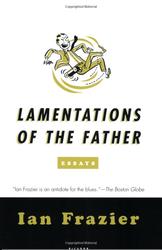
Ian Frazier, Lamentations of the Father

Cartoon of a vexed father slipping on a child's wheeled toy and falling backwards, a vexed look in his eyes. The [mag: New Yorker] sort of humor gets its canonical expression in S.J. Perelman, whose style is probably best captured in his classic essay “Insert Flap ‘A’ And Throw Away.” I can’t find any full copies of that essay on the web, though Language Log grabs some choice quotes.

At the risk of analyzing [mag: New Yorker] humor to death, it tends to combine a) an excerpt from a real-life newspaper article, which it then expands into b) an absurdist interpretation of that same article, typically including c) the narrator making an ass of himself. It may also include d) the male householder trying and failing to grasp some shred of dignity (see Perelman quote, above).

Ian Frazier does all of these things. What makes him different from Perelman or Woody Allen or any of a long line of absurdist [mag: New Yorker] writers is that Frazier is not funny. I am sorry to declare this. I laughed a few times during Lamentations of the Father, but mostly I had no choice but to step outside the frame and note, “Yes, I see what you’re doing there. I see that you want me to laugh.” Whereas when you read a Perelman or an Allen or a Steve Martin essay, you’re too busy doubled over laughing, in tears, to think about what the author is trying to do.

Perelman brings something else to the enterprise that Frazier just does not have it in him to use: a crazy, effortless, ridiculous command of the English language. Perelman is the man who uses the word “firkin” in two of my favorite sentences ever:

He is a hearty trencherman, as befits a man of his girth, and has been known to consume a firkin of butter and a hectare of gherkins in less time than it takes to say ‘Bo’ to a goose.

and

Of course, five cents in those days bought a good deal more than it does now; it bought a firkin of gherkins or a ramekin of fescue or a pipkin of halvah…

These are sentences that don’t need to exist. They are very, very silly. They add up, through steady and deliberate accretion, to endless belly laughs. They are cleverer than anything I will probably ever come up with in my life. By writing for [mag: The New Yorker], Ian Frazier has placed himself beside these sainted authors; he cannot avoid a negative comparison.

So my advice is to skip Lamentations of the Father and go straight to what Frazier was aiming for in his cargo-cult-comedy exercise. Read any of Woody Allen’s short collections (Without Feathers, Side Effects); Most of the Most of S.J. Perelman; or the [mag: New Yorker]’s own collection, Fierce Pajamas.

Peter-Paul Koch, ppk on JavaScript —

Peter-Paul Koch, ppk on JavaScript

![Cover of ‘ppk on JavaScript’: the letters ‘ppk’ spelled out hacker-like, with ‘]{’ supposed to form a ‘k’ and so forth.](https://static.stevereads.com/img/book_covers/ppk_on_javascript_cover_smaller.jpg)

This is a book for beginning JavaScript developers. If they come to this book with any pre-existing software-development experience, and they have any choice in the matter, the most sensible response will be to run away from the field as fast as possible.

There’s no elegance in this book. It is a collection of ways to hack around browser defects. This is expected, given that its author runs the famous QuirksMode website, documenting in glorious detail all the ways that browsers vary in their support for web standards. You’ll find, for instance, that Internet Explorer calls the target of an event its srcElement, while the standard calls it its target. So then you’re required to write a little shim like ppk’s doSomething() method. Or you’ll find that the XMLHTTPRequest object behaves differently under different browsers, requiring another abstraction like ppk’s createXMLHTTPObject().

None of this is actually interesting. At best, when you’re done using every one of these abstractions, you will have overcome some silly impediments to doing what you actually want to do. What is interesting about software development is actually solving problems. When a language — or, in this case, an ill-specified language with competing frameworks — gets in the way of getting the task done, it forces you to gnash your teeth just to accomplish basic chores, not to speak of the challenge that you entered the profession to solve. Syntax hurdles are not interesting; actual substantive problems are.

This sort of problem is why libraries like jQuery exist. Instead of dealing with every browser’s strange implementation of XMLHTTPRequest, you deal with a normalized jQuery object that looks like $(someObject). That $(…) business is where all the target-versus-srcObject, ActiveXObject-versus-XMLHTTPRequest nastiness gets hidden.

Indeed, throughout ppk on JavaScript, all I could think was that much of what Koch was writing should be hidden behind frameworks like jQuery. (And if Koch were writing this book today, I’m fairly certain he’d help you skip all that.) An ungodly fraction of the rest of ppk on JavaScript is devoted to the basic syntax details of JavaScript — for-loops, while-loops, and the rest. Any experienced developer is going to skip right over these.

It is a valuable book if you want to understand the fundamentals beneath your jQuerys and Node.jses and such. I’m sure it’ll be good to have on my shelf to grab when I encounter some corner case. But over time, the difficulties covered in ppk on JavaScript are getting hidden more and more beneath frameworks, and pushed out of existence as browsers become more standardized and websites drop support for old browsers. So ppk on JavaScript starts to look like a dated catalog of the bad old days.

P.S.: It’s a small nit, but I really did enjoy this line of Koch’s: “Frankly I don’t believe that Internet over mobile phones will ever amount to much in Europe and North America”. ppk on JavaScript came out in late 2006; the iPhone came out in mid-2007. Talk about bad timing. This convinces me (as if I needed any more convincing on this point) that playing the tech prognosticator is a mug’s game.

In defense of AT&T — June 22, 2010

In defense of AT&T

People love to bust on AT&T, but I have to say that I have no — zero — complaints about them:

* __Reception__: AT&T’s reception has been better than it ever was when I was on Verizon. I can make calls from inside my girlfriend’s house in New Hampshire, and from inside my parents’ house in Vermont; on Verizon, I always had to step outside in both those places. And AT&T doesn’t even have service in Vermont! Needless to say, their reception in Boston is just fine. I’ve had some problems in the immediate vicinity of my workplace in Kendall Square; I believe that’s because the volume of electronic equipment there is over the top and causes lots of electromagnetic interference. I’ve had some problems with their reception in New York City. (NYC people: has AT&T gotten any better there?)

* __Their online store__: People were bitching and moaning about being unable to buy an iPhone 4 because AT&T’s website got slammed. I had no such problem. I ordered an iPhone from them on the day it became available, and was notified today that it’s shipped. (By the way: is “I’m going to have to wait a few days to order my several-hundred-dollar pocket computer, *and I am pissed*” the definition of “first-world problem”?)

* __Customer service__: Verizon’s customer service was always great, and they always tried to find me the plan that fit my needs. AT&T has done the same. (Bank of America’s customer service is also stellar. I guess I’m supposed to hate BofA too, but I don’t.)

Others may have had worse luck, but I kind of wonder if people just like getting mad at big companies.

Barack Obama…for state senate! —

Barack Obama…for state senate!

Back when I was in college (Carnegie Mellon class of 2000), a friend who was attending the University of Chicago gave me a placard that was posted hither and thither on Chicago’s South Side: a dorky-faced guy with a ridiculously toothy grin smiling out at us. It read

“Barack Obama

for state senate”

My buddy Josh and I thought this was hilarious. Over the years, we turned the guy on the placard into a superhero. We’d be studying for one hard exam or another and would say to one another, “You know who could ace the piss out of this test right now?” The other would respond, “*Barack Obama!*” to which the first would respond, inevitably, “…*for state senate!*” Or we’d be at the gym: “Man, these weights are *tough*! … Know who could lift them without breaking a sweat?” “*Barack Obama!*” “…*for state senate!*”

The years go by. It’s 2004. There’s a dude up on the stage at the Democratic National Convention who’s making everyone ask, “Why do I have to vote for Kerry? Why can’t I vote for this guy?” Josh and I called one another: “Uh … dude, do you see who’s on stage right now?” It was surreal.

It’s still surreal. Every few months it occurs to me afresh that Josh and I were making this obscure local politician the punchline of a joke probably a decade before he became president of the United States. Bizarre.

Little Eclipse nits I want to fix: a series of notes to myself — June 18, 2010

Little Eclipse nits I want to fix: a series of notes to myself

As I think of them, I’ll add notes here on what I want to add to Eclipse. Eclipse is really pretty fantastic, and it’s 90% of the way to feeling like a really comfortable tool for me. Here’s what would make it perfect. Since it’s an open-source tool, I should be able to fix it.

1. Sometimes — but not always — you can Select All in the Project Explorer. When you can’t, you can click the first project in the list, then shift-click to the last project in the list. I submit that if that is possible, then Select All ought to be possible.
2. Periodically, Eclipse or Maven or m2eclipse or somesuch will have a mild freakout: *I can’t build project X until I get project Y!* But it’s just that project Y is closed. So: *get the various plugins to open project Y when necessary.*
3. run-jetty-run ought to honor the pom.xml, specifically the XML directive that tells jetty to use a specific port.
4. Command+Shift+R (under OS X)/Ctrl+Shift+R (everywhere else, I guess) doesn’t let your cursor keys wrap around the list control. My cursor starts at the top of the list of matching resources; I should be able to press the up arrow to go to the bottom-most matching resource, and vice versa.

Much larger than mere nits:

1. I wish Eclipse worked at all for Python development. I don’t know anyone who’s had good luck with Pydev, though maybe I need to give it another shot.
2. I wish Eclipse integrated better with FreeMarker: syntax highlighting, proper indenting and reformatting, jumping from macros to their definitions and their uses within your workspace, etc.
3. There are times when the only way I can unbreak my m2eclipse environment is by dropping to the command line and running various incantations like `mvn clean install eclipse:clean eclipse:eclipse`. I should never have to drop to the command line (that’s the point of an IDE, no?), but much smarter people than me say that they’ve never been able to control Maven flawlessly from inside Eclipse.