Vacation reading, 2013-12 — January 3, 2014

Vacation reading, 2013-12

(__Attention conservation notice__: 3600-some words on the four books I read over Christmas and New Years. A lot of it is my processing and synthesizing my understanding of the runup to World War I. Valuable for *me*, anyway.)

Not a bad run: four books from December 21 to December 31. My total for 2013 was 30 books, which is quite a bit south of where I want to be. Alas.

__Albert Hirschman, [book: The Rhetoric of Reaction: Perversity, Futility, Jeopardy]__

You really need to read Hirschman. This is the third of his books that I’ve read, after [book: Exit, Voice, and Loyalty: Responses to Decline in Firms, Organizations, and States] and [book: The Passions and the Interests: Political Arguments for Capitalism before Its Triumph]. I’ve also read Jeremy Adelman’s biography of Hirschman. The man really is worthy of a biography. Apart from a legendarily eclectic academic career, he saved thousands of people from the Nazis and much besides. Again, I’m way behind on reviews; suffice to say in the meantime that Adelman’s book is well worth a read, because Hirschman’s life is fascinating.

The Hirschman method, based on the few books of his that I’ve read, is deceptively simple, but it’s all about the execution. In writing [book: Exit, Voice, and Loyalty], he considered some typical reactions to a failing institution — think about your local public school, or your favorite mobile-device manufacturer. The reactions are to abandon the failing institution (e.g., send your kids to a private school instead, or use an iPhone), which he calls “exit”; or to stick around and try to change it (lobby the public school to better educate its students, send lots of letters to the CEO explaining that their phones are behind the times). “Loyalty” is really sort of a turbocharger for voice: it’s an extra bit of stickiness that might make you exercise your voice more.

Even on their own, these little concepts are tremendously useful and clarifying; humans respond to a great many situations through exit and voice. Yet the concepts are small-scale and non-vacuous enough that you really can say meaningful things about them, rather than just gesticulating vaguely in their direction.

*But there’s more!* Hirschman really turns on the magic when he shows how these three pieces interact with one another. Again, let’s focus on the example of a failing public school. If private schools are encouraged, you can exit from the public school freely. You might, then, be willing to use your voice less. In particular, the people who care most about their kids’ educations — the ones who would otherwise be using their voice — may be the first to exit, leaving behind only the less-interested parents, thereby accelerating the school’s decline. So exit can weaken voice.

Flesh out these concepts, apply them to a mass of interesting situations, do it with shockingly brief writing that nonetheless manages to say a lot, do some formal mathematical modeling in the appendix, and pack the whole thing into 176 pages. That’s [book: Exit, Voice, and Loyalty]. It’s breathtaking.

But that’s not important right now! We were talking about [book: The Rhetoric of Reaction]. I’m angry that you distracted me from my point.

The same series of tricks applies here. Again, we have three components. This time, the question is how reactionaries respond, in their rhetoric, to any kind of social change. Hirschman is at pains to be clear that he’s not looking down on reactionaries; he’s merely trying to understand their responses to the world. He’s pretty clearly read more people reacting to social change than you and I have; I imagine the man heading off to the library for months and years, reading, studying, synthesizing, processing, and abstracting. At the end of all that, he picked three classic responses to social change:

* __Perversity__: You think you’re going to improve x, but in fact the change you envision is going do achieve exactly the opposite of what you intend: it’s going to make x worse.

* __Futility__: The real structure of the world underlying the thing you’re trying to change is absolutely immobile. You think you’re toppling the ruling class, say, but they will always manage to stay on top. Real social change is impossible.

* __Jeopardy__: Trying to change the thing you’re trying to change is going to make something else — something that we care about just as much — worse.

Again, on their own these are really powerful concepts. They help put a large class of conservative argument into focus. From there, they can be studied with greater clarity. Futility is an interesting one, which can be used by both the left and the right. The left says, “Yes, the ruling class will continue to pull the levers, so at worst our attempts to overthrow it will be fruitless; but try we must.” The right says the opposite: that the ruling class will continue to pull the levers, so why bother?

Here’s Hirschman, in a delightfully arch way, addressing the simultaneous complaints that a) means-tested welfare programs don’t actually reach the people they’re supposed to reach (the money goes to the middle class instead, or to the bureaucrats who provide social services), and b) that those same programs encourage a life of indolence:

> It requires special gifts of sophistry to argue at one and the same time that welfare payments have those highly advertised perverse effects on the behavior pattern of the poor *and* that they do not reach these same poor.

It’s hard to convey, without reading the book in its entirety, just how effortless Hirschman makes all of this. His book is both dense with historical evidence dating back to the French Revolution (which, I gather, is the time when the Western world first learned about “revolution” in its modern sense *and* thereby created reactionaries like Edmund Burke), rich in style, and somehow light as a feather. He reminds me very much of Quine:

> He calls to mind […] one of the exceedingly refined diners at those [formal] suppers, for whom the proper use of the fish-knife is automatic, second nature and almost first; for one of the qualities of Quine’s writing is that he makes everything, not least his minute clarity and precision, seem easy, obvious and spontaneous.

Just like [book: Exit, Voice, and Loyalty], [book: The Rhetoric of Reaction] is short: just 224 fairly large-print pages. It’s absolutely worth the few hours it will take you to read.

One final note: Hirschman entered this project as he watched, seemingly with great dismay, the polarization of the American political debate, whereby *my* political beliefs are reasoned, rational responses to empirical truth, while *yours* are mere visceral mutterings. By its end, he found just as much rhetorical incoherence in liberals’ positions as in conservatives’, and this wasn’t just a search for pox-on-both-your-houses David Brooks balance; there really are certain tried-and-true liberal rhetorical devices which share just as unreliable a connection to the facts as conservative ones. For instance, there’s the “if we don’t do this now, then far worse consequences will come later” trope. And there’s the slippery-slope argument, of course, which is maybe the flip side of the previous one: if we do this now, then we open the door for far worse possibilities later on.

The thing to note about rhetorical devices generally is that they needn’t bear any connection to the actual truth of the matter. Indeed, the wide variety of contexts in which they’re called into battle suggests that they’re used more often than when the facts alone would call for.

Hirschman’s main achievement, then, may be that he helps us recognize when something that looks like an empirical or logical claim is merely a rhetorical one.

__Corey Robin, [book: The Reactionary Mind: Conservatism from Edmund Burke to Sarah Palin]__

I read this directly after Hirschman, and I’m glad I did. First, there’s something to Hirschman’s balance and humanity that is missing in Robin’s book, which I might not have noticed had I not read Hirschman first. Second, there’s a concision to Hirschman that isn’t there in Robin.

Robin’s basic aim is to show that, from Edmund Burke to now, conservatism has basically been about two things: 1) keeping the rabble in line, and 2) violence as a creative spark — war as an essential element in maintaining a dynamic society.

This work makes me uncomfortable in a few ways. First, these may be accurate synopses of what important conservatives have thought over time, but it’s really not clear to me that this is what animates conservatism-as-she-is-lived today. Walk up to a Republican friend of yours and ask him or her why he or she is conservative. I doubt the answer you’ll get is that he or she wants to claw back some of the freedoms that the poor and disfranchised have gained — at the expense of the privileged — over the last 200 years. I also doubt you’ll hear this notional Republican explain that he or she voted for Mitt Romney because Romney promised more wars.

There are at least a couple reasons why this objection might be irrelevant. Maybe conservatives believe these things without articulating them. Maybe the actions of conservative voters betray these underlying motives, even when their words do not. These are both possible, but Robin doesn’t consider them. Robin doesn’t really consider the experience of lived conservatism.

My conservative friends — and even friends who wouldn’t outright identify themselves as conservatives but have conservative leanings — tend to be conservative, not because they feel like the lower classes deserve to be crushed, but rather because they feel that the liberal alternative of greater government intervention is a non-starter. They believe that government is likely to be in the pockets of those it’s supposed to be regulating; that government wastes taxpayer’s money; and that market competition is a better alternative to government monopolies. For starters.

Mind you, I have retorts to all of these. And I have retorts to all of these, specifically, when we get down to specific topics like health insurance or retirement security. Conservatives have surreplies to the retorts. And so goes the debate.

Granted, I also know conservatives who have stated explicitly that they were going to vote against Obama because he was going to raise their taxes. This is less a “debate … within a shared objective function” than is the peaceful discussion about Social Security and Medicare that I outlined above. Robin is on surer ground against these folks: it’s pretty straightforwardly about keeping something to yourself that you don’t want someone poorer than you to get. Or, again, you could just want the government not to take your tax money because you think you can do something better with it than the government can.

My point is just that, when you come face to face with actual conservative ideas, the “screw the working class and start wars” argument seems like a Procrustean bed for lived conservatism. It’s just hard for me to buy it.

I’d also have a hard time if the conservative equivalent of Corey Robin wrote a book claiming that liberalism, all throughout its history, has preferred rational theory to lived experience (which is a rough outline of how conservatives viewed the French Revolution, and viewed Thomas Jefferson), and would prefer to centralize everything under a wise, all-knowing state. Maybe that’s been true of certain thinkers, but that’s not at all why I consider myself a liberal. I would more or less immediately stop reading any book that described me in that way; its violations of realism would call the rest of it into question.

The best Robin could try to claim is that when Republicans argue for lower taxes, they’re actually just disguising their real intentions. Paging Lee Atwater:

> “You start out in 1954 by saying, ‘Nigger, nigger, nigger.’ By 1968 you can’t say ‘nigger’ — that hurts you. Backfires. So you say stuff like forced busing, states’ rights and all that stuff. You’re getting so abstract now [that] you’re talking about cutting taxes, and all these things you’re talking about are totally economic things and a byproduct of them is [that] blacks get hurt worse than whites.
>
> “And subconsciously maybe that is part of it. I’m not saying that. But I’m saying that if it is getting that abstract, and that coded, that we are doing away with the racial problem one way or the other. You follow me — because obviously sitting around saying, ‘We want to cut this,’ is much more abstract than even the busing thing, and a hell of a lot more abstract than ‘Nigger, nigger.'”

Another way to put this is that, whatever their *intentions*, their actual policies have the inevitable consequence of screwing the poor and starting wars. And maybe the Republican voter is being hoodwinked into voting for policies that he doesn’t actually want (or which actively undermine his own interests). I would enjoy a book about this premise quite a lot. It would get me closer to an understanding of my fellow-citizens. Robin’s book, sadly, does not do this.

The “conservatives believe in violence” argument is interesting, even if you replace “conservatives” with “people”. The basic gist is that conservatives believe a technocratic, rationally managed society whose GDP curves always bend gently upward is boring. Societal greatness comes through acts of boldness, through fighting, and through conquest. Hence, in particular, conservatives’ support for the free market, and their love of foreign domination. Again, it’s hard for me to believe that my conservative friends would accept this as an accurate description of why they, for instance, supported the Iraq War. That’s not why George Packer did. They were driven by genuine humanitarian impulses — that Hussein was a bad dude. (Let’s not get started down the “but there are lots of other bad dudes” road; that’s not an actual argument.)

There’s something to this: Americans (and Germans; see the Pflanze review below) do seem to love war, regardless of their political leanings. They dutifully get in line behind their leaders whenever we pick the latest poor little country to blow up. And we certainly do venerate the bold business conquistador.

To back out a step, I think the positive way to frame this — rather than the negative way that Robin frames it — is that we liberals need a living, breathing, bold, energizing ideology for the 21st century; that Keynesian technocratic demand management combined with a strong welfare state probably lacks the vigor necessary to inspire greatness in Americans; and that, in the absence of a compelling ideology, people will succumb to the allure of violence, xenophobia, and selfishness. If this argument itself wasn’t in Packer’s [book: Blood of the Liberals], it could easily find a home there.

So I think I’d be happier with Robin’s book if it were less about What Conservatives Really Think, Deep In Their Brainstems, than if it were about a liberalism that could inspire. I’m pretty sure Robin does have such ideas in him; they probably involve organizing labor and helping out the world’s marginalized. I’d be proud to read such a book; it would help me produce the world I want, in which we all believe that we’re part of a community. I’m less proud to read [book: The Reactionary Mind].

__Otto Pflanze, [book: Bismarck and the Development of Germany, Vol. 1: The Period of Unification, 1815-1871] and [book: Vol. 2: The Period of Consolidation, 1871-1880]__

I think my obsession with Bismarck started when I realized, a couple years ago, that the modern welfare state began under him in the late 1800s. How did Germany manage to create what took the U.S. either half a century or a century-plus to implement? Long story short: I haven’t yet come to a solid understanding of the answer. But Bismarck himself is fascinating, so it’s okay.

Otto Pflanze’s three-volume work is, very clearly, the canonical work on Bismarck. That would be obvious even if I had never read another Bismarck work, just as Caro’s four-volume LBJ series will very clearly never be surpassed in its sphere. (As it happens, I have read another work on Bismarck, namely Steinberg’s one-volume bio, which is more psychological study than Pflanze’s. There’s important overlap, which I’ll try to get to.)

Very, very long story short: Bismarck unified the German states in 1870 into what we now call Germany. I wouldn’t have understood the magnitude of that achievement if it weren’t for Pflanze. For one thing, I was not aware that the south of Germany is quite distinct from the north. The south was more Catholic, the north more Protestant; the south was more agricultural, the north more industrial. The south includes Bavaria; the north includes Prussia. How Bismarck fused these disparate states into the nation we know today consumes the first, gripping volume of Pflanze’s work.

The very short answer is: nationalism. Bismarck’s interests were essentially those of the absolutist Junker power structure, and he spent his entire career defending those interests in the face of an industrializing, democratizing, nationalizing world. His central challenge was to harness the forces of the modern world against one another to achieve a unified Reich. He used liberals’ patriotism and nationalism first to defeat Austria and defeat dreams of a wider union between Germany and Austria (“great Germany”); then acquired Schleswig-Holstein in its entirety from Denmark without dividing the territory in half; and finally turned German nationalism outward toward France, in the Franco-Prussian War, in 1870 and 1871, to effect the final union of German states.

This is something I only recently realized: the Franco-Prussian War is really, really important:

First, it gave us Germany as we know it today.

Second, German seizure of Alsace-Lorraine during that war was a continuing thorn in the French side.

Third, that seizure of Alsace-Lorraine contained some of the first serious notions of the German [foreign: Volk]: that even though Alsatians identified as French, Germans (initially not including Bismarck, it seems) believed that it was part of a broader Germany which had to be reunited with the fatherland.

Fourth, German atrocities — particularly during the siege of Paris — left France with a burning hatred of Germany. This hatred seemed to be personified in Raymond Poincaré, just in time for World War I. (Though of course it’s possible that any French statesman, given this context, would have behaved the same way.)

Fifth, the war’s end made the French pay a crushing indemnity to the Germans, which seemingly has echoes in the post-WW1 treaty of Versailles, whose manifest failings were an important contributor to World War II. (Indeed, the German states named Wilhelm their emperor under the newly formed Reich at Versailles upon the war’s conclusion. Pflanze doesn’t explain exactly how this location was chosen, nor how the French felt about it, but I do wonder whether the World War I treaty was signed there as a final coda to the Franco-Prussian War.)

Sixth, the war empowered generals in dangerous ways. Bismarck had exploited Prussian respect for the military in his plans for German union, and seems thereby to have opened Pandora’s box. When the war came, the generals fought with only military ends in mind, while Bismarck raged at the strategic damage that their brutal siege had done to Germany’s international relations. This echoes loudly in David Halberstam’s [book: The Best and the Brightest], about how the U.S. military took on an autonomous power in Vietnam, with disastrous results. (You can also see it in Douglas MacArthur’s decision to invade China without support from his civilian superiors, in his grudging return to the States, in the American public’s outrage that Truman had “lost China”, in his battle before the U.S. Senate, and in the public’s eventual realization that the generals’ view of the world is narrower than that of their civilian superiors.)

So I think it’s really important that I read up on the Franco-Prussian War. That’s the very long way round to explaining one reason why it’s important that you know about Bismarck. [1]

There’s so much else to say about Pflanze. The man’s sense of balance is exquisite; never do I feel that I’m in the hands of a hagiographer. Pflanze is trying to understand, from a historian’s distance, whether Bismarck shares any part of the blame for what Friedrich Meinecke called “the German catastrophe“. At two volumes in (out of 3), I only have the beginnings of an answer. First, Bismarck established a state which, by design, only had the appearance of democracy, while it was in fact autocratic and centralized. Second, his cooptation of German nationalism left the traditional Prussian structure — a strong monarch, a Junker landowning class, and an obedient military — in place on a grander and more dangerous scale. And third, his delicate puppetry, by which he controlled every situation throughout his nearly half-century of rule, couldn’t survive his death.

The second volume is less exciting than the first. The second volume is about the humdrum, but vitally important, work of lashing nominally unified German states together so that they’d act as an empire. This involved parliamentary maneuvering that would make LBJ proud, and endless bureaucratic tinkering. No wonder Bismarck had to spend increasingly long periods taking the baths to repair his damaged nerves; the man embodied, and indeed created, the German Reich. Its problems were his problems. (Thankfully, Pflanze only spends as much time on the man’s psyche as is necessary to explain the broader problems. He’s less of a psychological historian than Steinberg.)

The second volume also discusses Bismarck’s famed [foreign: Kulturkampf], which was essentially a war against Catholics and socialists. The Catholics were in Germany’s south and in Polish parts of Germany. They didn’t go gentle into that good night. In fact they organized the Center Party. This was a long, pointless battle that took Bismarck the better part of a decade.

I can’t quite recommend that someone coming to this topic from ground zero should dive right into Pflanze, in the same way that 69 Love Songs is not the best intro to The Magnetic Fields. I’m still looking for the right one-volume work on Bismarck. But if you want the full meal, look no further than Pflanze. Your grandkids will still be reading him when they want to understand what went wrong in 20th-century Germany.

[1] – A note here about how I, at least, read and learn history. I had one block of knowledge about World War I previously, and a bit of knowledge about the post-Napoleonic world by way of Henry Kissinger. I knew the *words* “Franco-Prussian War”, but didn’t know the first thing about them. Now that I’ve got some context, it’s very easy for me to remember that the Franco-Prussian War comes at the end of the formation of the German Empire, and that it predates World War I, and that it provides important context for the latter. This is how I remember U.S. presidents, as well. Can other people remember historical facts and dates on their own, without needing to situate them within a longer story?

I realize I’m kind of ridiculous, but I still can’t convince myself to buy a Kindle — January 2, 2014

I realize I’m kind of ridiculous, but I still can’t convince myself to buy a Kindle

Reasons for and against:

For:

1. Everyone seems to love their e-reader. (I would just say “their Kindle” if there weren’t people in my life using Nooks and such.)
2. Everyone I know who has one tells me that it increases the amount they read, if only because the “you have only 30 minutes left” indicator constantly tempts them from the bottom of the page.
3. E-books obviously present lots of possibilities for note-taking and such. And I do a lot of note-taking.
4. Imagine, wild as it may sound, that you’re traveling with your partner and her family to a distant beach. Might it be nice not to burden you and your partner with 11 pounds of books? (Not a remote hypothetical. I just asked Amazon how much [book: The Reactionary Mind] and [book: The Rhetoric of Reaction] in paperback, plus the three volumes of Otto Pflanze’s Bismarck biography in hardcover, plus [book: King Leopold’s Ghost] in hardcover, plus [book: Iron Kingdom] [sensing a theme?] in hardcover, totaled, and the answer is 11.4 pounds.)
5. Variable text size is nice. I can just set the Kindle on the elliptical machine’s handlebars at work, tap the text size up appropriately, and read from a distance.

Against:

1. I am still all about beautiful books. Would the Kindle ever preserve pages this beautiful?
2. Until the Kindle can do hyphenation with justified lines, it is going to make me cringe. I don’t understand why the Kindle doesn’t yet use the Knuth and Plass algorithm, which as far as I understand it is public domain and in use by everyone, up to and including Microsoft Word.
3. I want to actually *own* the books I read, rather than have them constantly subject to Orwellian deletion.
4. Just as my kids will not know what cassette tapes are, or CDs, or DVDs, and will live in an entirely virtual world, they will also likely not know books. They will surely not understand why daddy has a 20-volume dictionary which he is always tempted to supplement, even though he spends all his dictionary time accessing the online OED through the Cambridge Public Library. And they will definitely not have the same experience daddy had, wherein he’d lay on the floor of his parents’ office, flip open to a random page in the World Book Encyclopedia, and go exploring for a little while. If they existed today, they would be using the Wikipedia, which — while it may be more accurate — is obviously no substitute for a real encyclopedia. (I use the Wiki every day, and have donated hundreds of dollars to its upkeep, but this is still obvious to me.)

So my job is to stand athwart history yelling Stop. I realize this is ridiculous. Nonetheless, here we are. I want my kids to be able to amble over to the bookshelves, see something interesting, grab it off the shelf, and give it a read. I’m inclined to buy an [book: Encyclopædia Britannica] off eBay just to have it around, and a [book: Dictionary of American Regional English], and the [book: Historical Statistics of the United States] (even while these perfect mythical children annually burn sacred incense to mourn the passing of the [book: Statistical Abstract of the United States]), and [book: Bartlett’s Familiar Quotations]. Absurd? Absolutely. Going to get progressively more absurd with the passing of time? You bet.
5. I really really *really* hate using a computer when I’m not at work. Reading e-books on my iPad would be so much not my speed that I don’t even want to discuss the prospect. Kindles are just on the boundary: closer to an Etch-a-Sketch than to an iPad, but still too close to a computer for comfort.

Having laid these out, I imagine most people are still on the Pro side. Whereas writing out this list has made me decisively Anti. I can’t be alone on this, can I?

Christopher Clark, The Sleepwalkers: How Europe Went to War in 1914 — December 8, 2013

Christopher Clark, The Sleepwalkers: How Europe Went to War in 1914

Soldiers marching, and ships forming imposing lines. The photograph of ships is apparently 'The Great Fleet assembled at Spithead for the King's review, 18 July 1914.'

This book is simply a must-read. If you’re like most of us, you really have no idea why World War I happened; that certainly was the case for me going into this book. I knew generally that there were some alliances, and that the terms of those alliances dictated that various people attack various other people. My knowledge essentially reduced to this Onion headline:

WAR DECLARED BY ALL / AUSTRIA DECLARES WAR ON SERBIA DECLARES WAR ON GERMANY DECLARES WAR ON FRANCE DECLARES WAR ON TURKEY DECLARES WAR ON DECLARES WAR ON BULGARIA DECLARES WAR ON BRITAIN / OTTOMAN EMPIRE ALMOST DECLARES WAR ON ITSELF / NATIONS STRUGGLE TO REMEMBER ALLIES

Having read Christopher Clark’s magisterial [book: Sleepwalkers], I wouldn’t say I’m an expert, but I certainly have a decent sense of how the pieces fit together. Clark does a particularly admirable job trying to overthrow the notion — reinforced by the Versailles Treaty’s war-guilt clause [1] — that Germany was solely responsible for the war. He attacks this from any number of directions, foremost of which were 1) the French government’s hatred toward Germany, and especially Raymond Poincaré’s, 2) the media’s role in stoking the flames, 3) the various governments’ use of the media as a tool, 4) the fact that many different nations were mobilizing their forces, and that Germany by no means acted first.

To back up a bit … actually, let’s back way up. Why should you care about World War I? Why do I care about it, in particular? My interest in it is actually as a bookend to the “long 19th century”. Henry Kissinger’s Ph.D. thesis, [book: A World Restored: Metternich, Castlereagh, and the Problems of Peace] traces the story from Napoleon’s final defeat until the structure of post-Napoleonic Europe had been more or less tentatively worked out. Skating past a lot of detail that Kissinger really ably dives into, the basic gist is that you had the Austro-Hungarian Empire trying very hard to keep itself together while nationalism was on the rise; you had Europe casting a wary eye toward France, which had so recently dominated the continent; somewhere in the distance you had the Ottoman Empire, which was veering toward collapse from the mid-19th-century on; and you had Britain coming into its own after the Industrial Revolution. Every slight move by any one of these powers led to a cascade of counter-moves to try to keep the uneasy peace. Soon after Kissinger’s story ends, you have Bismarck unifying Germany, thereby introducing another complexity on the continent. And by 1914 the whole thing fell apart spectacularly. A very-long-term intellectual project of mine is to understand, in detail, how exactly that happened. Were the seeds of 1914 planted in 1789? How about in 1815? Hobsbawm would say, I think, that World War I was a natural outgrowth of the French Revolution.

All of that might still not explain why you should care. I didn’t realize exactly why I cared until I was well into Clark’s book. The big question for modern life is: could we ever go back to a continental war? We’re in a world now where Europe is bound, if nothing else, by strands of commerce. (Here’s where I’d want to dig into trade statistics from before World War I to see whether this story holds up. I recall, also, that there was more migration across European borders before the war than there has been since. The Great War seems to have shut down borders permanently.) Is there some way to bond European states in some permanent, automatic way by their self-interest? Or would the end of the euro, for instance, bring us back to the bad old days? (I should probably reread Mazower.)

Then World War I is important for the changes that it wrought on the Continent. The war exposed the instability in the Russian monarchy: within four years of the gunshots at Sarajevo, the monarchy was over and the Russians had sued for peace. And not long after the war, the Ottoman Empire was done, and Turkey was its own country. And of course World War II was in many senses just the second half of World War I, or at least a resolution to the disastrous treaty that ended the first war. Much of the world we live in today is an outgrowth of the world that the Great War formed. Tying the history of the world from the French Revolution to the EU together into a single coherent thread is something I’d very much like to do.

So to run through the days before war quickly: as everyone knows, Gavrilo Princip assassinated the Archduke Franz Ferdinand, heir to the throne of the Hapsburg dual monarchy, on June 28th of 1914, thereby sparking the war. Clark starts, reasonably enough, with the runup to the assassination. Basically, preparations for the assassination ran deeply into the Serbian government — all the way to a man called Apis, who had earlier murdered King Alexander, and who died before a firing squad before World War I was over. The Serbian government’s complicity was known to all within days or weeks of the assassination. So first of all, it was by no means unreasonable of the Hapsburgs to declare war on Serbia. Point number one against the “it was Germany’s fault” argument.

Now the alliances fall in. On the one side you have France, the UK, and Russia. Exactly why France and the UK ended up on the same side is not at all obvious, and Clark picks it apart quite carefully. Indeed, the French had plans only a few years earlier to invade the UK. So maybe the hint to pick up from that is: history is not pre-determined. Next: why France and Russia? A substantial fraction of the book is devoted to answering just that question.

Russia was on Serbia’s side, though. Partly this gets down to dreams of a worldwide union of the Slavic peoples. And since Serbia was pretty clearly the bad guy in the assassination, this puts Serbia, Russia, France, and the UK on the opposite side from the Austro-Hungarian Empire. And the French and British thought (whoops) that Russia would be a great and unassailable power within a few years, so they wanted to be on Russia’s side when the inevitable conflict came.

Now add in the final days of the colonial era, with the European powers all snapping up countries in Africa, Russia trying to control Afghanistan, Japan invading China, and everyone hoping to swoop in after the Ottoman Empire collapsed and control the coast of Turkey. Germany, having only really been formed from Prussia and some other states in the late 1800s, was getting systematically excluded from the spoils: the UK and France didn’t want anyone else horning in on their possessions. It’s not obvious that this should make Germany an adversary to the other great powers, but it certainly didn’t bring Germany into the fold.

Unpacking all of these stories, and dozens more, down to the detail of individual actors and with the elegance of a novelist, is the great achievement of [book: The Sleepwalkers]. Highly recommended.

[1] – “Germany accepts the responsibility of Germany and her allies for causing all the loss and damage to which the Allied and Associated Governments and their nationals have been subjected as a consequence of the war imposed upon them by the aggression of Germany and her allies.”

I hate to be a stickler about Krugman’s data analysis, but — December 7, 2013

I hate to be a stickler about Krugman’s data analysis, but

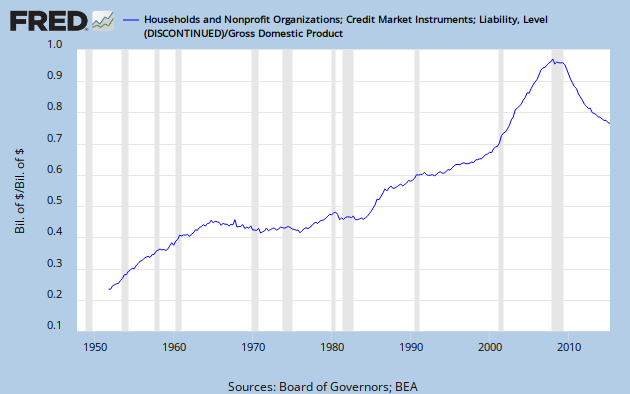
When he starts a column with the phrase “underneath the apparent stability of the Great Moderation lurked a rapid rise in debt that is now being unwound”, and uses this graph as evidence

debt as % of GDP. Shows a rise from before 1990, with a kink upward at around 2000Q4, then a decline when the recession ended.

, then someone who is as much of a fan of FRED as I am is going to want to reproduce Krugman’s data, whence we end up with

Same graph as above, but on a longer time scale. Basically debt as a % of GDP increased continuously from the early 1950s until the recession.

I’ll grant that something especially crazy started happening around the year 2000, but I don’t think you’d really single out that particular era, if this graph were your only bit of evidence, and say, “Ah ha! Debt really became unsustainably large right there!” Debt has been increasing continuously since the 1950s. The point of Krugman’s article lies in other directions (namely, how much of a hit on future GDP we’ll take because the country is now deleveraging), but my question would be: how far do we have to fall? Back to where it was in 1999? Or back to where it was in 1960?

Russell Banks, Lost Memory of Skin —

Russell Banks, Lost Memory of Skin

The only real thing to call out about this cover is that there's an iguana on it. He is important, that iguana.

If I tell you that this book is, in large part, about sex offenders living under an overpass in a notional Florida town that you should basically envision as Miami, I have explained the substructure for the plot but told you very little about what makes this book so haunting. If I then explain to you that what makes it haunting is what it says about living in America today — the gaudy high rises on the Florida coast; addiction to pornography; dysfunctional single-parent families; children with no friends other than those they meet online — I’m not really going to woo you into reading this novel.

So suffice to say that [book: Lost Memory of Skin] is a little gut-churning masterpiece that I was obsessively reading every chance I got over Thanksgiving. You should read it, too. It’s an exceptionally well-told story that somehow also manages to say a lot of really important and depressing things about American life in the early 21st century.

Peter A. Diamond and Peter R. Orszag, Saving Social Security: A Balanced Approach —

Peter A. Diamond and Peter R. Orszag, Saving Social Security: A Balanced Approach

The title with 'Saving' in black, 'Social Security' in white, and a jigsaw-puzzle background. 'A balanced approach' is the missing piece to the jigsaw puzzle. DO YOU GET IT.

In this country, we seem to revisit the same topics over and over again; it’s the price of living in a democracy, I suppose. The charlatans want you to forget that we’ve been over the same terrain many times; they hope that your attention span is short. If they pound the same terrifying sound bites into your head over and over, they hope that you’ll eventually fear what they want you to fear. [1]

So it is with Social Security. It doesn’t matter how many times people explain that there is no Social Security crisis. There’s always going to be someone who hates it, so there will always be a market for mendacious arguments against it.

That’s where Diamond and Orszag come in, reminding us of exactly why Social Security is the way it is. It’s an annuity, which is to say that is pays you a fixed amount for the rest of your life, no matter how long your life lasts; that way you can’t outlast your savings. Better than that, it’s an inflation-protected annuity, meaning that your Social Security savings won’t be decimated as the years pass. And it provides benefits if you become disabled. And it’s a joint-and-survivor annuity, meaning that your spouse will get a fraction of your Social Security benefit after you die. Maybe better still, if you’re of a liberal cast of mind: it’s progressive, in that people who’ve earned little throughout their lives get a larger percentage of it back when they retire than do wealthy people.

So if you know nothing else about Social Security, keep that one-sentence rough definition in mind: Social Security is a progressive, inflation-protected, joint-and-survivor annuity. Anyone with a plan for “saving” Social Security had better explain either a) how they’re going to keep those attributes, or b) why a system lacking those attributes still deserves to be called “Social Security”.

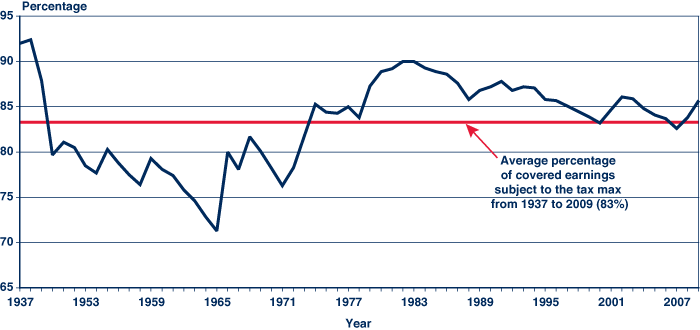
A spiky line: at its highest, right around 92% in 1937; falls as low as 70% in 1965; rises back to 90% or so in 1980; has fallen gradually back to 85% or so by 2007 Social Security has some problems, of course. The biggest is that the ratio of current workers to current retirees is falling. There are a few obvious responses to this. One is to cut benefits. Another is to increase the retirement age (which is, in fact, synonymous with cutting benefits). A third is to raise taxes. Diamond and Orszag, being affiliated with the Brookings Institution, pick the middle way: some taxes, some benefit cuts. Along the way, they lay out, in sober, quantitative detail, some other financing problems. One is that Social Security only taxes income up to a certain limit; because we live in a society suffering from rising inequality, the fraction of income subject to Social Security taxation has been falling (see chart at right).

There seem to be some obvious solutions here. One is to do whatever we can to raise the ratio of current workers to current retirees. How about allowing more people into the country, for instance, by liberalizing immigration laws? That’s entirely off the table in Diamond/Orszag. Next up: how about adjusting the taxable maximum (the “tax max”, as the SSA apparently calls it) so that the same fraction of U.S. payroll is always below it? Or how about removing the tax max altogether? That’s what we did to the Medicare tax starting in 1994.

Diamond and Orszag consider some variant of the former (increasing the tax max). Removing it altogether is just not centrist enough for them. It’s not at all clear why. I have to imagine that it’s because they wanted to put together a proposal that would appeal to some Republicans and some Democrats, and for that I have to salute them. I also, though, have to wonder if it’s a fool’s errand to try to woo a party that has been trying to sell us on Social Security privatization.

Diamond and Orszag devote one of the best chapters of [book: Saving Social Security] to these private accounts (the book dates from 2004, right in the thick of the Bush Administration’s push to privatize). With as much force as responsible scholarship will allow, they tear the idea of privatization to shreds. First, privatization would subject retirement savings to the ups and downs of the market. Riding the market may, as a general matter, be a fine idea, but that’s not the purpose that Social Security is supposed to serve. Social Security is supposed to provide a base level of savings that keeps the elderly out of poverty. Social Security is supposed to — and does — avoid financial mistakes that many of us make. For instance, when we cash out our 401(k)s upon retirement, we should convert them immediately into annuities so that our savings don’t end before we do; Social Security does this for us. If you claim that you want to replace Social Security with a system of private accounts to “strengthen” Social Security, but you don’t impose some sort of requirement on people’s private retirement savings — e.g., you don’t require that they buy an annuity, and you don’t require their savings to shift from equities to bonds as they age — then you’re not actually strengthening it; you’re replacing it with something else. If, on the other hand, you impose a number of restrictions on people’s private accounts, such that those accounts are just as constrained as the existing Social Security system is, then what problem are you solving? The cynical answer is that you’re solving the problem of insufficient fees going into mutual-fund companies’ pockets. Diamond and Orszag are not nearly so cynical. Or maybe they’re just very polite.

I’d be curious what Diamond and Orszag would write today, now that the White House and Senate are under the control of the Democratic Party. (Diamond was President Obama’s nominee to serve on the Federal Reserve Board. Orszag was Obama’s Director of the Office of Management and Budget.) More to the point, we’ve just gone through a financial implosion that decimated many people’s retirement savings. Now would seem to be the right time to push to strengthen — truly strengthen — Social Security in automatic ways that would be hard to roll back. For instance, how about mandating automatic adjustments to the retirement age that factor in the poverty and race of the recipient? The poor don’t live as long as the wealthy, and black people don’t live as long as white people; why not allow everyone to have an approximately equal-length retirement by setting the retirement age to life expectancy minus a fixed amount? And why not eliminate the tax max? Diamond and Orszag don’t really argue the merits of an all-liberal (e.g., only increase taxes on the wealthy and don’t cut benefits) or all-conservative (the reverse) policy; they merely nod in the direction of both and then say that they’re aiming for something in the middle. Nowadays it’s not clear that they would claim many admirers on either side from this approach. (One of the book’s first footnotes cites Dean Baker’s book [book: Social Security: The Phony Crisis], which apparently argues that there’s no problem to solve. It goes on the wish list.)

The following will probably sound snarky, when I don’t mean it to at all: [book: Saving Social Security] would be the Bible in a technocratic world. To quote Cosma Shalizi (who was writing on a different topic): Diamond and Orszag would love to be arguing from “just a little bit to the left of a technocratic center, and to debate those just a little bit to [the] right about optimal policies within a shared objective function, and pretend[] that it is a technical and not a political discussion. But … shit is fucked up and bullshit”. Such is the fallen world we’re in.

Generally speaking, I don’t know how to deal with Brookings these days. They seem like technocratic centrists in a world that uses technocratic centrists as its tools, if it uses them at all. With any luck, the world will shift back to a place where Brookings and friends can go back to being a central part of the discussion.

[1] – This just came up today, when Rick Santorum explained his opposition to ObamaCare in the same breath that he lauded Nelson Mandela, along the way telling us that the size of government keeps increasing. Never mind that the government is only large because we’re in a recession, and that if you instead look at government expenditures as a percentage of potential GDP, we’re right where we were in the era of the sainted Reagan.

“How Academia Resembles a Drug Gang” — December 4, 2013

“How Academia Resembles a Drug Gang”

Fascinating read, via the estimable Rick Perlstein (whose [book: Nixonland] you really want to read, and which I’ll one day get around to properly reviewing), via Corey Robin at Crooked Timber. [1]

I think of my friends in desperate pursuit of tenure — or even a job that promises tenure in a mirage-like way — and I wish them luck. I used to dream that academia would be free of all the bullshit that I expected the corporate world to be filled with, and that academics had endless freedom to research whatever they chose. My sense is that the latter just isn’t true. As for the bullshit piece: I’m sure academia has its own bullshit; it’s just different bullshit than the bullshit I deal with.

We’re all part of the capitalist machine, whether we like it or not. Fortunately, that means the solution to your problems is likely the same as the solution to mine: organize.

[1] – Robin one day leapt onto my radar, and has been writing astonishing essays ever since. His [book: Reactionary Mind] is on my list, though I think I need to read [book: The Rhetoric of Reaction: Perversity, Futility, Jeopardy], by the great A.O. Hirschman, first. I also owe you guys a review of a Hirschman biography that I recently read, not to mention Hirschman’s own [book: The Passions and the Interests: Political Arguments for Capitalism Before Its Triumph]. What can I say; I’m behind.

How low an unemployment rate can we tolerate? — November 20, 2013

How low an unemployment rate can we tolerate?

On the occasion of Jared Bernstein’s and Dean Baker’s publishing an essay on how low an unemployment rate we can tolerate before inflation spirals out of control, it’s worth linking back to a something I wrote in 2010 about James Galbraith’s views on the matter.

Even supposing that there actually is a NAIRU (i.e., a level of unemployment below which inflation will start accelerating), and even supposing that something bad will happen if we cross below that line, it’s not as though we lose control of the ship right then. At that point we know what happens: the Federal Reserve jacks up interest rates, unemployment skyrockets (particularly as mortgage rates rise and employment in the housing sector collapses), and inflation drops back down. It’s happened before. We have control over this. Doesn’t the Federal Reserve just need to signal that it takes its dual mandate seriously? If everyone believes that the Federal Reserve will bring the hammer down if inflation rises too high, what’s the big deal? Better to let inflation rise too high because unemployment was allowed to drop too low, and correct the problem later, than allow millions of people to remain involuntarily idle.

Podesta’s new inequality institute — November 6, 2013

Podesta’s new inequality institute

A think tank devoted to the study of inequality, headed by John Podesta (Clinton chief of staff, Obama advisor, and founder of the Center for American Progress), featuring Emmanuel Saez, Raj Chetty, and Brad DeLong? Wow. I am *fascinated* by where this will go.

(I have dropped off of Facebook and Twitter, so you might expect this blog to contain more in the way of “a link with a little commentary around it”.)

Inasmuch as universal health insurance is fundamentally about inequality, maybe here is the place to include a link to Jon Cohn’s great piece entitled “Obamacare Makes Men Pay for Maternity Care. Good!” The slam-dunk argument in the piece, and the moral principle that really ought to have universal appeal (but sadly doesn’t) is:

> __So you ended up XY instead of XX. Get over yourself.__ Even conservatives generally stipulate that insurance should protect people from the financial consequences of random events. But they seem not to recognize that being born a woman is a random event. Sorry, dudes, you had no control over that. Allowing insurers to discriminate based on gender means penalizing half the population, just because those folks ended up with one type of chromosome instead of another.

That’s liberalism in a nutshell: in whatever way works best, try to minimize the effects of random misfortune.

As I mentioned to a friend:

> While we’re on the topic, John McDonough’s [book: Inside National Health Reform] is a must-read. It’s the book I think of whenever anyone says that “no one has read all of the Affordable Care Act.” McDonough’s book is what to read if you in fact want to understand every page of the ACA. It contains one chapter for each title of the ACA, along with a really patient explanation of the politics and Congressional procedure that led to its being the way it is. I want to buy a hundred copies of it and hand them out at parties.

I’ve not yet reviewed it, because I am a terrible person. I’ll let the above stand, for now, as the stub of a review.

Teresa Ghilarducci, When I’m Sixty-Four: The Plot against Pensions and the Plan to Save Them — October 22, 2013

Teresa Ghilarducci, When I’m Sixty-Four: The Plot against Pensions and the Plan to Save Them

Golden egg with a crack in it
Skip it. Read Sass’s [book: The Promise of Private Pensions] instead. Ghilarducci’s writing is clunky, the book is overloaded with numbers that distract rather than inform, and it’s studded throughout with offset boxes that give you “numbers to digest” or “bottom line”s; these end up sounding condescending and annoying and distracting, rather than informative. The book generally feels like a hastily assembled and incompletely edited collection of miscellany, rather than a coherent story about pensions.

Throughout the entire book, Ghilarducci refers to her solution to the retirement-security problem, namely a defined-contribution scheme to augment Social Security; this solution appears in chapter 10. It would be a progressive alternative to the failing 401(k) system, which doesn’t encourage people to save and instead just gives prosperous people a tax-advantaged place to park money that they would have saved anyway.

So that’s a fine idea, but … why not just expand Social Security and be done with it? The only real objection Ghilarducci raises to this expansion is that it suffers from Social Security’s pay-as-you-go approach — i.e., that Social Security transfers from current workers to current retirees, rather than setting aside an account for each worker. But as Ghilarducci lays out repeatedly, this isn’t really a problem: Social Security’s trustees use very conservative assumptions when measuring the program’s solvency; and even under those assumptions (which, to repeat, are likely *overly* cautious), any solvency problem can be fixed by little tweaks. E.g., removing the cap on earnings subject to FICA. So her only objection to expanding Social Security is that it may have a funding problem that it doesn’t actually have.

On the other side, she freely admits that her defined-contribution benefit scheme — since it is explicitly designed to be funded in advance, rather than pay-as-you-go — will not be able to help those who are going to retire soon; they won’t have any time to contribute to her defined-contribution scheme. So the downside to her plan is that it leaves out most everyone who’s retiring today. The downside to simply expanding Social Security benefits up to what other countries use for their pension schemes is … nothing noticeable.

Had Ghilarducci just advocated expanding Social Security and being done with it, the book would have been very short. Better to skip it and read elsewhere about expanding Social Security. I’ll try to find a good book to recommend in that direction.