Really useful link on how much parents are expected to pay for their kids’ college — March 31, 2014

Really useful link on how much parents are expected to pay for their kids’ college

This probably won’t be relevant by the time I need to think about saving for my as-yet-notional children’s college education, but it’s still super-useful: the [newspaper: New York Times]’s Economix blog runs down the numbers.

Basically the big questions I had going into the article were:

1. Why bother saving at all, if every dollar saved is one more dollar that you need to contribute to your kids’ college educations? (Short answer: one dollar saved implies less than one dollar of contribution.)
2. Are any savings vehicles beyond the reach of the financial-aid authorities? (Short answer: yes, 401(k)s and home equity don’t factor into the calculation. This suggests a new term: “college-aid shelter”. It’s analogous to a tax shelter.)

So consider this a link for future reference.

Changing my mind about BitCoins —

Changing my mind about BitCoins

This Freakonomics episode changed my mind. And that’s not something I say often about Freakonomics.

I think actually what it did is lower my expectations. BitCoin, or something like it, seems like it’ll live on — or at least *should* live on — because it removes the credit-card intermediaries. The show brings up a really good example: immigrant communities who send remittances back to their families every month are often paying extortionate fees to do so, and they’re the last people who can afford such fees. Removing the intermediaries, so that I can send you money without any transaction overhead, is a good thing. And the euthanasia of the rentier is something strongly to be desired.

Note what this *isn’t* saying — note what *isn’t* relevant here. BitCoins *as a currency* are not the important thing, necessarily. You can divorce BitCoins from the libertarian fever dreams of a Federal Reserve-free world.

You can also abstract away from BitCoin itself. Whether BitCoin survives is irrelevant; what you should want is for decentralized transaction-processing services to persist.

Go listen to the podcast. It’s a good one.

Looking forward to the uselessness of the 2016 election — March 29, 2014

Looking forward to the uselessness of the 2016 election

Some facts about the 2016 election:

* Probably most everyone you know has already figured out which party he or she will vote for.
* The actual person with the “(D)” or the “(R)” after his or her name doesn’t much matter. What matters is the party. Your candidate, when he or she is in office, will have to do what his or her party wants. Moreover, your candidate will probably *want* to do what his or her party wants, and it’s good that this is the case: if you vote for a Democrat, you know generally that this person will be in favor of expanding the welfare state — or will at least support welfare-state expansion more than will the candidate with the “(R)” after his or her name. The Republican candidate will praise the virtues of small businessmen, will demand that Obamacare be overturned, and will promise to cut your taxes.
* If you live in California or Massachusetts and you vote for a Republican, or if you live in Texas or Mississippi and you vote for a Democrat, your vote doesn’t matter. You may as well not vote in the general election. Your vote in the primary, though, does matter.
* The press coverage will be filled every day with lots of irrelevant personal details. If you thought the coverage of the Malaysian Airlines flight was absurd, you get to look forward to two years of nonsense, starting in earnest once the midterm elections are over in November. The twenty-four-hour news cycle isn’t going to fill itself.
* If the economy is doing well in the year before the election, you should expect that the Democrats will do well; if it’s not, you should expect Republicans to do well. This isn’t deterministic, of course, but it’s a strong relationship.
* Whatever party you’re part of will be right and good and logical and rational; whatever the party on the other side is will be wrong and evil and illogical and irrational. I say this for all values of “you” including “me”. I wish this weren’t so, but it is.
* Your party might well put forward a candidate who excites you into believing that This Time Is Different — that you’ll get the liberal or conservative stalwart you’ve always wanted, that the welfare state will expand to protect everyone or will be gutted and freedom returned to the people. In reality the government you’ll get is the government you had. There are many veto points in American government. And as our society gains institutions like a system of political parties or a military-industrial complex or a private health-insurance industry, those institutions make it harder and harder to change anything fundamentally (go read Skowronek on this point).

Consider all of these just rules of thumb, not truths handed down on tablets. But I think they’re all safe bets. I’m particularly sad about the tribalist aspects: despite my best efforts, we’ll probably end up thinking that the guy who disagrees with us about the Affordable Care Act is not only a bad candidate whom we can’t support, but is in fact the Antichrist, whose one and only hope in life is to take women into back alleys and perform coathanger abortions on them. Because that’s what They all want, right? To take away women’s hard-won freedoms. That is, when They’re not also trying to return black people to the back of the bus and keep poor people down.

Maybe few of us think this explicitly (though I’ve met a fair number of my fellow liberals who do); most of us do implicitly. How many of us believed that a Romney administration would be not only a bad one, but would in fact be a nightmare from which the country would never wake? If we didn’t explicitly believe this, then why did the election seem so fraught?

So maybe that’s another bullet point to add to my 2016 predictions:

* This election will be Very Important Indeed; maybe The Most Important Ever. This election will be a watershed: on the one side, a bright future for America; on the other, bleakness and a return to the dark ages.

I don’t entirely mean to make light of it. Elections matter. The re-election of Barack Obama in 2012 meant that the Affordable Care Act came into being; had Romney been elected, there’s a chance that it would have been overturned. If nothing else, President Romney would likely have done all he could to slow its implementation. Speaking only for myself, the Affordable Care Act alone justified re-electing President Obama. And inasmuch as I could only trust a Democrat to implement the ACA, I would have voted for anyone with a “(D)” after his name. And inasmuch as I live in Massachusetts, it doesn’t matter whom I voted for in the general. And to the extent that economic fundamentals determine who wins, my vote matters even less. Elections matter, but it’s good to have some perspective on where your vote fits in the grand scheme of things.

I’m just not at all looking forward to the entirely predictable course of the next 2.5 years. The last time around, I swore that I wouldn’t read the news in the year leading up to the election. Maybe I’ll be able to keep to that promise this time, and double down on reading books about things that matter.

Oh, whom am I kidding? I’ll do the same stupid things this time around that I always do.

Gerald Grant, Hope and Despair in the American City: Why There Are No Bad Schools in Raleigh — March 22, 2014

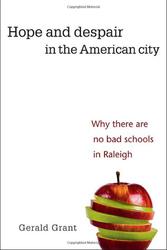
Gerald Grant, Hope and Despair in the American City: Why There Are No Bad Schools in Raleigh

Title in black text, subtitle in red text. A sliced apple at the bottom of the page, with green slices and red slices interspersed.

Why are urban school systems so bad? It’s the segregation, stupid. Wealthy white people left the city, or put their kids in private schools, leaving only poor black children in inner-city schools. Merge city and suburban school districts like Raleigh did, says Gerald Grant, and — after a lot of hard work — you’ll see a million flowers bloom. Education for the wealthier, whiter kids will not get worse, while education for the poorer kids will get better. More specifically, the poor kids will learn the middle-class habits of the wealthier kids around them — habits that they wouldn’t necessarily learn at home; they’ll learn the bourgeois virtues; they’ll learn the “soft skills” whose importance James Heckman has so prominently endorsed. Meanwhile the white schools will gain from diversity — from having multiple diverse points of view when making any decision.

Grant heartbreakingly contrasts Raleigh’s experience with that of the town where Grant has worked for decades, namely Syracuse. A combination of factors led Syracuse to be almost perfectly segregated, with predictably disastrous consequences. By no means was this segregation accidental, and it doesn’t necessarily reflect people’s individual, uncoordinated, uncoerced choices: 20th-century redlining discouraged banks from funding black homeownership; probably well-intentioned but ultimately disastrous policies from the War On Poverty confined black people to large urban high-rises, rather than spreading them out throughout white neighborhoods. Segregation stopped being officially supported in the 1960s, but it has continued in official and devastating ways up to the present day.

Here Grant asks a very important question: does it matter, as far as enforcing the laws goes, whether segregation was the intent or whether it was just the result? The answer seems pretty clear to me: even if the laws weren’t explicitly intended to segregate, they need to be overturned if segregation was the more or less predictable outcome. The present alignment of the Supreme Court means that we’re not likely to see laws overturned when they de facto segregate their communities. And the country moving en masse to a Raleigh-style union of urban and suburban school districts, while a noble goal that we should aim toward strategically, is probably some ways off. So Grant proposes some pragmatic, achievable, short-term fixes, among them something very much like Boston’s METCO: a purely voluntary program to bus kids from poor urban schools to wealthy suburban schools. [1] I can’t think of any sensible argument against Grant’s position, particularly when it’s purely voluntary.

This dovetails with some of now-senator Elizabeth Warren’s ideas in her 2003 book The Two-Income Trap. One of the most fundamental forces driving middle-class life to be so unaffordable for so many Americans, says Warren, is that the good schools and the expensive places to live are synonymous: you can only send your kids to a good public school in a town if you live in that town. The inevitable outcome, in places like the Brookline suburb of Boston, is that housing prices are through the roof, and middle-income people are forced to live where the schools aren’t as good. Let’s sunder the link between good schools and good places to live, says Warren; people who live in Roxbury should be able to send their kids to school in Brookline or Weston. (Apologies for the local dialect in this paragraph. I imagine that Warren, who lives a short walk from me in Cambridge, had much the same example in her mind as she wrote her book.) A good life for your kids won’t only be available to the wealthiest parents. I wonder whether Warren would stand by these ideas now that she’s Senator Warren.

Slavery and Jim Crow are baked as deeply into American society as they could be; they infect politics, culture, and economics. Blacks didn’t have the effective right to vote until a century after Emancipation; we shouldn’t expect that America’s original sin has magically stopped corrupting us after two centuries of official and semi-official racism. Moreover, we shouldn’t treat ending Jim Crow as something that will help only black people; white people also benefit from frequent contact with those who are different from them. No one wants to force anyone to do anything they don’t want to do; the challenge is just to open up the same opportunities to rich as to poor, and to black as to white. Gerald Grant reminds us equal opportunity can and should start with the schools.

[1] – Apparently there’s a book on this topic called The Other Boston Busing Story which immediately goes to the top of the list. You should also read about the main Boston busing story — the one that people think of when they think “Boston busing”. You should, in particular, read J. Anthony Lukas’s Common Ground, which remains one of the few books that I believe every American ought to read. Other books in that category include The Making of the Atomic Bomb (among the few best works of nonfiction I’ve ever read, and without doubt the best work of science writing), and Robert Caro’s The Power Broker: Robert Moses and the Fall of New York.

If you remember nothing else from Becky Pettit’s Invisible Men: Mass Incarceration And the Myth of Black Progress, remember this — March 15, 2014

If you remember nothing else from Becky Pettit’s Invisible Men: Mass Incarceration And the Myth of Black Progress, remember this

Silhouettes and shadows of an array of people

You should remember that most U.S. economic statistics are based on people living in a household, and that more and more people are not attached to households because they’re imprisoned. As a result, statistics which purport to show a decrease in the income gap between black people and white people are usually far too optimistic. If we add prisoners back to the data, we add a group of people who are largely poor, largely high-school dropouts, and largely black. Prisons have become a black hole into which we toss our problems. Even that wouldn’t be so terrible, if the imprisoned population hadn’t nearly quadrupled between 1980 and 2012. The magnitude of the mismeasurement therefore grows over time. Our social problems therefore remain beyond the reach of official statistics. Official statistics are, over time, increasingly mismeasuring the lives of marginalized populations and overstating the gains that we’ve made as a society over the last half-century. If the statistics were more accurate, and were more careful about including the imprisoned population, we would have to face up to our failure as a society.

These statistical problems span many different areas, which Pettit quickly touches on. Rates of poor people’s diseases such as tuberculosis are far higher among prisoners, for instance. Among the most striking observations is on the voting rate, which again is often measured relative to households, or measured by surveying those within households (ignoring prisoners altogether). Black voters were supposed to have come out in shocking numbers for President Obama in 2008. That’s probably still true, but consider how much the number changes when you consider that such a large fraction of black people (particularly black youth) is imprisoned.

Pettit’s main value in this book, I believe, is that she inserts a wedge into all your subsequent reading: you’ll now notice when statistics read that they apply to the “civilian non-institutionalized population”. Or when you read about progress in some field, maybe you’ll take a few more seconds to consider whether the numbers on which this claim is based are faulty, and whether those numbers exclude our more marginalized populations.

I can’t say that the book as a whole is worth reading. For 90% of readers, it should have been condensed to a series of blog posts or a Kindle Single. The charts and graphs are interesting, and Pettit’s data analysis is invaluable: she does the hard work of re-analyzing all measures of social progress by reincorporating prison data with household-based American Community Survey data. The legwork Pettit performs, that is, is immensely useful. And the collection of citations to others in the field is useful if you find yourself wanting to re-run her analyses. But most readers will just want to see the results, and will flip quickly past the standard academic “I will now argue; [argument]; I have just argued” structure.

This reminds me, I’m sad to say, that most books are not actually all that good as books; the blog era is teaching us this. You don’t need to read most books. Of the books that you do read, you can skim most. Novelists are better than nonfiction authors at preparing sumptuous feasts which require you to savor each word (I’m not skimming Tolstoy). I’m looking through the list of books I’ve read from 2001 or so until now, and I’m finding few nonfiction works that really need to be consumed in their entirety. Some nonfiction authors are very good indeed at putting together a full work that spins out the consequences of a few principles, requiring you to consume the whole thing to see the vast expanse of the plan; Daniel Dennett is one such author. Dennett is also rare in being an exceptional writer (or at least a writer with a good editor); you really don’t want to skip any of his words. Same with Judge Richard Posner. It’s the rare nonfiction author who covers a vast scope, whose writing is free of slack and therefore forbids skimming, and who is a master stylist. To pick a few authors out of the air: Richard Posner, Daniel Dennett, and Joan Didion fit the bill. Maybe Krugman on a good day. Oh, and I’ve heard that the new Thomas Piketty joint is epic, which is what you’d expect if you know anything about Piketty and Saez.

So don’t worry if you feel like you ought to like nonfiction more than you do. Most of it isn’t very good.

I wonder if Five-Whys-style sessions ever get this far — March 7, 2014

I wonder if Five-Whys-style sessions ever get this far

We join our conversation in progress:

[…]
“This bug slipped through because the product was poorly QAed.”

“Why was the product poorly QAed?”

“Because our QA is poor.”

“Why is our QA poor?”

“Because it’s a low-caste job.”

“Why is QA a low-caste job?”

“Several reasons, all of which generally fall under ‘QA isn’t respected as much as engineering.'”

“Why isn’t it respected as much as engineering?”

“Well, it’s not paid as well as engineering is, for one thing.”

“Why isn’t it paid as well as engineering?”

“Because what they’re doing is fairly rote testing, rather than actually building test harnesses and so forth. If QA were actually engineers, they’d be paid like engineers.”

“Why isn’t our QA actually engineers?”

And *that* is where the real discussion should start.

(Hat tip to my friend Dan Milstein, who’s all about the 5 Whyses.)

Not to cavil with Krugman, but … —

Not to cavil with Krugman, but …

Today he says that “private-sector wages…continue to run well below pre-crisis levels”, and uses this graph to support that claim:

Average hourly earnings of all employees

He’s not being quite accurate. As you can see from the y-axis, that’s year-over-year *growth* in hourly wages. Since the y-axis is everywhere above zero, we conclude that wages have always been growing. They’ve just been growing less than they were before the crisis.

…Which is Krugman’s point, I think. The main argument for increasing interest rates is to keep inflation in check. Inflation might be running amok if labor costs are skyrocketing. Labor costs are not skyrocketing; they’re under control. If interest rates need to rise now because labor costs are out of control, then they needed to rise back in 2007-2009 as well.

My buddy FRED will show you average earnings, as opposed to year-over-year change in earnings.

Honestly, this was probably just a typo on Krugman’s part. In context it’s obvious what he meant. But I would be shocked if the typo didn’t start propagating.

Initial thoughts on reading Hofstadter’s “Paranoid Style” — March 6, 2014

Initial thoughts on reading Hofstadter’s “Paranoid Style”

Richard Hofstadter wrote a very famous essay entitled “The Paranoid Style in American Politics”, which mapped the contours of a certain habit in American political life — a tendency to turn mere political debates into contests between good and evil. It’s not just that your side is right and their side is wrong; it’s that their side is practically the embodiment of the Devil himself, and their side’s victory would mean the end of the United States as we know it. Hofstadter goes into a lot of rich and lovely detail about the conspiratorial style that accompanies this, including its often scholarly pretensions; an abundance of footnotes will, one supposes, bulletproof the arguments.

All of this feels like a very accurate description of American political life; anyone who lived through the “death panels” era will see some truth in it. And indeed, Hofstadter’s habit of getting to the core of American phenomena has often come into my life like a breath of fresh air, relieving some of the strain of the Bush administration. We were fucked, sure, but then we’d always been fucked; as Hofstadter put it elsewhere,

>

When one considers American history as a whole, it is hard to think of any very long period in which it could be said that the country has been consistently well governed. And yet its political system is, on the whole, a resilient and well-seasoned one, and on the strength of its history one must assume that it can summon enough talent and good will to cope with its afflictions. To cope with them but not, I think, to master them in any thoroughly decisive or admirable fashion. The nation seems to slouch onward into its uncertain future like some huge inarticulate beast, too much attainted by wounds and ailments to be robust, but too strong and resourceful to succumb.

So the man says true and important and in some perverse sense relaxing things about America. Yet two aspects of “The Paranoid Style” make me wonder how useful it is.

The first problem is deciding how to identify paranoid strains in everyday life. Suppose a rational, intelligent friend tells you that ObamaCare is the coming of sharia socialism. Suppose that, using one criterion or another, you identify this argument as a species of paranoia. Does that mean it’s *wrong*? One wants a criterion that will reliably distinguish cranks from the sane. Just because you’re paranoid, goes the line, doesn’t mean they’re not after you. Hofstadter gives us no way to determine whether *this* paranoid fellow over here is crazy, whereas this one over here is telling the truth.

It’s probably too much to expect that Hofstadter will give us a fully fleshed out theory of psychoceramics. Maybe it’s useful just to know that the U.S. has created an indigenous form of paranoid political culture. Hofstadter is at pains to note, though, that paranoid political culture is in no way indigenous to the United States. (In fact I would have liked him to have chased down its religious roots. It hardly seems coincidental that a country founded by hardcore Christian zealots would channel the book of Revelation into its politics.)

So “The Paranoid Style” seems like little more than what it says on the tin: a style guide. Here are some fun observations about some durable aspects of our culture. Should I be happy with that? Or should I expect more from Hofstadter?

Crooked Timber: “Principled bigotry is still, you know, bigotry” — March 5, 2014

Crooked Timber: “Principled bigotry is still, you know, bigotry”

The Conor Friedersdorf article that Henry Farrell links to is as odd as Henry makes it out to be. I guess the logic is that if you believe in some principle that leads you to reject photographing a gay couple’s wedding, but you have no personal animosity toward gay people as such (e.g., “some of my best friends are gay”), then you’re not homophobic?

I mean, I guess there’s some question of definition here. But “I support gay people, except for the bit wherein they have the same rights as the rest of us” is … at least the sort of thing that should give one pause.

I’m reminded of John Holbo’s very excellent Crooked Timber piece from nearly a year ago, pointing out that people have an odd soft spot for religiously based beliefs:

Suppose your neighbor leans over the fence and says, Dear neighbor, I notice you tend to sleep in until noon on Saturdays. I wish you would get up by 8 AM. I have a moral view according to which people should get up by 8 AM on Saturday morning. Your neighbor is free to say this. But he isnt entitled to you taking him seriously.

Religious beliefs are fine. But they don’t entitle your perspective to any more weight than beliefs which are, say, based on a devotion to the Flying Spaghetti Monster. I wonder whether the religious basis of homophobia is what makes Friedersdorf leap to the defense of the photographers. Are their principles somehow more noble for being religious?

P.S.: Rereading the oh-so-excellent Holbo piece, I realize it’s actually even more relevant to this Farrell piece than I initially recalled. Holbo responds to a very confused premise, of the form “Genuine violations of people’s civil rights can’t be the sort of thing that we debate about; no one can reasonably stand to see anyone’s civil rights violated. Therefore, if we’re earnestly debating the rights of gay people — if there’s morally serious opposition to gay equality — then we must not be talking about a civil-rights issue. Therefore gay rights shouldn’t be framed in those terms.” Holbo replies:

The problem with this is that, if it were a good argument, it would prove that the civil rights struggle wasnt actually a civil rights struggle either. After all, not everyone who opposed civil rights for African-Americans did it with dogs and firehoses. Most whites certainly many whites who opposed civil rights did so in a more mild-mannered, lets-debate-it-in-an-op-ed kind of way.

Likewise with Farrell’s piece today: Friedersdorf seems to be making the same sort of “these people aren’t bigots; they just have a calm, centrist, reasoned opposition to equal rights for gay people.” Most whites in the 50s and 60s were probably not explicitly bigoted, just as most folks who oppose gay marriage today aren’t explicitly homophobic. But does it matter?

Anyone know how to get current dollars out of FRED? —

Anyone know how to get current dollars out of FRED?

The Disposable Personal Income(DPI) graph counts total DPI across the whole U.S. in nominal dollars. I can transform it to per-capita nominal DPI easily enough. And there’s a CPI graph, so that’s cool. But now I want to combine the two to get DPI in current dollars. I could divide the nominal DPI by (CPI/100). The CPI equals 100 in some base year (1982-84, as it happens), so CPI/100 there would tell us how much dollars have deflated from the base year to now; if CPI = 200 today, dollars are worth half what they were in 1982-84. So then dividing DPI by CPI/100 would give us everything in 1982-1984 dollars.

I’d like to get everything in 2014 dollars. I can’t think of any obvious way to get that out of FRED. Am I just not thinking straight? If the CPI index in year x was 150, and it’s 200 now, then I want to multiply disposable income from year x by 200/150 to get everything in 2014 dollars.

I’d really like median DPI, but that doesn’t seem to be available. In fact I’d also like post-tax, post-transfer income (which should be basically DPI with Social Security, food stamps, etc. added in), but I don’t think that’s in FRED; I’ve not looked around much, but at least the CBO measures this stuff; I could probably mine their sources for the raw data.

The Census Bureau has real DPI in 2005 dollars, measured from 1980 to 2000, apparently derived “U.S. Bureau of Economic Analysis, Survey of Current Business, April 2011, earlier reports and unpublished data”. So I’ll look there, too. And if worse comes to worst, I’ll find various people at the Census Bureau and the BEA.

This concludes your daily data-mongering.

__P.S.__: I mean, I could just grab the most recent CPI number from the CPI raw-data series, and divide by that rather than by 100. But I’d like whatever graph I form here to auto-update as new current-day CPI numbers come in.

__P.P.S.__: Ah. Disposable Personal Income: Per capita: Current dollars (A229RC0). That was easy.