Accounting fictions, cutting off your nose to spite your face, pound-foolishness, and other metaphors besides — February 19, 2011

Accounting fictions, cutting off your nose to spite your face, pound-foolishness, and other metaphors besides

The reporting on budget cuts is just all wrong. The [newspaper: Times] reports that the House is set to cut $60 billion, but doesn’t really go into detail on what those cuts include.

Among the cuts that it does describe are an amendment to deny funds to Planned Parenthood. Now, this is really stupid. As of 2008, only 3% of Planned Parenthood’s expenses went toward abortion; about 13 times that much went to contraception, and 9 times more toward STD treatment.

So what does a “smaller budget” in the Planned Parenthood context mean? It means more unplanned pregnancies. This may or may not increase expenses in the future (you can imagine scenarios under which it increases, and others under which it decreases), but you miss the entire picture if you focus narrowly on how much avoids going into the budget today.

Or take the IRS, everyone’s favorite bad guy. The GOP is predictably going after it. But we know what happens: cut from the IRS budget, and more people avoid paying the taxes that the law requires them to pay. If you think the tax burden is onerous, fine; then change the law so that it’s less so. But if you want to enforce the tax law, that enforcement costs money. The IRS budget pays to enforce the tax law. If you think that a marginal dollar of IRS expense leads to less than a dollar in taxes recouped from cheats, then suggest ways to improve the ratio. The way the press talks about the budget, however, avoids discussing benefits, and the GOP is in no rush to debate the merits of a marginal dollar in IRS expenditures. (Far be it for me to suggest that the *very point* of cutting the IRS’s budget is to make it easier for wealthy people, the GOP’s natural constituency, to cheat on their taxes.)

Or take the $131 million the GOP wants to cut from the Securities and Exchange Commission’s budget. Greater SEC oversight might have prevented the financial crisis that we’re just now digging out of. That would have saved us trillions of dollars in bailout money. If a marginal dollar of spending on the SEC yields more than a dollar of savings, we should spend that dollar; if it doesn’t, we shouldn’t. But narrowly focusing on expenses without focusing on results is the essence of foolishness.

Everyone loves to attack regulation of the sort that the SEC engages in. And yes, it confers costs on businesses. When the EPA fines firms for dumping toxic waste into the water, that’s regulation too, and that’s an expense. But it also saves money: keeping toxic waste out of the water keeps people safer, lets them live longer lives, keeps them in productive economic activity for more hours every day, etc.

The SEC’s and the EPA’s budgets are visible costs: the numbers are written down in a book and debated. Their benefits — birth defects prevented, financial crises averted — are longer-term, and the connection is not always visible. In fact, if government is working well, we often don’t notice the regulation’s benefits. Had the SEC been working perfectly, we might have avoided a financial crisis altogether. When FEMA fell apart under the Bush administration and New Orleans drowned, we noticed that failure; had FEMA done its job, there would have been nothing to notice. We had 30 or 40 years of financial stability after the Great Depression, in no small part because banks were kept highly regulated and boring. I suspect this invited people to think that regulation was unnecessary, because the world seemed to do fine without it. But that doesn’t mean the regulation went away; it just means the regulation was invisible.

Invisible, properly-functioning regulation — from FEMA, from the SEC, from the EPA — means invisible benefits: cities that don’t flood, financial crises that don’t drive us into recession, rivers that we can swim in without thinking of the agencies that made it possible. The costs, though, are there for everyone to see in the budget books every year.

To every decision there are costs and benefits, but somehow government policies are treated as though they conferred costs and never benefits. This same refusal to see the forest for the trees came up when the Affordable Care Act was being debated. Democrats insisted on keeping the cost of the bill below an arbitrary limit of $1 trillion over 10 years. But don’t focus on “how much the government spends on health care”; focus on “how much the average taxpayer is spending on health care”; whether the taxpayer’s expense comes out of taxes or from his wallet is largely immaterial. Presumably when the government spends $1 trillion on health reform, that’s going to lower the amount that we consumers have to spend out of pocket. So it’s just transferring expenses from one bucket (out-of-pocket health-care expenses) to another (taxes). Does a dollar taken from taxes reduce out-of-pocket expenses by more than a dollar? If so, there’s a good argument that we should spend that dollar; if not, there’s less of a good argument.

Granted, you could argue that government expenses are *always* worse than personal expenses, no matter the ratio. This is an argument from principle, which you get from dyed-in-the-wool libertarians, and it’s crazy. I think most Americans would reject it out of hand, and it absolutely wouldn’t sell. Suppose a dollar of government health-care expense, or a dollar spent regulating the private insurance industry, saved $10 off the average American’s out-of-pocket health expenses. Would you be willing to let the government handle this and charge you your dollar of tax? I know I would; I hope you would too.

Sometimes what government gives us for our taxes is something that the private market just couldn’t provide. Medicare provides insurance for old people, which they *couldn’t get at any price beforehand*. Here it’s not even a question of how much it costs the government to provide something that the market also provides; it’s the government creating a functioning market where none existed before.

Again: to every policy there are costs and there are benefits. We live in a time when government policies are assumed to consist solely of costs with nary a benefit. Republicans rejoice in this assumption, which allows them to talk about “cutting $60 billion” without having to answer the question: are they also cutting more than $60 billion in benefits?

We need to stop considering government expenses in their own separate bucket. At the very least, we need two expense buckets: out-of-pocket expenses and tax expenses. We simply cannot view the federal budget in isolation from the rest of the economy.

Agile — January 31, 2011

Agile

I promised on Facebook that I’d say some things about the Agile software-development idea. I’m by no means an Agile expert, but it made a lot of sense to me. There were a few components that I really liked when we used it at my last job. They’re pretty dyed-in-the-wool Agilists; I probably would be if I really dove into it, but as it is I’m picking and choosing the bits I liked. Here goes:

* __Daily stand-up meetings.__ You and your team literally stay standing long enough for each of you to explain a) what you did yesterday, b) what you’re going to do today, and c) what’s holding you back, if anything. If you spend too many days in a row saying, “I meant to finish x, but I didn’t, and I swear it’ll be done today,” eventually those on your team are going to ask if they can help you get past whatever roadblock you’re encountering. Which is a polite way of saying, “Come on, now; hurry it up.”

Staying standing is vital here. Meetings get over a lot more quickly if you’re on your feet rather than kicking them up and sipping a cup of coffee.

* __Feelings of human shame__. I feel like the last bullet calls out one important part of Agile: it’s built on the very deep-seated need not to fail in front of others. It’s certainly possible in a lot of organizations to hide in a corner and fail for a long time before anyone notices. Agile makes that much less likely: if you fail, you’ll fail within a few days in front of your whole team. Better to ask for help than flounder pridefully.

* __Monthly kick-off__: You tell everyone what you’re going to do. They get a chance to ask you why you chose to prioritize one thing over another.

* __Monthly show-and-tell__: You and your team stand up in front of everyone in your organization (sensing a pattern?) and show what you did; they get to evaluate, among other things, whether you did what you said you would do during the kickoff. Preferably everyone on the team does this for his or her own part of the project. Again, you do not want to be the person who failed to get your thing done.

* __Small teams with a few defined roles__. In our case the roles were developers (the people actually writing the code), QA engineers (testing), and “product owner.” The product owner is the voice of the customer. She (and I’m happy to say that this isn’t just political correctness overcompensating: we really did have a delightful, brilliant, energetic product owner who happened to be a woman, along with plenty of kick-ass male product owners) tells the developers what we need to build and lets us figure out how to build it. Then she talks to customers and figures out what to have us do. And she tries as hard as she can to clear shit out of our way so that we can get work done. I was a part of at least one meeting filled with three or four engineers, that our product owner interrupted halfway through to say, “Do the engineers really have to be here for this?” whereupon, the answer having been in the negative, we got up and left. See “__Few meetings, fast, standing up__,” below.

* __Short iterations__: The interval between planning and show-and-tell is pretty critical. You don’t want it to be too long: saying, “This project will take a year to complete” is as good as saying that it’ll never be done. But you don’t want a show-and-tell every week; that’s too much bureaucratic overhead — or maybe not, if that’s what your team decides is right. But it certainly feels to me like there’s a tradeoff: keep going until the marginal benefit of shortening deadlines is just offset by the marginal cost of larding the process up with meetings.

There are several important reasons to have these short cycles. One is, as I mentioned, that planning for a small task is (duh) easier than planning for a long one; you’re much more likely to end up accomplishing what you said you would. Second is that you’re *outrunning your customers*, namely those inside and outside your company who want you to do things for them. The faster you can get something rough and ready in front of them, the less likely they are to say, “You know what would be really nice? …” or “Oh, sorry, turns out that we fired the CEO and now we’re looking for something different.” You’ve also given them something to anchor their expectations: now instead of comparing what’s in their head to a blank canvas, they’re comparing it to something real. That’s likely to focus people and ground them.

Certainly the most exhilarating work experience I’ve had since leaving college was building a rough prototype at my last job. We got something out the door in, if memory serves, 3-4 weeks (might’ve even been more like 2) and in front of customers. We asked them right away: is this something you want? Yes, the UI is crappy, but ignore that; we’ll make it look nice later. (Those of you objecting here that design — of software, of posters, of books, of whatever — is fundamentally bound up with the functioning of the product and isn’t just about “making it pretty”: yes, you’re right, but I’m pretty damn convinced that rough-and-ready is a tradeoff worth making.) Does it do, functionally, something you’d want? What else would you want it to do? Does this replace something you use in your everyday work? After you get done using this tool, what’s the very next thing you’d go do?

Once we had those answers, and we were convinced that real people would really use this thing, we sat head down at our computers for a couple weeks (I think we were on two-week cycles here) and got another block of interesting work done. People came by during the show-and-tells, looked at it, critiqued it, and told our product owner what else it needed to have. Heads back down. After a few months of this, I looked up and — hot damn! — we had a really nice piece of work in front of us. I can’t say I was responsible for big chunks of the code, but I did what I could, and I felt proud of what we’d accomplished.

* __Few meetings, fast, standing up__: This isn’t part of according-to-Hoyle Agile, and you could have it as part of any organizational structure, but I suspect that organizations which take Agile to heart will want to use this too. At my last job we took Paul Graham’s notion of maker time versus manager time to heart. The idea there is that, for a manager, the hourlong meeting is the quantum of work; the manager’s day is scheduled in one-hour blocks. Whereas writing software — and maybe this is true of other focused endeavours — takes a few hours to get into. Me, I needed the music to be set up right, I needed maybe a cup of coffee, I needed to knock off some smaller programming challenges to get the muscles limbered up … it could take me an hour or two just to get going. An hourlong meeting thrown into the middle of that bungs everything up: by the time you get out of the meeting, you forget where you left off and need to do the coffee, the programming exercise and so forth all over again.

Meetings are good for some things. If you’re hashing out a strategy, or the structure for a few weeks of work, you probably need meetings. But to the extent that you can shunt them onto email, or onto quick in-person chats in the hallway, you’re creating space for your makers to make stuff. (By the way, I was extremely cautious — maybe too cautious — about approaching people, for exactly this reason. First I emailed them, which seemed like the least-intrusive way to get in touch. Then I IMed them. Then I walked over to them and chatted. Yes, the last method is likely to be fastest *for me*, but it’s also likely to break their concentration.)

* __Test-driven development__. This is even less a part of classic Agile, and if you’re a certain sort of person maybe you feel you don’t need it. Me, I needed it. The idea here is that you write the tests for your code first, then write the code, then confirm that your code passes the tests, then write some more tests, then write some more code. At every iteration, write a failing test just as fast as possible. For me, this was a way to combat my own inertia, so this is sort of like __Feelings of human shame__: Agile fundamentally seems like a way of adapting an organizational structure to fit human behavior. When I forced myself to write a failing test as fast as I could, I was fighting my own habit of overthinking a problem before I started solving it. Yes, thinking is important, particularly when it comes to design, but there’s a certain kind of thinking that is either a) telling you why a certain thing won’t work, or b) pre-emptively making a solution elegant before you’ve made it at all. Test-driven development (TDD) says that elegance can wait just a bit. Write your test, then write your solution, then confirm it works (test passes), then make it elegant (i.e., more general, i.e., refactored). You’ll get the elegance soon enough, but in the meantime you’ll have working code. And who knows: by skipping the elegance for a bit, maybe you’ll find that a whole different approach works better.

Like I said, this isn’t really by-the-book Agile. But these are all things that make a lot of sense to me, and worked great for us.

Returning to the blog on a down note — January 13, 2011

Returning to the blog on a down note

I hate to return to the blog, after such a long silence, on this note, but I find it impossible to read Ezra Klein today — frustrated at the cheap sentimentality in one part of President Obama’s Arizona speech — without thinking of this passage from The Brothers Karamazov:

Listen! I took the case of children only to make my case clearer. Of the other tears of humanity with which the earth is soaked from its crust to its center, I will say nothing. I have narrowed my subject on purpose. I am a bug, and I recognize in all humility that I cannot understand why the world is arranged as it is. Men are themselves to blame, I suppose; they were given paradise, they wanted freedom, and stole fire from heaven, though they knew they would become unhappy, so there is no need to pity them. With my pitiful, earthly, Euclidian understanding, all I know is that there is suffering and that there are none guilty; that cause follows effect, simply and directly; that everything flows and finds its levelbut that’s only Euclidian nonsense, I know that, and I can’t consent to live by it! What comfort is it to me that there are none guilty and that cause follows effect simply and directly, and that I know it?I must have justice, or I will destroy myself. And not justice in some remote infinite time and space, but here on earth, and that I could see myself. I have believed in it. I want to see it, and if I am dead by then, let me rise again, for if it all happens without me, it will be too unfair. Surely I haven’t suffered, simply that I, my crimes and my sufferings, may manure the soil of the future harmony for somebody else. I want to see with my own eyes the hind lie down with the lion and the victim rise up and embrace his murderer. I want to be there when every one suddenly understands [pg 268] what it has all been for. All the religions of the world are built on this longing, and I am a believer. But then there are the children, and what am I to do about them? That’s a question I can’t answer. For the hundredth time I repeat, there are numbers of questions, but I’ve only taken the children, because in their case what I mean is so unanswerably clear. Listen! If all must suffer to pay for the eternal harmony, what have children to do with it, tell me, please? It’s beyond all comprehension why they should suffer, and why they should pay for the harmony. Why should they, too, furnish material to enrich the soil for the harmony of the future? I understand solidarity in sin among men. I understand solidarity in retribution, too; but there can be no such solidarity with children. And if it is really true that they must share responsibility for all their fathers’ crimes, such a truth is not of this world and is beyond my comprehension. Some jester will say, perhaps, that the child would have grown up and have sinned, but you see he didn’t grow up, he was torn to pieces by the dogs, at eight years old. Oh, Alyosha, I am not blaspheming! I understand, of course, what an upheaval of the universe it will be, when everything in heaven and earth blends in one hymn of praise and everything that lives and has lived cries aloud: Thou art just, O Lord, for Thy ways are revealed. When the mother embraces the fiend who threw her child to the dogs, and all three cry aloud with tears, Thou art just, O Lord! then, of course, the crown of knowledge will be reached and all will be made clear. But what pulls me up here is that I can’t accept that harmony. And while I am on earth, I make haste to take my own measures. You see, Alyosha, perhaps it really may happen that if I live to that moment, or rise again to see it, I, too, perhaps, may cry aloud with the rest, looking at the mother embracing the child’s torturer, Thou art just, O Lord! but I don’t want to cry aloud then. While there is still time, I hasten to protect myself, and so I renounce the higher harmony altogether. It’s not worth the tears of that one tortured child who beat itself on the breast with its little fist and prayed in its stinking outhouse, with its unexpiated tears to dear, kind God! It’s not worth it, because those tears are unatoned for. They must be atoned for, or there can be no harmony. But how? How are you going to atone for them? Is it possible? By their being avenged? But what do I care for avenging [pg 269] them? What do I care for a hell for oppressors? What good can hell do, since those children have already been tortured? And what becomes of harmony, if there is hell? I want to forgive. I want to embrace. I don’t want more suffering. And if the sufferings of children go to swell the sum of sufferings which was necessary to pay for truth, then I protest that the truth is not worth such a price. I don’t want the mother to embrace the oppressor who threw her son to the dogs! She dare not forgive him! Let her forgive him for herself, if she will, let her forgive the torturer for the immeasurable suffering of her mother’s heart. But the sufferings of her tortured child she has no right to forgive; she dare not forgive the torturer, even if the child were to forgive him! And if that is so, if they dare not forgive, what becomes of harmony? Is there in the whole world a being who would have the right to forgive and could forgive? I don’t want harmony. From love for humanity I don’t want it. I would rather be left with the unavenged suffering. I would rather remain with my unavenged suffering and unsatisfied indignation, even if I were wrong. Besides, too high a price is asked for harmony; it’s beyond our means to pay so much to enter on it. And so I hasten to give back my entrance ticket, and if I am an honest man I am bound to give it back as soon as possible. And that I am doing. It’s not God that I don’t accept, Alyosha, only I most respectfully return Him the ticket.

That’s rebellion, murmured Alyosha, looking down.

Rebellion? I am sorry you call it that, said Ivan earnestly. One can hardly live in rebellion, and I want to live. Tell me yourself, I challenge youanswer. Imagine that you are creating a fabric of human destiny with the object of making men happy in the end, giving them peace and rest at last, but that it was essential and inevitable to torture to death only one tiny creaturethat baby beating its breast with its fist, for instanceand to found that edifice on its unavenged tears, would you consent to be the architect on those conditions? Tell me, and tell the truth.

The Adam Smith book club starts Monday — November 13, 2010

The Adam Smith book club starts Monday

As promised a month ago, the Adam Smith reading starts Monday. I was late, myself, to buy the books, so I only discovered a few days ago that the editions I mentioned before — Modern Library for Wealth of Nations, Great Minds for Theory of Moral Sentiments — are hard to come by. They don’t look hard to come by on Amazon, but my favorite bookseller — from which I buy all my books, if I can help it — tell me that it would be hard for you fine people to find them in your own favorite local retailers.

So. What I have here next to me is the University of Chicago Press edition, which is a reprint of the apparently canonical Cannan edition. This one is unabridged, five books long, and about 1200 pages.

I hope this new edition doesn’t screw people up. I was aiming for unabridged editions before, and this is an unabridged edition. So whatever edition you have won’t be too far from what I have.

I’ve got my best people at the Harvard Book Store working ’round the clock to find me the proper edition of Theory of Moral Sentiments. When I have that one in hand, I’ll mention it here as well. But we have our hands full with Wealth of Nations for a little while.

What’s the definition of “disposable personal income”? — November 8, 2010

What’s the definition of “disposable personal income”?

Matt Yglesias today looked at the change in disposable personal income over the last few years, and I wanted to check that the definition of the term didn’t count “disposable income” as income less, say, mortgage and credit-card payments. If it did, then you’d expect to see disposable income go down as people pay down debt.

Turns out the definition doesn’t deduct debt payments, but it confuses me in other ways. Here it is:

Personal income is the income received by persons from participation in production, from government and business transfer payments, and from government interest. Personal income includes income received by non-profit institutions serving households, by private non-insured welfare funds, and by private trust funds. Income from production is generated both by the labor of individuals and by the capital that they own. Private income not earned in production, such as from capital gains or the sale of assets, is excluded. Personal income is calculated as the sum of wage and salary disbursements, employer contributions for employee pension and insurance funds, proprietors income, property income (personal interest, dividend and rental income), and transfer payments to individuals, less personal contributions for social insurance.

Disposable personal income is personal income less personal tax payments. While personal income does not include capital gains realized through the sale of assets, personal income taxes do include the taxes paid for these capital gains.

(Internal footnote omitted.)

I’m puzzled by a couple aspects of this definition:

  1. “[E]mployer contributions for employee pension and insurance funds” makes it in? So when my employer contributes to my 401(k), that counts as disposable income? Okay, I can half-see that: if need be, I could raid the 401(k). But I’d pay a penalty if I did, so I hope that something less than 100% of my contribution counts toward my disposable income. But then what about the “insurance funds” part? My employer’s contribution to unemployment insurance counts toward my disposable income? The employer contribution to long-term disability? To health insurance? This would seriously inflate this measure of disposable income: as has been well-documented, health-care costs have been rising, so a lot of money that might otherwise have gone toward rising salaries has instead gone into health-insurance payments.

  2. Disposable income doesn’t include capital gains? But why? That’s income I can spend, just as much as is income earned through honest toil. And if they’re not going to include capital-gains income, then why do they deduct capital-gains taxes?

I’ll look around for a more in-depth discussion of this definition. If anyone can clarify, please do.

To all those who insist on tarring every Jon Stewart fan with the same brush — November 6, 2010

To all those who insist on tarring every Jon Stewart fan with the same brush

…namely the “it’s all a bunch of ironic hipsters whose lives are so comfortable that they don’t feel any real commitment to anything” brush, I ask: isn’t it just possible that much of Stewart’s audience voted for Barack Obama expressly because they feel sadness for those who can’t afford health insurance, and want to help those less fortunate than themselves? For instance, maybe, just maybe, the young liberals in the audience wanted universal health care for entirely non-ironic reasons?

I resist the temptation to close with an unironic fuck-you.

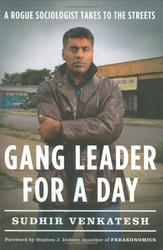
Sudhir Venkatesh, Gang Leader for a Day: A Rogue Sociologist Takes to the Streets —

Sudhir Venkatesh, Gang Leader for a Day: A Rogue Sociologist Takes to the Streets

The author looks at the camera. He's Indian and looks kind of tough, but he's also clean-cut with a nice haircut. He's a handsome fellow. He's wearing a leather jacket with the collar turned up. Behind him is a bombed-out inner-city neighborhood

The greatest danger of a book like this is that it could become catastrophe tourism — the sort of book that you read, then recite to your friends with excessive condescending blinking that says, “Yeah, it’s real tough out there in the shit, man.” Fortunately, Gang Leader for a Day is very much not like that. The author himself also isn’t trying to impress you with the friends he made in the gang, and he removes himself as much as possible from the story. That story is about the people living in the projects; the author only appears when he explains — always briefly — how he got the access he did.

Venkatesh entered graduate school in sociology at the University of Chicago in the early 90s, he tells us, and rapidly found himself dissatisfied with the rarefied, high-level statistical approach to understanding groups of people. In order to feel that he knew something about these groups, he had to get to know actual people. So off he goes to the now-demolished Robert Taylor Homes, on the south side of Chicago. He walks into one of the homes, and just happens to run into a charismatic gang leader named JT. JT is central to the rest of the book: he shows Venkatesh how gangs work at the lowest levels, he eventually introduces Venkatesh to the very wealthy men at the top of the Chicago gang pyramid, and — as the title suggests — he lets Venkatesh “run” the gang for a day.

Let’s back up a little bit, though. The remarkable thing about this introduction is how short it is: there’s only a few pages between the start of the book and when Venkatesh starts spending serious time with JT. A more self-absorbed author would have spent lots of time laboring over the start of grad school, and would have even celebrated his remarkable stroke of luck at happening upon JT so quickly. But no: Venkatesh is in a hurry to tell us about the people he met. He’s got a heck of a story to tell, so he dives right in.

The eventually goal of his Ph.D. dissertation was to map out how the underground economy in the projects works. Central to that economy is the utter failure of official institutions to support a humane life. I would say that Venkatesh “portrays” the Chicago Housing Authority (CHA) as hopelessly corrupt and inept, if it weren’t, instead, that Venkatesh takes this as a basic fact of life. Everyone in the book knows that the CHA is a massive scam, and besides: the book offers endless examples of its criminality. Why bother arguing a point when you can instead show its obvious truth?

The folks living in the projects know, for instance, that the CHA will never replace the front doors to their apartments if those doors get busted down. On freezing, windy, snowy Chicago winter days, with the homeless and the drug-addicted squatting in the hallways, the missing doors can be fatal. Here’s where the gang, and Ms. Bailey (the grand dame of her swath of the Robert Taylor Homes) move in. Favors get traded: the CHA and Ms. Bailey have an I-scratch-your-back-you-scratch-mine policy going, someone knows someone else, someone else owns a spare door, someone else can offer a temporary apartment while the one’s getting repaired.

There are shootings and stabbings all over the place, but no one expects that the police will come investigate them. There are rumors, in fact, that a crooked cop forced one of the project’s women to perform oral sex on him in front of her boyfriend. The police are mostly not the projects’ friends: they stay away when they’re needed, and abuse the residents when they do stop by.

There’s no legal support for the poor folks there. The CHA provides almost no housing support. Upwards of 90% of the projects’ residents are unemployed; those who do manage to get an education and a job leave and never come back. … Well, except for JT: he left the projects, got a business degree, and returned to a managerial role within the Black Knights gang. I couldn’t help but picture Stringer Bell from [film: The Wire] playing the role of JT, almost from the start of the book.

In fact, I couldn’t help imagining [film: The Wire] as a film adaptation of Gang Leader for a Day. The guiding idea behind [film: The Wire] is that there aren’t good guys and bad guys; there are just forces operating on everyone from above and below. You do certain things to placate your boss at your company, and your boss is doing things to placate his. Go up a few levels, and the CEO is trying to get what he wants, subject to the whims of his board and the stockholders. Turns out the same thing is true in the Robert Taylor Homes: JT and the other managers are trying to keep their gang wars as quiet and contained and predictable as possible, because there’s nothing the police hate more than unpredictable violence that spills beyond the confines of the projects. CHA employees don’t need to demand the occasional sexual favor from Taylor Homes residents, but everyone knows that nothing’s going to get done if those favors aren’t forthcoming. (There’s a lot of casual prostitution in the Homes. It’s not a job; it’s a response to a pressure.)

Of course Venkatesh is subject to his own pressures. He has to get out a Ph.D. thesis. And it takes him a while to realize that he should consult a lawyer: he can’t watch over the illegal activities of a drug-selling gang without eventually inviting a police inquiry. In a really astonishing passage, he realizes that everyone else within the Homes has known this from the start. From the start, they’ve been keeping the really incriminating stuff away from him. Everyone other than Venkatesh is aware of the [film: Wire]-like world they’re living in.

Which makes sense, of course: most of the book’s readers live in a world with well-regulated, formally contracted transactions between well-behaved actors. Things break; we get them repaired. We hear gunshots, we call the cops, the cops come. Enough middle-class white people band together to make the South End a nice place, and eventually it works out. Ours is a world where everything functions more or less as it should. Peel back just a layer or two, though, and you lay bare the quid pro quo underlying it all. Informal institutions subject to their own rules govern everything, because the formal institutions have utterly failed. (This book makes economics look comical. Economics often studies only rigorously formalizable contracts; it’s as though medicine only studied diseases that aren’t cancer.)

I can’t recommend Gang Leader For A Day highly enough. Like Common Ground, it ends up speaking larger truths by never wavering in affection for its subjects. This affection translates into a relentless need to portray them honestly, warts and all. It’s a triumph of storytelling.

The modern world is interesting for reasons other than the Internet — October 20, 2010

The modern world is interesting for reasons other than the Internet

William F. Buckley, chin held way up, looking thoughtful with his hands near his chin in some sort of weird 'wait, how did your hand end up in that position?' kind of postureJessa Crispin linked via Twitter to a piece about novelists’ difficulty talking about the Internet. Should their characters be like a lot of us, constantly switching between Facebook, Twitter, email, phone calls, text messages, and the rest? Should their books deliberately avoid writing about those things, and instead focus on (here I adopt a Brahmin chin tilted 30 degrees up from the horizontal; imagine Bill Buckley saying this) “the eternal present”?

Listen, the Internet is important. Many of us spend a lot of our time on it. But we spend a lot of our time doing lots of other things, too. How about focusing on rampant job insecurity, for instance? How about focusing on what happens when people lose jobs and realize that there’s virtually no social safety net left?

I’m not saying that writing has any obligation to be socially relevant; it doesn’t. As a practical matter, writers only have an obligation to do what pays the bills. (Or not! They might not be able to make money writing, so they do whatever else they need to do to pay the bills, like sling lattes at Starbucks while they write on the side.)

What I am saying, though, is that we have a tendency — either when we look at the world we live in now, or at former worlds — to focus on one detail and obsessively assert that That’s What Everyone Spent All Their Time Thinking About. Look at slavery, for instance: it’s really hard to read about the era between the signing of the Constitution and the Civil War without getting this picture of everyone just counting the days until society was torn apart by war. Or England from the late 18th century through the mid-19th: there’s this picture of people toiling away in the dark Satanic mills and thinking nonstop about What Industrialization Meant when they weren’t Suffering The Ill Effects of Industrialization. Surely these things were important — world-historical, even — but so were lots of other things.

And in the grand scheme of modern living, the Internet is time-consuming, but it’s not at all clear that it’s important. Spending time with your family is important. Getting enough sleep, eating well, and exercising are important. Not needing to drink yourself to sleep at night is important. Inasmuch as work-related stress impinges on all of these things, work is very important. Facebook is not important.

So why are there so many more stories and essays about the effect of the modern media environment on fiction writing than there are about the effect of job insecurity? David Foster Wallace, for instance, spent just about his entire career obsessing over television’s and the web’s effect on fiction writing: his essay “E Unibus Plurum” [sic], which was included in A Supposedly Fun Thing I’ll Never Do Again; Infinite Jest itself (about a movie so addicting that you’d sacrifice anything to keep watching it); an essay or two in Consider the Lobster; and a good fraction of the post-Infinite Jest interview with Wallace in Although Of Course You End Up Becoming Yourself focus on the media. Wallace is considered an “important writer” largely on that basis.

Where are the people writing novels about job insecurity? It sounds a little silly when phrased that way; no one would really want to read that. But it’s not clear, stated abstractly, that anyone would want to read a novel about the effects of television on American ennui, but there you have the shortest possible description of Infinite Jest.

Hypothesis: Wallace’s fiction — and all other fiction coming from people who obsess more about the media environment than they do about the rest of life — appeals more to urbane single dudes in their 20s and 30s, whose biggest concern is that they use Twitter too much, than it does to folks who are having trouble making ends meet.

Then again, the last piece of fiction I can remember reading from someone who was self-consciously trying to Engage With The People was George Packer’s Central Square, about my beloved neighborhood. I give Packer credit for trying, but that book was condescending, as virtually all of Packer’s writing since then has been. (Though you really, really, really need to read his Blood of the Liberals.) Condescension may be inevitable when you’re deliberately trying to make a point through your fiction; you engage in telling rather than showing.

So maybe the idea should be: don’t write a novel that tries to talk about income inequality, or talk about job insecurity, or talk about the pernicious effects of Angry Birds. Just write a novel that respects its characters enough to depict them honestly, and hope that anything you want to say will emerge naturally from that. When I find such a novel, I’ll let you know.

On the virtues of heterodoxy: a pompous blog-post title in response to a pseudonymous blogger — October 14, 2010

On the virtues of heterodoxy: a pompous blog-post title in response to a pseudonymous blogger

(Attention-conservation notice: 1,600 words on why it may be a good idea not to read cranks. Also some words on academic orthodoxy. Scattered thoughts on building institutions for seeking the truth.)

My friend, who blogs pseudonymously and will hereafter be known as “PB” (for Pseudonymous Blogger), takes me to task for suggesting the existence of cranks. (Note that I didn’t dismiss any specific people out of hand.) PB has long invited me to read the heterodox folks that he follows, including some “with a large collection of old John Birch Society literature.” As my readers know, I tend to read more from the academic wing; PB attacks academia like so:

Academics in the social science to do not get fired or demoted if they get things wrong. They do not get additional grad students if they are right. The grad school and peer review process reward one thing – conforming to the current intellectual fashions.

I believe I’ve heard about other places where leaders reward servants less for their objective correctness and more for hewing to what the leaders believe. I believe that’s called every single human institution ever.

I tease. If the problem is as PB describes, it’s an institutional incentives problem, and the question is how to build better institutions. Think of the various institutions we have in this world whose purpose is (ostensibly, anyway) to seek out truth. We have juries, to find truth in the legal realm; academia, to find it within more abstract domains; the media, to find what our leaders are hiding and bring policies to the broader public; and many others. Every one of them is guilty in some way of confirmation bias. Cass Sunstein, who’s now the head of OIRA, is famous for documenting how groups of people who believe the same things and only speak with one another are likely to arrive at a more-extreme conclusion than if they had some dissenters in their midst. He’s also famous for taking this line of research and using it to suggest that the Internet needs “general-interest intermediaries”, like the [newspaper: New York Times] and the [newspaper: Wall Street Journal], to help soothe society’s emergent extremism. Of course it’s an open question whether the general-interest intermediaries serve the purpose that he thinks they do.

PB focuses on a couple successes from his heterodox sources, but recall the proverb about stopped clocks. The question is how well an institution works overall. We statisticians talk about “type I” and “type II” errors, or “false positives” and “false negatives,” respectively. A false positive, in the context that PB and I are talking about, is when you identify something as true when it’s false; a false negative is when you identify something as false when it’s true. Suppose, for instance, that I adopt as a decision rule that I will never read anything written by someone who’s been a member of the KKK. I may well reject some smart writers because my rule is too crude; these would be false negatives. The basis for my rule is that I expect most of what the KKK member utters to be false; by rejecting KKK writers out of hand, I’m trying to minimize my rate of false positives (again, accepting something as true when it’s in fact false). There are costs associated with false positives, and costs associated with false negatives. To compute the total expected cost of a decision rule, multiply the cost of a false positive by the probability of a false positive, and add to it the cost of a false negative times the probability of a false negative. Going along these lines eventually gets you to the Neyman-Pearson Lemma, which is fundamental to statistics.

Rejecting too many people as cranks may give you a high rate of type-II errors: you may reject some good people out of hand. If PB’s right, mis-labeling cranks is also likely to give you too high a rate of type-I errors: you’re just confirming the conventional wisdom, which has a terrible track record. If I’m reading PB right, then, his claim is that academia’s error rate is terrible in both directions, hence “dominated” in the game-theoretic sense. My response would be twofold: first, find me an institution that balances type-I and type-II errors better than academia. This isn’t a rhetorical question; if there is such an institution, I’d like to find it. But the point is not to focus on isolated instances where someone predicted something better than someone else; the point is to look at overall error rates in both directions. Second, I’d ask PB to suggest institutional improvement that would make academia — or juries, or the media, or pick-your-favorite-institution — do its job better.

Based on what PB wrote, I suspect we’d both look for changes in the incentive structure. If it’s empirically true that academia hires on the basis of confirming what the incumbents already believe, how do we change that? To pick one example out of the air: is there any way to make academics put their money where their mouths are? The examples PB cites from macroeconomics, for instance … is there any way to make Ben Bernanke suffer financially if the economy goes south and benefit if GDP rises? You can look to what corporations do — stock options, for instance — to put some skin in the game, but we also know all the sorts of gaming that go along with those incentives. Unless you structure them properly, you have the epidemic of “I’ll Be Gone, You’ll Be Gone.” Structuring incentives is an incredibly nontrivial problem. To pick but one book on the subject out of the air, take a look at Managerial Dilemmas: The Political Economy of Hierarchy. Or, from another angle, read Herbert Simon’s paper on “The Proverbs of Administration”, wherein Simon notes that most every managerial proverb has an equal and opposite proverb that gets thrown around just as confidently.

So in short, I’m not at all confident in my ability to construct incentives that reward the right behavior within institutions, and I certainly don’t feel as though, if I were made Dictator of Academia, I could build better incentives than those that are already in place.

Also, I’m fairly convinced that PB is just empirically wrong about the ideological homogeneity of academia. I think he may be confusing what happens within one institution with what happens in the academy as a whole. Does PB really contend that the University of Chicago and Princeton University are hiring the same economists? No, of course not: they argue bitterly. Just look at Princeton’s Nobel laureate Paul Krugman denouncing the U of C’s Nobel laureate Ed Prescott. Or look at a good century of arguing in statistics over whether we ought to be Bayesians or frequentists. And that’s in statistics, where empirical and mathematical confirmation are, at least in principle, much more readily available than in the social sciences or the humanities. I’m curious what PB’s standard for homogeneity is. Are academic disciplines homogeneous whenever they avoid pistols at dawn?

If academia is argumentative, it may well be so because the incentives encourage it. Judge Richard Posner, in Public Intellectuals: A Study of Decline, argues that academics have every incentive to be contentious — at least within the public sphere — because it gets you attention when you reject the status quo. I see very few books entitled Most Everything You Know About The World Is Basically Correct.

All of that said, PB and I would surely agree that the conventional wisdom often gets things disastrously wrong. To take but one example, you can look at conventional views of market regulation. From the New Deal through World War II and up until the 1960s, the conventional wisdom — which took canonical form, perhaps, in the great Paul Samuelson’s 1948 textbook — was that the goal of economics was to control markets toward desired ends. Eventually the conventional wisdom switched to the idea that markets were best left on their own. You can argue both sides of this — and, importantly in this context, academia has argued both sides of it, continuously, for half a century. What made the switch happen? Well, it’s complicated, but surely a part of it is that it’s convenient for businessmen to argue that they’re best left unregulated. They were going to argue this anyway; academic economics just offered them some tools. But a whole set of entirely orthodox economic results says something quite different: what individual actors do rationally on their own can lead to a disastrous, unwanted result in the aggregate. You can look anywhere within orthodox economics for confirmation of this idea (see Bowles, Microeconomics: Behavior, Institutions, and Evolution; and Schelling, Micromotives and Macrobehavior). The problem probably isn’t academic rejection of heterodoxy; it’s that economics can be used as a tool of ideology in a more direct way than can mathematics, so it is used as such a tool.

Of course PB is right that there were big glaring warning signs that we were in an unsustainable bubble. Dean Baker flagged a lot of these in Plunder and Blunder. Lots of very intelligent keepers of the conventional wisdom, like Bernanke and Greenspan (Ph.D.s both), who should have known better, got it wrong. All this tells me is that, when the economy’s booming and lots of people are making money, it’s very hard to be the guy who (as the conventional saying goes) “takes the punch bowl away.” Now that everything’s collapsed, we’ll have more people honoring the conventional wisdom. The wisdom was always there; the will to follow it was not.

As for PB’s generous invitation to read along with him on one or more topics: it’s a generous offer, but take a look at how much other stuff is either in my queue or sitting on my floor, tempting me. Add to that a chapter-by-chapter read of Adam Smith, a heretofore-unnannounced chapter-by-chapter read of Gerard Debreu’s Theory of Value, and a couple bits of big news that I’m waiting to fully ferment before I mention them here; the result is that I don’t have the time to read in what sound like fascinating areas. But I appreciate the offer.

Dashiell Hammett, The Thin Man — October 13, 2010

Dashiell Hammett, The Thin Man

Standard Everyman's Library cover: a photo of the author with an effect over top as though you were viewing him through many very thin blinds on a window.

This is a bit more fun and quite a bit less dark than The Maltese Falcon. Though both here and there, someone is dead within the first couple pages, basically within mere moments of contacting the narrator or main character.

Here the narrator is a lovably lazy, bibulous man named Nick Charles. He used to be a private investigator, but he’s long since retired to attend to the investments left to him when his wife’s father died. Charles jokes on a few occasions about marrying her for the money, and you’re never quite sure if it’s a joke or a “joke.”

He comes semi-unwillingly out of retirement to investigate Just One More Case, when his old lawyer friend and war buddy calls him up to say that an old eccentric client has gotten back in touch; soon after, a confidant of that client is dead, and we’re immediately to wonder: did the crazy guy do it? (Answer: maybe!)

The Thin Man’s main allure is the nutty family from which the crazy man comes; they’re brilliantly drawn characters. Years ago he’d divorced his capricious, violent, unpredictable wife Mimi, who lights up this book’s pages (even if it’s a blacklight) and leaves you just a little terrified every time you meet her. She’s such a caricature that she belongs on stage where she can be rendered operatically. (I imagine this was deliberate. The Thin Man got turned into a series of six movies and a television show.) Mimi’s son reminds me of Elijah Wood’s character from [film: Sin City], only without the violence but with the capacity, lurking just below the surface, for utter terror.

Every Hammett novel in this collection must feature a gorgeous 20-something blonde. The one here is Mimi’s daughter, who has apparently grown from a gorgeous child to a delicious adult. At one point she passes out drunk, and Nick and his wife undress her for bed — seemingly for no purpose other than so that Hammett and the audience can gaze lovingly upon her “beautiful little body.” Whenever she shows up, someone is drooling over her; clearly we’re meant to as well.

Again, since we know that we’re going to be led bewilderingly through twist after twist and turn after turn, the plot is incidental. Phone calls, letters, and chance meetings seemingly deflect Nick from finding the killer, but we know that in the back of his capacious mind he’s keeping it all together and ploddingly unmasking the bad guy. Meanwhile he does some copious drinking. It’s great fun.