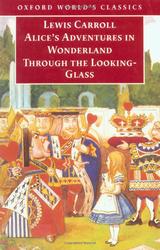
These are books that I had inexplicably not read. I don’t know how that even happened. I certainly knew them by reputation, and I’d certainly known where many of the cultural allusions — the Red Queen running with all her might and yet still not moving, impossible things before breakfast, the Jabberwocky, etc., etc. — came from. There’s still lots of cleverness that I didn’t know about, like this bit:
“[…]The name of the song is called “HADDOCKS’ EYES.”‘
‘Oh, that’s the name of the song, is it?’ Alice said, trying to feel interested.
‘No, you don’t understand,’ the Knight said, looking a little vexed. ‘That’s what the name is CALLED. The name really IS “THE AGED AGED MAN.”‘
‘Then I ought to have said “That’s what the SONG is called”?’ Alice corrected herself.
‘No, you oughtn’t: that’s quite another thing! The SONG is called “WAYS AND MEANS”: but that’s only what it’s CALLED, you know!’
‘Well, what IS the song, then?’ said Alice, who was by this time completely bewildered.
‘I was coming to that,’ the Knight said. ‘The song really IS “A-SITTING ON A GATE”: and the tune’s my own invention.’
This is a terrific introduction to the use-mention distinction, I gather. Though normally when people talk about the use-mention distinction, they’ll differentiate between “Mount Everest” (a string containing 13 characters) and Mount Everest, a mountain in Asia. Here Carroll is making the split more decisive: the use is one thing (the song’s name), and the mention is entirely another (a string that doesn’t look at all like a representation of the song, if that makes sense). It’s clever, and not a little bewildering. I’d love to hear how much of it little Alice Liddell could process when Carroll was spinning his tales for her.
Nothing really happens in Carroll’s books. Alice ambles about, weird things happen, animals speak paradoxically to her, and that’s that. These are still very fun reads, though.
I love the packaging on the particular Oxford World’s Classics edition of Alice in Wonderland and Through the Looking-Glass that I read, but I think the endnotes are useless. Most often they point you to a reference that Carroll may have been making in the text, but most of the time I strongly doubted that he was making such a reference. Even if he had been, the endnotes pull you away from the text to make a point that does absolutely nothing to improve your understanding. It’s not as though Alice in Wonderland needs an exegesis on the level of Ulysses. So I’d advise buying this lovely edition, then ignoring the endnotes altogether.
 Steve Reads
The annotated edition I like is The Annotated Alice, annotated by Martin Gardner. Some of the notes are still more than even I wanted to know, but they are in the very wide margins, so at least you aren’t flipping back and forth.
LikeLike
0 Pingbacks